
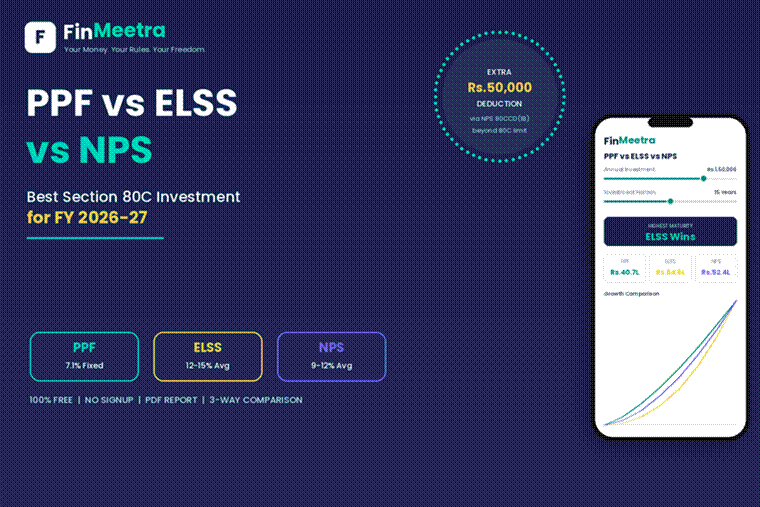
PPF vs ELSS vs NPS
Every February and March, the same scramble happens. Millions of Indians realize their Section 80C investments for the year are incomplete, and they have weeks — sometimes days — to decide where to put their money. PPF vs ELSS vs NPS A LIC policy someone’s cousin is selling? Most people pick whatever’s easiest to understand under time pressure, not what’s actually right for them. If you read our guide on how to start your first SIP, you already know that starting early matters more than starting perfectly — but for 80C specifically, the CHOICE between these three instruments has a much bigger long-term impact than people realize.
Here’s the uncomfortable truth: PPF, ELSS, and NPS are not interchangeable “tax-saving boxes” you tick once a year. They behave completely differently — different returns, different lock-in periods, different tax treatment at maturity, and different roles in your financial life. We’ve already covered the power of compounding and how asset allocation shapes your long-term wealth — this calculator brings both ideas together specifically for your Section 80C decision.
This calculator runs the real math for FY 2026-27: enter your annual investment amount and horizon, set your expected ELSS and NPS return assumptions, and see exactly how PPF’s guaranteed 7.1% stacks up against market-linked ELSS and NPS over your specific timeframe — including the tax bite each one takes at maturity.
The FinMeetra PPF vs ELSS vs NPS Calculator
This blog covers the complete article, explanation, and supporting data for the PPF vs ELSS vs NPS Calculator. The interactive calculator tool (sliders, 3-way comparison charts, and PDF download) is a separate embeddable component — built and delivered independently from this Word document — designed to sit directly below this section on your live blog page.
PPF vs ELSS vs NPS Calculator
Compare all three Section 80C options side by side, with real numbers
Which Has the Shortest Lock-in?
ELSS — just 3 years, the shortest of all 80C options. PPF locks in for 15 years (partial withdrawal from year 7). NPS is locked until age 60.
Which Is Truly Tax-Free?
PPF is EEE — contribution, interest, and maturity are all tax-free. ELSS maturity faces 10% LTCG above Rs.1L gains/year. NPS lump sum (60%) is tax-free; the annuity portion is taxable.
Can I Use More Than One?
Yes — and most people should. The Rs.1.5L 80C limit can be split across PPF and ELSS, while NPS offers an ADDITIONAL Rs.50,000 deduction under 80CCD(1B), over and above the 80C limit.
Ready to start investing under Section 80C?
Open an account or compare ELSS funds:
PPF vs ELSS vs NPS: The Core Differences
All three qualify for tax deduction, but that’s where the similarity ends. PPF is a government-backed savings scheme with a fixed, quarterly-revised interest rate — currently 7.1% per annum, compounded annually. ELSS is an equity mutual fund (the only mutual fund category with an 80C tax benefit) — meaning its returns depend entirely on stock market performance, similar to the equity funds we discussed in our Index Fund vs Active Fund comparison. NPS is a retirement-focused, regulated investment that lets you choose your own equity-debt mix, with returns landing somewhere between PPF’s certainty and ELSS’s volatility.
| Feature | PPF | ELSS | NPS |
| Returns | 7.1% fixed (govt-set) | 12-15% historical avg (market-linked) | 9-12% (equity-heavy) or 8-9% (debt-heavy) |
| Risk | Zero — sovereign guarantee | High — equity market volatility | Medium — depends on allocation chosen |
| Lock-in | 15 years | 3 years (shortest) | Until age 60 |
| Tax on Investment | 80C, up to Rs.1.5L | 80C, up to Rs.1.5L | 80C + extra Rs.50K (80CCD1B) |
| Tax on Maturity | Fully tax-free (EEE) | 10% LTCG above Rs.1L gains/yr | 60% tax-free; 40% taxable annuity |
| Min Investment | Rs.500/year | Rs.500 (via SIP) | Rs.1,000/year |
| Best Suited For | Conservative, risk-averse savers | Long-term wealth builders, risk-tolerant | Retirement-focused, disciplined investors |
Tax Treatment: Where PPF Quietly Wins
This is the part most comparisons gloss over. PPF falls under the EEE (Exempt-Exempt-Exempt) category — your contribution is deductible, the interest earned is tax-free, AND the maturity amount is completely tax-free. No other mainstream 80C instrument offers this full triple exemption as cleanly.
ELSS, despite its much higher expected returns, gives up some of that edge at exit: Long Term Capital Gains above Rs.1 lakh per financial year are taxed at 10%. NPS sits in between — only 60% of your maturity corpus can be withdrawn tax-free as a lump sum; the remaining 40% must be used to purchase an annuity, and the monthly pension income from that annuity is taxable at your regular slab rate. If you’ve already used our Old vs New Tax Regime Calculator to figure out which regime you’re in, remember that 80C deductions — including all three of these — are available ONLY under the Old Regime.
If you’re in the New Tax Regime, none of these three deductions apply to you directly under 80C. PPF and ELSS still make sense as investment vehicles on their own merits — just not as tax-saving tools in your case.
Real Math: Rs.1.5 Lakh/Year for 15 Years
Let’s run the actual numbers. Assume someone invests the full Rs.1.5 lakh 80C limit every year for 15 years (matching PPF’s natural maturity period) into each instrument separately, using the historical return assumptions we verified earlier — figures broadly consistent with what we found while researching our piece on why 90% of Indians own the wrong mutual fund category:
| Rs.1.5L/year for 15 years | PPF (7.1%) | ELSS (13%) | NPS (10%) |
| Total Invested | Rs.22,50,000 | Rs.22,50,000 | Rs.22,50,000 |
| Gross Maturity Value | Rs.40,68,209 | Rs.68,50,760 | Rs.52,42,459 |
| Tax on Maturity | Rs.0 (EEE) | ~Rs.4,50,076 (LTCG) | Taxable on 40% annuity |
| Net Maturity (approx.) | Rs.40,68,209 | Rs.64,00,684 | Rs.31,45,476 + annuity |
Even after accounting for LTCG tax, ELSS’s net maturity value is nearly 59% higher than PPF’s, and roughly double NPS’s accessible lump sum. This is the same compounding principle that powers every long-term SIP — equity’s higher average return compounds into a dramatically larger gap over 15 years, even with tax taken out.
This comparison assumes ELSS delivers its historical average return every single year, which it will NOT do in reality — some years will be sharply negative, others strongly positive. PPF’s 7.1% is guaranteed; ELSS’s 13% is an assumption, not a promise.
Who Should Pick What?
- Choose PPF if: you’re risk-averse, want guaranteed returns, and don’t mind a 15-year commitment — ideal as the ‘safe core’ of your tax-saving portfolio.
- Choose ELSS if: you have a 3+ year horizon, can tolerate market swings, and want the shortest lock-in among all 80C options with the highest long-term growth potential.
- Choose NPS if: you’re specifically saving for retirement, want the EXTRA Rs.50,000 deduction under Section 80CCD(1B) on top of your 80C limit, and are comfortable with your money being locked until 60.
Most disciplined investors don’t pick just one — they blend two or three, the same way we recommended blending strategies in our asset allocation guide. Here’s a simple blend framework based on your life stage:
| Profile | PPF Share | ELSS Share | NPS Share | Why |
| Conservative (50s+) | 60% | 15% | 25% | Capital safety priority |
| Balanced (30s-40s) | 30% | 40% | 30% | Growth + stability mix |
| Aggressive (20s-30s) | 15% | 55% | 30% | Long horizon, can absorb volatility |
The Lock-in Reality Check
Lock-in period is where people get tripped up. ELSS’s 3-year lock-in is the shortest of any 80C instrument — far shorter than tax-saving FDs (5 years) or PPF (15 years). But here’s the catch most people miss: each ELSS SIP installment has its OWN 3-year lock-in. If you invest monthly, your December installment is locked until 3 years from December, not from your first investment. This is the same staggered-maturity principle we explained when discussing how SIPs actually work over a decade — patience compounds, but you need to track each tranche separately.
NPS’s lock-in until age 60 is the strictest of the three — appropriate for its purpose (retirement), but it means NPS money should never be counted as accessible for medium-term goals like a home down payment or your child’s education.
How to Use This Calculator (60-Second Guide)
- Step 1: Enter your Annual Investment Amount — how much you plan to invest this year (up to Rs.1.5L for the standard 80C limit).
- Step 2: Set your Investment Horizon in years — how long you’ll keep investing and stay invested.
- Step 3: Adjust the Expected ELSS Return slider if you want a more conservative or aggressive assumption than the 13% default.
- Step 4: Adjust the Expected NPS Return slider based on your chosen equity-debt allocation.
- Step 5: See all three maturity values — PPF, ELSS, and NPS — side by side, with the winner highlighted.
- Step 6: Review the year-by-year growth table and download a branded FinMeetra PDF report for your records.
Key Takeaways
- PPF, ELSS, and NPS are NOT interchangeable — they differ fundamentally in returns, risk, lock-in, and tax treatment at exit.
- PPF is the only one offering full EEE tax treatment — contribution, interest, AND maturity are all tax-free.
- ELSS has the shortest lock-in (3 years) and the highest historical returns (12-15%), but is NOT guaranteed and carries real market risk.
- NPS offers an extra Rs.50,000 deduction under 80CCD(1B), beyond the Rs.1.5L 80C cap — but locks your money until age 60.
- Over a 15-year horizon with full 80C contributions, ELSS’s net maturity value (after LTCG tax) can exceed PPF’s by roughly 59%, purely due to compounding at a higher rate.
- All three deductions apply ONLY under the Old Tax Regime — verify your regime choice first using our Tax Regime Calculator.
- Most disciplined investors blend PPF + ELSS + NPS rather than picking just one — the right mix depends on your age and risk tolerance.
- Never treat NPS money as accessible for medium-term goals — it’s genuinely locked until retirement.
Frequently Asked Questions
Q: Can I invest in PPF, ELSS, and NPS all in the same year?
Yes. You can split your Rs.1.5 lakh 80C limit across PPF and ELSS in any combination you choose, and separately invest in NPS to claim an ADDITIONAL Rs.50,000 deduction under Section 80CCD(1B) — which doesn’t count against your 80C limit at all.
Q: Which has given the best returns historically — PPF, ELSS, or NPS?
Over 10-15 year periods, well-managed ELSS funds have historically delivered the highest returns (12-15% CAGR), since they’re equity-oriented. NPS, depending on your chosen equity allocation, typically falls in the 8-12% range. PPF is the most predictable at a fixed 7.1%, but has the lowest long-term growth potential among the three.
Q: Is PPF really 100% safe?
Yes — PPF carries a sovereign (government) guarantee, making it one of the safest fixed-return instruments available to Indian retail investors. The interest rate is revised quarterly by the Ministry of Finance but has remained relatively stable in the 7-8% range for several years.
Q: What happens to my ELSS investment if the market crashes right when my 3-year lock-in ends?
You can simply hold the units beyond the 3-year lock-in if the market is down — the lock-in is a minimum holding period, not a forced exit. Many investors stay invested well beyond 3 years to ride out short-term volatility, since ELSS is fundamentally a long-term wealth-building tool despite its comparatively short lock-in.
Q: Can I withdraw from PPF before 15 years if I need the money urgently?
Partial withdrawals are permitted from the 7th financial year onward, subject to specific rules and limits. Loans against your PPF balance are also available after the 3rd year. Full premature closure is allowed only in specific circumstances like medical emergencies or higher education, and may involve a reduced interest rate as a penalty.
Q: Does NPS make sense if I’m not worried about retirement yet?
NPS is specifically designed for retirement and should primarily be evaluated on those terms — not purely as a tax-saving tool. If your main goal is the extra Rs.50,000 deduction and you’re comfortable locking that specific amount away until 60, it’s worth using. But don’t over-allocate to NPS at the expense of more flexible, liquid investments for nearer-term goals.
Q: Should beginners start with PPF or ELSS?
It depends on your risk tolerance, not just your experience level. A beginner with a long time horizon and the ability to stay calm during market dips can absolutely start with ELSS — it’s no harder to invest in than a regular SIP, which we cover in our beginner’s guide to starting your first SIP. A more risk-averse beginner, or someone who’d panic and sell during a downturn, is often better served starting with PPF and adding ELSS gradually as they build comfort with market volatility.
Blogs That Make This Calculator More Powerful
- The Power of Compounding — How Rs.5,000/Month Grows into Rs.1.76 Crores
- How to Start Your First SIP in India — Complete Beginner’s Guide
- SIP vs Lump Sum — Which Investment Strategy Actually Wins?
- Asset Allocation Strategy for Indian Investors
- Index Fund vs Active Fund — Which Really Wins?
- Why 90% of Indians Own the Wrong Mutual Fund Category
- The Rs.30 Lakh Mistake — Direct vs Regular Mutual Funds in India
- The Rs.50 Lakh Trap — Why Most Indians Retire Poor Despite Earning Well
- Old vs New Tax Regime Calculator — Find Out Which Saves You More
- Explore All Free Calculators — FinMeetra Calculator Hub
ENJOYED THIS CALCULATOR? HERE IS WHAT YOU CAN DO NEXT:
Leave a Comment — Which 80C instrument are you using this year, and why? Share your reasoning with the community.
Subscribe to FinMeetra Newsletter — Real money insights every week. Subscribe here
Try our free SIP Calculator — Plan your equity investments alongside your 80C strategy. Open SIP Calculator
Share This Calculator — If this helped clarify your 80C decision, share it with someone still confused between PPF, ELSS, and NPS.



Pingback: You Earn ₹20 LPA Salary. Why Doesn't It Feel Like It? (Real Numbers)
Pingback: How to Stop High TDS from Reducing Your Monthly Take-Home Salary