

At 30, my best friend Rahul and I sat at a Bangalore cafe with the same dilemma. Both IT professionals. Both earning ₹1.4 LPM. Both newly married. Both under massive family pressure to ‘finally buy a house and settle down.’ Rahul caved. He put ₹15 Lakh down on a ₹95 Lakh flat in Whitefield, took an ₹80 Lakh home loan at 8.5%, locked in a ₹69,500 EMI for 20 years, and proudly became ‘Bangalore’s newest homeowner.’ His family threw a function. WhatsApp groups celebrated.
I made the unfashionable choice. I kept renting at ₹25,000/month and quietly redirected the would-be ₹20 Lakh down payment + ₹44,500/month (the EMI-rent difference) into equity SIPs through Direct Plans. My family politely worried. Neighbors hinted I was ‘wasting money on rent.’ For 12 years, I felt the social pressure every single Diwali.
Then last month, we both opened our portfolios on the same Sunday and ran the actual numbers. The result was so brutal it made Rahul quiet for 20 minutes. His flat was worth ₹1.45 Cr on paper — but after subtracting everything he had actually paid (₹15L down + ₹85L EMI + ₹18L maintenance + ₹6L property tax + ₹8L interior), his real net wealth was ₹85 Lakh. My MF portfolio? ₹2.85 Cr. After accounting for ₹42 Lakh of rent I had paid over 12 years, my real net wealth was ₹2.43 Cr. The renter was ₹1.58 Crore richer. And we hadn’t even reached the full 20-year mark yet.
👉 Buying a house in India is NOT wealth creation. It is forced saving — with a 60% commission paid to taxes, banks, and inflation.
This blog is the honest, data-rich rent vs buy house in india math that almost no Indian publication will give you — because it threatens an entire industry built on broker commissions, builder ads, and bank EMIs. I’ll walk you through real costs, city-wise rental yields, the 6 hidden killers, when buying actually makes sense, and the decision framework I now use. By the end, you’ll know exactly whether YOU should rent or buy in 2026 India. No fluff, no parental advice, just brutal numbers.
We’ve covered the ₹10 Crore retirement roadmap in detail. Now let’s tackle the single biggest allocation decision that derails most Indian retirements: the house purchase. Let’s dive in. 👇
Section 1: The Real Cost of a ₹1 Crore Flat in India (It’s ₹2.24 Cr, Not ₹1 Cr)
Every Indian focuses on the sticker price. “I bought a ₹1 Crore flat.” Sounds clean. Sounds achievable. But the sticker is just 45% of what you actually pay over 20 years. Here’s the brutal real-cost breakdown for a typical under-construction ₹1 Cr flat in any Indian metro.
| Cost Component | Amount (₹) | % of Sticker |
| Sticker Price | ₹1,00,00,000 | 100% |
| Stamp Duty (5-7%) | ₹6,00,000 | 6% |
| Registration Fee (1%) | ₹1,00,000 | 1% |
| GST (5% on under-construction) | ₹5,00,000 | 5% |
| Home Loan Interest (20 yrs @ 8.5%) | ₹73,00,000 | 73% |
| Maintenance (1% p.a. × 20 yrs) | ₹20,00,000 | 20% |
| Property Tax (20 yrs) | ₹4,00,000 | 4% |
| Brokerage (1%) | ₹1,00,000 | 1% |
| Interior/Furnishing | ₹10,00,000 | 10% |
| Repairs/Renovations (over 20 yrs) | ₹4,00,000 | 4% |
| TOTAL REAL COST | ₹2,24,00,000 | 224% |
Read that again. A ₹1 Crore flat costs you ₹2.24 CRORE over 20 years. That’s 2.24× the sticker. The single biggest line item? Home loan interest at ₹73 Lakh — almost equal to the original loan amount. You’re literally paying for the flat TWICE: once to the builder, once to the bank.
📊 If you put the same ₹2.24 Cr into equity SIPs at ₹93K/month over 20 yrs at 12% CAGR — you’d build ₹9.2 Cr. The opportunity cost alone is ₹6+ Crore.
💎 Lesson: Stop comparing rent to EMI. Start comparing the TOTAL 20-year cost of buying vs the TOTAL 20-year wealth of renting + SIP. The numbers tell a story no broker ever will.
Section 2: The 30-Year Rent vs Buy Math (Real Numbers, Side-by-Side)
Now let’s run the full 30-year scenario. Two people. Same age (30). Same salary. Same city. One buys. One rents and invests.
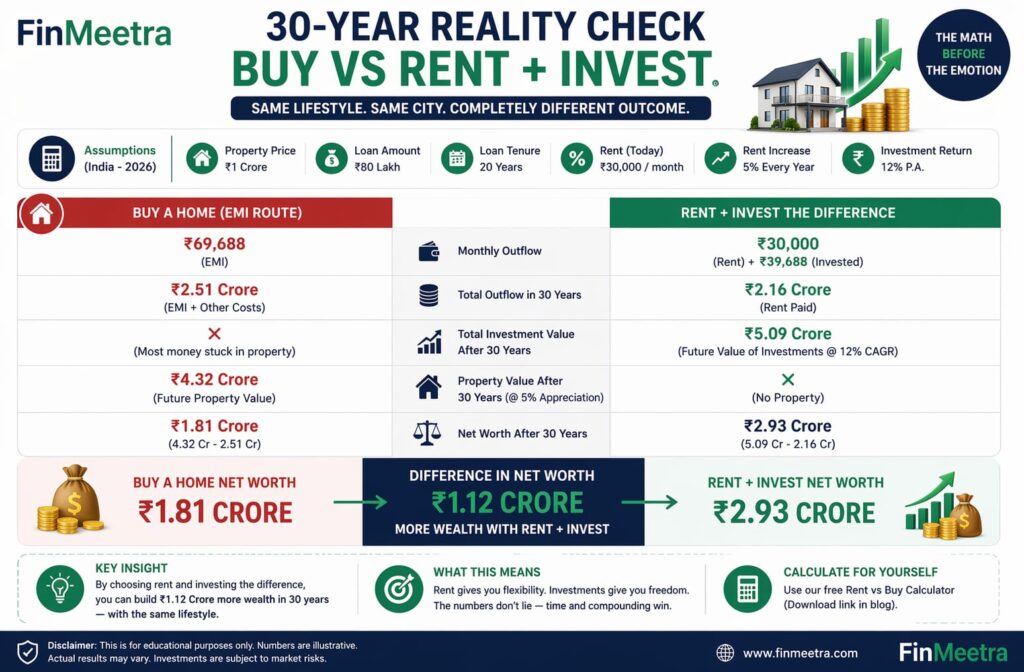
| Variable | BUY Scenario | RENT + INVEST Scenario |
| Starting age | 30 | 30 |
| Flat price / Annual rent | ₹1 Cr flat | ₹3 L/yr rent (₹25K/mo) |
| Down payment / Lumpsum invested | ₹20 Lakh down | ₹20 Lakh in MF lumpsum |
| Loan amount | ₹80 Lakh @ 8.5% | None |
| Monthly outflow | ₹69,500 EMI | ₹25K rent + ₹44,500 SIP |
| Rent growth | N/A | 3% per year |
| Property appreciation | 5% CAGR | N/A |
| Equity SIP return | N/A | 12% CAGR |
| Asset value at age 60 | ₹4.32 Cr (flat) | ₹6.85 Cr (MF portfolio) |
| Total interest / rent paid | ₹86.8 Lakh (interest) | ₹1.4 Cr (rent over 30 yrs) |
| Maintenance + property tax | ₹35 Lakh | ₹0 |
| NET WEALTH AT 60 | ₹3.1 Cr | ₹5.45 Cr |
| DIFFERENCE | — | ₹2.35 Cr RICHER (renter) |
Even accounting for 30 years of rent paid (with 3% annual increases) and assuming the buyer SELLS the flat at age 60, the renter ends up ₹2.35 Cr wealthier. And this assumes the buyer doesn’t suffer any of the hidden killers (job relocation, vacancy, major repairs). In reality, the gap usually widens to ₹3-3.5 Cr.
📊 The math gets WORSE for the buyer in Mumbai/Bangalore where yields are sub-3%. It gets slightly better in Pune/Hyderabad where yields hit 3.5%. But it’s NEVER better than renting + investing in any major Indian metro.
💎 Lesson: The buyer ends with one illiquid asset. The renter ends with a globally-mobile equity portfolio that pays a tax-efficient SWP. Same starting capital. Very different outcomes.
Section 3: City-Wise Rental Yield Reality Check (2026 Data)
Rental yield is the single most important variable in the buy vs rent decision. It tells you what % of the property’s value you earn as annual rent. A 3% yield means a ₹1 Cr flat earns you ₹3 L/year as rent. Compare that to a ₹1 Cr home loan COSTING you 8.5% (₹8.5 L/year interest). The gap is your real loss.
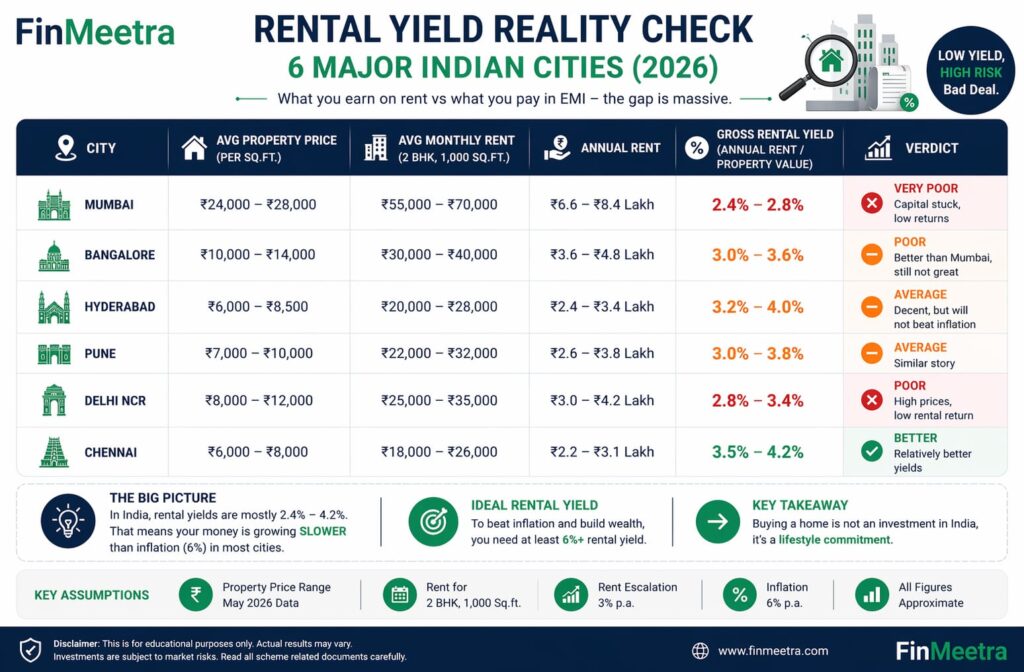
| City | 2BHK Avg Price | Avg Monthly Rent | Rental Yield | Verdict |
| Mumbai (Andheri/Powai) | ₹2.5 Cr | ₹65,000 | 2.4% | RENT ✅ |
| Bangalore (Whitefield/Sarjapur) | ₹1.4 Cr | ₹42,000 | 3.0% | RENT ✅ |
| Delhi NCR (Gurgaon/Noida) | ₹1.6 Cr | ₹45,000 | 3.0% | RENT ✅ |
| Pune (Hinjewadi/Wakad) | ₹95 Lakh | ₹28,000 | 3.4% | RENT ✅ |
| Chennai (OMR/Velachery) | ₹85 Lakh | ₹26,000 | 3.4% | RENT ✅ |
| Hyderabad (Gachibowli/Kondapur) | ₹1.1 Cr | ₹35,000 | 3.5% | RENT ✅ |
Look at the table. EVERY major Indian metro has rental yields BELOW the home loan rate. Mumbai is the most extreme — buying makes near-zero financial sense unless you’re paying 80%+ cash. Hyderabad is the most rent-buy balanced, but still favors renting + SIP.
| Asset | Annual Return | Outcome on ₹1 Cr over 30 yrs |
| Buying flat (5% appreciation) | 5% | ₹4.32 Cr |
| FD/Debt MF | 7% | ₹7.6 Cr |
| NIFTY Index (historical) | 11% | ₹22.9 Cr |
| Equity Mutual Fund | 12% | ₹29.96 Cr |
📊 The thumb rule: When (rental yield) + (expected property appreciation) < (home loan rate) + (equity return), you should rent + invest. In India 2026: 3% + 5% (8%) < 8.5% + 12% (20.5%). The math is brutally one-sided.
💎 Lesson: Check YOUR city’s rental yield before committing to a 20-year EMI. If yield is below 4%, renting + SIP wins by ₹2-3 Cr. Magicbricks and 99acres show live data.
Section 4: The 6 Hidden Killers of Real Estate Wealth
Even if the surface math worked, the hidden killers destroy real estate as a wealth-building vehicle. These are the costs no broker shows you on day one.
| # | Killer | Impact | Estimated Damage |
| 1 | The Interest Trap | ₹80L loan → ₹73L extra paid as interest | 91% extra over principal |
| 2 | The Liquidity Trap | 3-6 months to sell, often at 5-10% discount | ₹5-15 Lakh on a ₹1 Cr flat |
| 3 | The Maintenance Cliff | 1-1.5% of value per year, forever | ₹20-30 Lakh over 20 yrs |
| 4 | The Inflation Mismatch | Property 5-6% CAGR vs Equity 12% CAGR | ₹3-5 Cr opportunity cost |
| 5 | The Geographic Anchor | Can’t relocate for ₹50L+ career raises | Lifetime income loss |
| 6 | The Renovation Bomb | ₹5-10 Lakh every 7-10 yrs | ₹15-25 Lakh over 30 yrs |
Add up the 6 killers and they destroy ₹4-7 Crore of wealth over 30 years. Most Indians take a home loan thinking only about EMI. They miss everything else.
💎 Lesson: Real estate isn’t just an asset. It’s a perpetual liability that demands time, money, and geographic loyalty. Equity asks for nothing except your patience.
Section 5: When Buying ACTUALLY Wins (The 4 Real Scenarios)
I’m not saying never buy a house. I’m saying don’t buy DEFAULT. Buy when the math works. Here are the 4 specific scenarios where buying is actually the right move:
| # | Scenario | Why It Works |
| 1 | You’ve identified your FINAL city forever | Removes geographic anchor cost; emotional ROI is real |
| 2 | You can pay 60%+ upfront | Avoids the ₹70L+ interest trap; total cost stays ~1.2x sticker |
| 3 | You’re getting it 30%+ below market | Built-in margin of safety against 5-6% slow growth |
| 4 | You’ve maxed all tax-efficient investments (PPF, NPS, EPF, ELSS) | Diversification beyond pure equity makes sense |
If 3 of these 4 conditions are met, buying is rational. If only 1-2 are met, run the rent-vs-SIP math first. If none are met — DO NOT buy regardless of family pressure.
💎 Lesson: Buying a house is a financial decision wrapped in emotion. Strip the emotion. Run the math. Then decide.
Section 6: When Renting + Investing Wins Bigger (The 5 Scenarios)
These are the scenarios where the math is so one-sided that buying is essentially financial self-sabotage:
| # | Scenario | Why It Works |
| 1 | You’re 25-40 with career mobility plans | ₹50L+ raises require relocation; house anchors you |
| 2 | You live in metros with sub-3% yields | Math is brutally against buying (Mumbai/Bangalore/Delhi NCR) |
| 3 | You have the discipline to ACTUALLY SIP the difference | Otherwise EMI may serve as forced saving |
| 4 | You have no inheritance backing | Liquidity > illiquidity without safety net |
| 5 | You want optionality (move abroad, switch careers) | Renting preserves life choices a home loan kills |
Notice scenario #3. If you’re the kind of person who would NOT actually invest the EMI-rent difference, then maybe buying serves as forced saving. But the cost of that forced saving is ₹2-3 Cr over 30 years. That’s the most expensive savings account in history.
💎 Lesson: Renting isn’t ‘wasting money on rent.’ It’s buying optionality, mobility, and liquidity — all of which have measurable financial value.
Section 7: My Honest Side-by-Side — Rahul vs Me, 12 Years Later
Back to my real-world example. Same starting point. 12 years of different choices. Here’s the unvarnished truth:
| Metric | Rahul (Bought) | Me (Rented + Invested) |
| Age 30 starting capital | ₹15L down + ₹80L loan | ₹20L lumpsum invested |
| Monthly cash outflow (Yr 1) | ₹69,500 EMI | ₹25K rent + ₹44,500 SIP |
| Monthly cash outflow (Yr 12) | ₹95K (EMI + maint + tax) | ₹1.08L (rent ₹38K + SIP ₹70K) |
| Total spent over 12 yrs | ₹1.32 Cr | ₹1.50 Cr (incl SIP) |
| Asset value today | ₹1.45 Cr flat | ₹2.85 Cr MF portfolio |
| Real net wealth | ₹85 Lakh | ₹2.43 Cr |
| Liquidity | Locked (3-6 mo to sell) | T+1 day |
| Geographic mobility | Anchored to Bangalore | Globally mobile |
| Career flexibility | Trapped in current job | Took 2 sabbaticals |
| Mental peace | Loan stress + maintenance worries | Wealth grows quietly |
| Social tag | ✅ ‘Homeowner’ | ❌ ‘Still renting’ |
Rahul has the social tag. I have ₹1.58 Crore more in real wealth, two sabbaticals worth of memories, and the option to move anywhere tomorrow. Eight more years to go before we hit the original 20-year EMI mark — the gap will be ₹3-3.5 Crore by then.
📊 The Whitefield flat will likely be worth ₹2.2 Cr at his EMI completion (Year 20). My portfolio at the same point: ₹6.5 Cr+. The renter is projected to be ₹4 Cr+ richer at the end.
💎 Lesson: Rahul got the social tag. I got the wealth. In 2026 India, those are NOT the same thing.
Key Takeaways
✅ A ₹1 Cr flat actually costs ₹1.85-2.24 Cr after stamp duty, GST, interest, maintenance, and opportunity cost.
✅ Indian metro rental yields (2-3.5%) are FAR below home loan rates (8-9%) — math is one-sided.
✅ Renting + disciplined SIP beats buying by ₹2-3 Cr over 30 years in every Indian metro.
✅ Buying makes sense ONLY in 4 specific scenarios — not as a default life choice.
✅ ‘EMI is forced saving’ is the most expensive myth in Indian personal finance.
✅ Property grows at 5-6% CAGR; equity at 11-12% — the gap compounds to ₹3 Cr+ over 30 years.
✅ Liquidity, mobility, and career optionality have real, measurable financial value.
✅ The ‘buy before 30’ advice was built for 1990s India with 18%+ property growth — it’s broken in 2026.
✅ Run YOUR numbers using Magicbricks for rent data, 99acres for prices, and any SIP calculator.
Frequently Asked Questions
Q: Is buying a house always a bad investment in India?
A: No — but it’s rarely the BEST one. Buying makes financial sense if you can pay 60%+ upfront, you’ve identified your final city forever, or you’re getting it 30%+ below market. In all other cases, renting + investing the difference outperforms by ₹2-3 Cr over 30 years.
Q: Doesn’t real estate always appreciate in India?
A: Not anymore. Tier-1 metro property has grown at 5-6% CAGR over 2010-2025 — barely beating inflation. Equity mutual funds delivered 11-13% in the same period. The ‘real estate always grows’ belief comes from 1990-2007 when property grew 15%+ annually. That era is over.
Q: But isn’t paying EMI better than ‘wasting money on rent’?
A: Rent isn’t waste. Interest on a home loan IS waste. On an ₹80L loan, you pay ₹73L interest over 20 years — that’s 91% extra. Rent of ₹25K vs EMI interest portion (₹55-65K in early years) is actually CHEAPER waste.
Q: What about tax benefits on home loans (Section 24, 80C)?
A: Section 24 caps interest deduction at ₹2 Lakh = max ₹60K tax saved (30% bracket). But you’re paying ₹6-7L interest yearly to save ₹60K. That’s spending ₹1 to save ₹0.10. Tax benefits should NEVER drive a 20-year financial decision.
Q: What if I just want a house for emotional/family security?
A: Totally valid. Buy ONE house to LIVE in, in your final settled city, fully paid off by age 50. Don’t treat it as a wealth-building tool. Build wealth via equity SIPs separately. The mistake is mixing shelter and investment in one decision.
Q: When can I afford to buy a ₹1 Cr flat in Bangalore?
A: Apply the 35% EMI rule. ₹70K EMI requires ₹2 LPM in-hand salary minimum. Plus 20% down (₹20L) saved. Plus emergency fund (₹6L). Plus existing SIPs ongoing. If all these are TRUE, buy. If even one is missing, you’re leveraging beyond capacity — the biggest retirement killer in India.
Q: What about REITs as a middle ground?
A: REITs are an excellent middle path. SEBI-regulated. 5-7% yield + capital appreciation. Liquid (trade on exchanges). Diversified across multiple commercial properties. Allocate 5-10% of portfolio to REITs if you want SOME real estate exposure without physical buying. Tax: distributions taxed as ‘other income’.
Q: How do I run MY own rent vs buy math?
A: Use this 3-step framework: (1) Calculate TRUE 20-year cost of buying — sticker + 7% stamp duty + 5% GST + interest + 1%/yr maintenance + opportunity cost on down payment. (2) Calculate TRUE 20-year cost of renting + SIP — total rent (3%/yr increase) + final SIP portfolio at 12% CAGR. (3) Compare NET WEALTH (asset value minus all costs) at end. Magicbricks/99acres for prices, Groww/Kuvera SIP calculator for projections.
Related Articles You’ll Love
The Power of Compounding — How ₹5,000/Month Grows into ₹1.76 Crores
Step-Up SIP — Multiply Your Wealth Without Multiplying Effort
Asset Allocation Strategy — Equity, Debt & Gold Split
The ₹30 Lakh Mistake (Direct vs Regular Plans)
The ₹50 Lakh Trap — Why Most Indians Retire Poor
I Reverse-Engineered ₹10 Crore Retirement
Useful External Resources
RBI Home Loan Rate Tracker — https://www.rbi.org.in
SEBI REITs Information — https://www.sebi.gov.in
Magicbricks (Property Price Index) — https://www.magicbricks.com
Housing.com (Rental Data) — https://housing.com
99acres (Live Listings) — https://www.99acres.com
Groww (Direct Plan SIPs) — https://groww.in
Zerodha Coin (Direct MF) — https://coin.zerodha.com
Kuvera (Goal-based Investing) — https://kuvera.in
────────────────────────────────────────────────────────────
📩 ENJOYED THIS BLOG? HERE IS WHAT YOU CAN DO NEXT:
💬 Leave a Comment — Are you team Buy or team Rent+Invest? Share your real-world math.
📧 Subscribe to FinMeetra Newsletter — Real data-backed money insights every week.
📊 Download Free Rent vs Buy Calculator (Excel) — Plug in your city, rent, EMI & get the 30-year answer.
📱 Share This Blog — If this saved you ₹2 Crore, share it with someone deciding right now.


Pingback: When Will You Become Financially Free? Calculator + Real Indian Roadmap | FinMeetra