Table of Contents
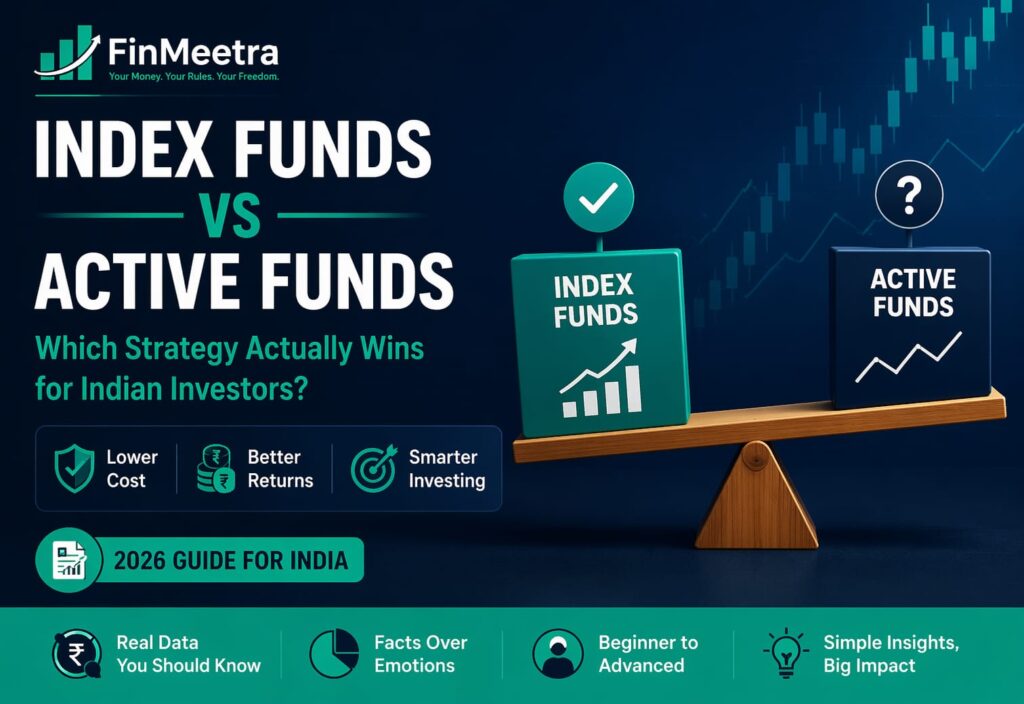
Walk into any mutual fund conversation in India and you’ll quickly hear the same debate: ‘Which is better — index funds or active mutual funds?’ YouTube creators argue for hours. Bank RMs push active funds aggressively. Friends swear by their ‘star fund manager.’ And in the middle of all this noise — most Indian investors stay confused, second-guessing every SIP decision.
Here’s the truth: this isn’t a debate of opinion. It’s a debate of data. And the data tells a much clearer story than most fund houses want you to believe. 👇
👉 80% of active mutual funds in India fail to beat their benchmark index over 10 years.
That’s not an opinion. That’s a finding from SPIVA — the global benchmark report that tracks active fund performance. Yet most Indians keep paying 1.5-2% expense ratios for active funds, while simple index funds — costing 0.1-0.3% — quietly outperform them. Over 25 years, this single decision can cost you ₹30-40 lakhs in wealth. 😅
We’ve already covered how to pick the right mutual fund using a 7-filter framework. But before you even pick a fund, you need to answer a bigger question: should you go active or passive? This post walks you through the complete Index vs Active comparison — with real returns data, cost breakdowns, and a simple decision framework built specifically for Indian investors. By the end, you’ll know exactly which strategy fits YOU. Without further wait, Let’s dive into the topic – Index Funds vs Active Funds: Which Actually Wins for Indian’s? 👇
What Is an Index Fund? (Simple Definition)
An index fund is a type of mutual fund that simply tracks a stock market index — like Nifty 50, Sensex, or Nifty Next 50 — without any fund manager actively picking stocks. The fund mechanically buys the same stocks that the index holds, in the same proportion. No emotion. No prediction. No human bias. Just pure replication.
Think of it like ordering a ‘thali’ instead of à la carte. 🍽️ A thali gives you a balanced spread of everything — small portions of rice, dal, vegetables, curd. You don’t pick and choose. You get the entire meal as it comes. Similarly, an index fund gives you exposure to the entire market in one shot. Boring? Maybe. Effective? Massively.
Active mutual funds work differently. A fund manager actively picks specific stocks they believe will ‘beat the market.’ They charge higher fees (1.5-2%) for this expertise. The premise: their skill will deliver returns above the index. The problem? In India, 80% of them fail to do this over 10+ years. So you pay more — and often get less. ⚠️
Index Funds vs Active Funds — The Core Difference
Before we dive into who wins, here’s the simplest side-by-side comparison every Indian investor should know. 👇
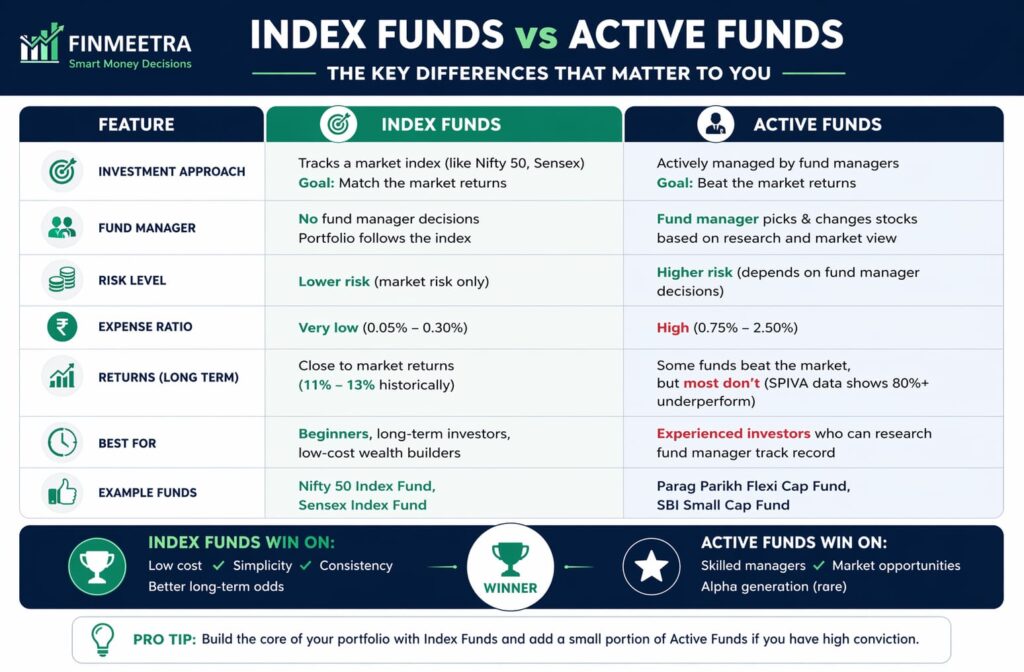
| Feature | Index Fund | Active Fund |
| 🎯 Goal | Match the market | Beat the market |
| 👤 Fund Manager | None (passive) | Active stock picker |
| 💸 Expense Ratio | 0.10% – 0.30% | 1.50% – 2.00% |
| 📊 Performance | Matches index | Tries to beat (often fails) |
| 🧘 Investor Effort | Minimal | High (monitoring needed) |
| 🪙 Long-term Returns | 11-12% (matches Nifty) | 10-13% (varies wildly) |
| 🛡️ Predictability | High | Low |
Notice the trade-off? You give up the chance to beat the market — but you also eliminate the risk of underperforming. In a country where 80% of fund managers fail to beat the index, that’s a phenomenal trade. 🎯
The 80% Truth — Why Most Active Funds Lose
This is the data point that should shake every Indian investor. The SPIVA India Scorecard (Standard & Poor’s Indices Versus Active) is published every year. It compares active mutual fund returns against their benchmark index. The findings are consistent and unforgiving. 👇
📊 In 2024, ~70-85% of Indian large-cap active mutual funds underperformed the Nifty 50 over a 10-year window.
Read that again. If you’d picked an active large-cap fund in 2015 — there’s an 80% chance you would have made LESS than just buying a Nifty 50 Index Fund. And the longer the time horizon, the worse it gets. Over 15 years, the underperformance rate is often 85-90%. ⚠️
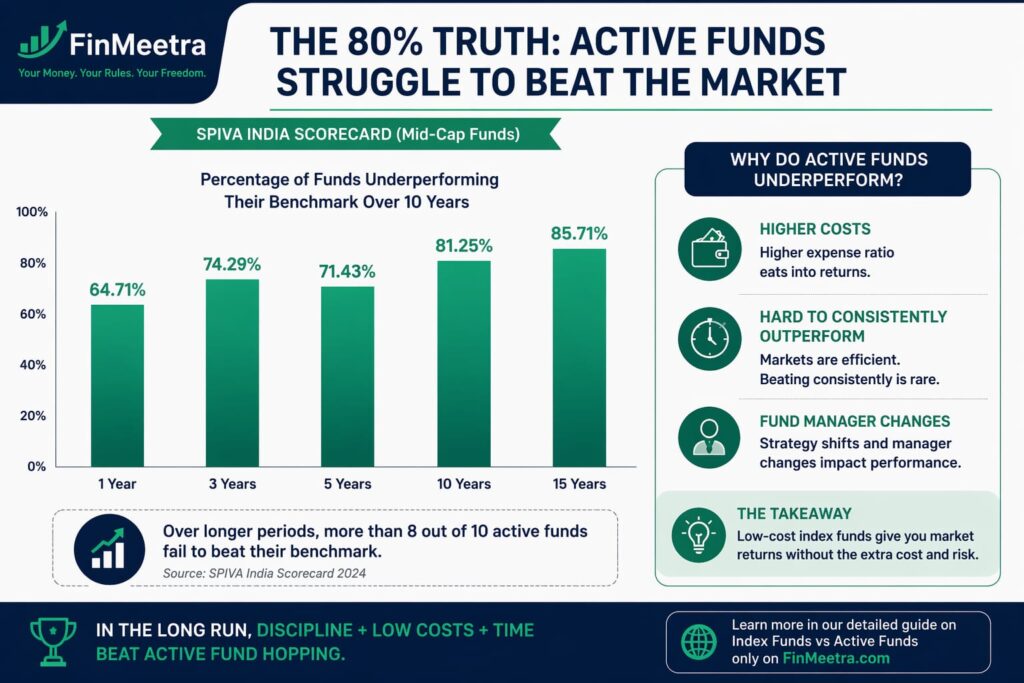
Why does this happen? Three brutal reasons. 👇
1. The Expense Ratio Drag
Active funds charge 1.5-2% expense ratio. Index funds charge 0.1-0.3%. That difference compounds. Over 25 years, a 1.5% gap can wipe out ₹35-40 lakhs from your final corpus — even if returns are identical. 💸
2. The Efficiency of Markets
Indian markets are getting more efficient. With thousands of analysts tracking every stock, the chances of consistently finding ‘undervalued gems’ are shrinking. Even great fund managers can’t beat random chance forever. 📉
3. Fund Manager Bias
Active managers are humans. They have ego, bias, and emotion. They sometimes hold losing stocks too long (loss aversion) or panic-sell in crashes. Markets don’t forgive these mistakes. 😟
When Do Active Funds Actually Win?
Index funds aren’t ALWAYS the better choice. There are specific situations where active funds can genuinely shine. Let’s be honest about them. 👇
✅ Scenario 1: Niche Categories (Small-Cap, Sectoral)
In small-cap and sectoral spaces, active managers can sometimes find genuine value before the market catches up. Index funds in these categories have fewer liquid options. So for small-cap exposure, a well-rated active fund (with consistent 7-10 year track record) can outperform.
✅ Scenario 2: New Themes (Defence, AI, Renewable Energy)
For emerging themes that don’t have established index funds yet, active funds offer access. But proceed cautiously — most thematic funds disappoint when the theme cools off.
✅ Scenario 3: Hands-On Experienced Managers
Some legendary fund managers (with 15+ year track records consistently beating benchmark) genuinely add value. But they’re rare. Less than 5-10% of active managers fit this category. Identify them carefully.
For 90% of Indian retail investors? Index funds remain the smarter, safer, more reliable choice. 🌱
Real-Life Comparison: Rahul vs Priya (10-Year Story)
Let me bring all this to life. Meet Rahul and Priya. Both are 30. Both started investing ₹10,000/month in January 2015. Same amount. Same time period. The only difference? Their fund choice.
🟢 Rahul: Picked a ‘top-rated’ active large-cap fund (5-star at the time).
🟢 Priya: Picked a simple Nifty 50 Index Fund.
Fast forward to January 2025 — they compared their portfolios. The numbers told a clear story. 👇
| Metric | Rahul (Active) | Priya (Index) |
| 💸 Total Invested | ₹12,00,000 | ₹12,00,000 |
| 📊 Expense Ratio | 1.85% | 0.20% |
| 📈 10-Year CAGR | 10.4% | 12.2% |
| 💰 Final Corpus | ₹20.8 Lakh | ₹23.1 Lakh |
| 💔 Extra Wealth (Index Wins) | — | +₹2.3 Lakh |
Same effort. Same SIP. Same time period. Priya ended up with ₹2.3 Lakh extra — purely because of lower costs and matching the market. And here’s the eye-opener: extrapolate this over 25 years, and the gap balloons to over ₹30 lakhs. 🤯
💎 Lesson: Sometimes the boring choice is the brilliant choice. Index funds don’t try to be heroes. They just quietly outperform — for decades.
How to Decide: Index or Active? (Simple Framework)
Use this 5-question decision framework before picking your next fund. Pick whatever has more ‘Yes’ answers. 👇
📋 The 5-Question Test
Q1: Are you a beginner or first-time investor?
→ Yes → INDEX FUND (lower risk, simpler, predictable)
→ No → Either works
Q2: Do you want to minimize costs over decades?
→ Yes → INDEX FUND (10x lower expense ratio)
→ No → Active funds are fine
Q3: Do you want predictable, market-matching returns?
→ Yes → INDEX FUND (matches benchmark, no surprises)
→ No → Active funds (if you can stomach underperformance risk)
Q4: Are you comfortable doing zero monitoring?
→ Yes → INDEX FUND (set and forget)
→ No → Active funds (require yearly monitoring)
Q5: Are you investing for 10+ years?
→ Yes → INDEX FUND (long-term wins favor passive)
→ No → Either works for short-term
🎯 If you got 3+ Yes answers → Go with INDEX FUNDS. That covers 90% of Indian retail investors. The remaining 10% (advanced investors with specific niche needs) can consider active funds.
Best Index Funds in India (2026)
If you’ve decided to go the index route, here are the most popular categories to consider. ⚠️ Note: This isn’t a recommendation — it’s a category breakdown. Always do your own research.
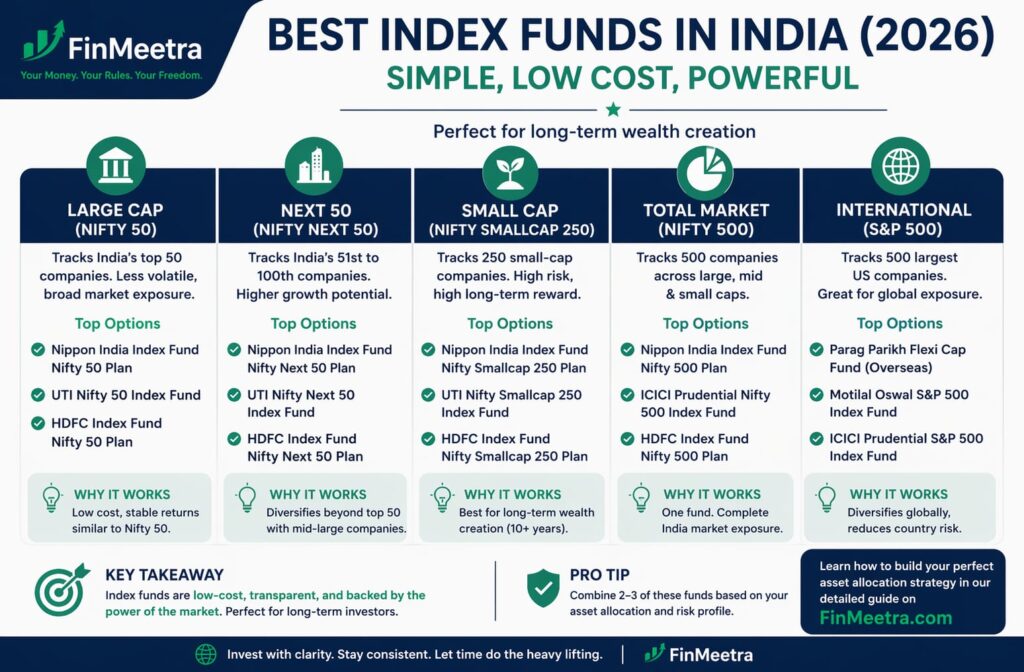
| Category | What It Tracks | Best For | Risk |
| 📊 Nifty 50 Index Fund | Top 50 companies | Core long-term exposure | Medium |
| 📈 Nifty Next 50 Index Fund | Companies ranked 51-100 | Slightly aggressive | Medium-High |
| 📉 Nifty 500 Index Fund | Broadest market exposure | Diversified passive | Medium |
| 🌐 Nifty Midcap 150 Index | Mid-cap stocks | Aggressive growth | High |
| 🪙 Nifty Bank Index Fund | Banking sector | Sector exposure | High |
🎯 Smart starter combo for most Indian beginners: 70% Nifty 50 + 30% Nifty Next 50. Simple, low-cost, diversified.
And if you’re building these as part of a larger portfolio, make sure to align them with your asset allocation strategy across equity, debt, and gold.
Common Mistakes to Avoid
Even smart investors fumble Index vs Active decisions. Watch out for these 5 traps. 👇
❌ Mistake 1: Picking Active Funds Based on Last Year’s Returns
Yesterday’s top performer is often tomorrow’s underperformer. Past 1-year returns mean nothing. Look at 10+ year track records consistently.
❌ Mistake 2: Owning Too Many Index Funds
5 Nifty 50 funds from different AMCs = same exposure, more complexity. 1-2 good index funds is enough.
❌ Mistake 3: Switching Between Index and Active Every Year
Pick one strategy. Stick to it for 10+ years. Switching destroys compounding.
❌ Mistake 4: Going All-In Without an SIP Plan
Follow this beginner’s SIP guide before starting your first index fund SIP.
❌ Mistake 5: Ignoring Step-Up SIPs
Even with the best index fund, a flat SIP loses to inflation. Apply Step-Up SIP to your index investments and supercharge your wealth quietly.
Key Takeaways
✅ Index funds passively track a market index (Nifty 50, etc.) — no fund manager.
✅ Active funds try to beat the market — and 80% of them fail in India over 10+ years.
✅ Expense ratio gap (0.2% vs 1.75%) compounds into ₹30-40 lakhs over 25 years.
✅ Use the 5-question framework — most Indians should pick index funds.
✅ Active funds work for niche categories (small-cap, themes) or proven managers.
✅ For beginners, Nifty 50 + Nifty Next 50 combo is the simplest starter portfolio.
✅ Combine index funds with Step-Up SIPs for compounding magic.
✅ Always align fund choice with your asset allocation strategy.
✅ The smartest investors don’t beat the market. They OWN it.
Frequently Asked Questions
Q: What is an index fund in simple words?
A: An index fund is a mutual fund that automatically tracks a stock market index like Nifty 50 or Sensex. It owns the same stocks in the same proportion as the index, without any active stock-picking. The goal is to match the market — not beat it.
Q: Are index funds better than active mutual funds in India?
A: For most retail investors, yes. SPIVA data shows 80% of Indian active funds fail to beat their benchmark over 10 years. Combined with the lower expense ratio (0.1-0.3% vs 1.5-2%), index funds typically deliver better long-term returns with less risk for beginners.
Q: What is the difference between index funds and ETFs?
A: Both passively track an index. Index mutual funds are bought/sold once a day at NAV, ideal for SIP investors. ETFs (Exchange Traded Funds) trade on stock exchanges like shares, requiring a demat account. For most SIP investors, index funds are simpler.
Q: What is a good expense ratio for an index fund?
A: Anything below 0.30% is considered low. The best Indian index funds charge between 0.10% and 0.25%. Always pick the Direct Plan (not Regular) for lower expense ratios.
Q: Can I start an SIP in an index fund?
A: Absolutely. SIPs work the same way for index funds as active mutual funds. You can start with as little as ₹500/month. Platforms like Groww, Zerodha Coin, Kuvera, and MF Central all support index fund SIPs.
Q: Which is the best index fund in India for beginners?
A: A Nifty 50 Index Fund is the safest starter — it tracks India’s top 50 companies. For slightly aggressive exposure, add a Nifty Next 50 Index Fund. Always pick the Direct Plan from reputable AMCs (UTI, HDFC, SBI, etc.).
Q: Do active funds ever beat index funds?
A: Yes — but rarely and inconsistently. Some active funds outperform in specific years or in niche categories (small-cap, thematic). However, over 10+ years, less than 20% of active funds in India consistently beat their benchmark. The odds favor index funds.
Q: Should I keep both index and active funds in my portfolio?
A: It’s a valid strategy. A common approach: 60-70% in index funds (core, low-cost) + 30-40% in 1-2 select active funds (for niche exposure). This balances cost-efficiency with potential upside. But for beginners, 100% index funds is perfectly fine.
Related Articles You’ll Love
The Power of Compounding — How ₹5,000/Month Grows into ₹1.76 Crores
How to Start Your First SIP in India — Complete Beginner’s Guide
How to Choose the Right Mutual Fund — 7-Filter Framework
Step-Up SIP — Multiply Your Wealth Without Multiplying Your Effort
Asset Allocation Strategy — Equity, Debt & Gold Split
Useful External Resources
Groww (Direct fund investment)
────────────────────────────────────────────────────────────
📩 ENJOYED THIS POST? HERE IS WHAT YOU CAN DO NEXT:
💬 Leave a Comment — Tell us: are you team Index or team Active? Drop your reasoning in comments.
📧 Subscribe to FinMeetra Newsletter — Fresh blogs, free calculators, and weekly money insights.
📊 Download Free Fund Comparison Toolkit — Compare any index fund vs active fund side-by-side
📱 Share This Post — If this helped you, share it with someone still paying high fees for underperforming active funds.