Table of Contents

Last year, I had dinner with two old college friends. Both 38. Both still in Bangalore. The first — Ravi — earns ₹2 LPM at a top MNC. Designer watches. Luxury SUV. Premium 4-BHK rental in Whitefield. Vacations in Europe. By every visible metric, he’s ‘winning at life.’ The second — Mehul — earns ₹80K/month at a mid-tier IT firm. Basic sedan. 2-BHK in HSR. Domestic vacations. Modest lifestyle. The ₹50 Lakh Trap: Why Most Indians Retire Poor Despite Earning Well
Then we got talking about retirement. Ravi mentioned ₹35 Lakh EPF, two ULIPs, an endowment policy, ₹15 Lakh in FDs. Mehul casually mentioned ₹2.1 Crore in his mutual fund portfolio. The table went quiet. Both started earning in 2015. The high-earner had 6x lower net worth. 🪞
👉 In India, earning ₹2 LPM doesn’t make you wealthy. It just gives you the OPPORTUNITY others don’t have.
What you do with that opportunity decides everything. Most high-earning Indians silently fall into what I call the ‘₹50 Lakh Trap’ — a series of 7 financial mistakes that quietly destroy retirement potential. They look successful on Instagram. They drive premium cars. But by 60, they’re staring at a financial cliff.
We’ve already covered how to build a portfolio through asset allocation. But before you allocate, you need to AVOID the silent traps eating your future. This blog walks you through all 7 traps, real data on what they cost, and the simple structural fix. Let’s dive in. 👇
Trap #1: Lifestyle Inflation — The Silent Wealth Destroyer
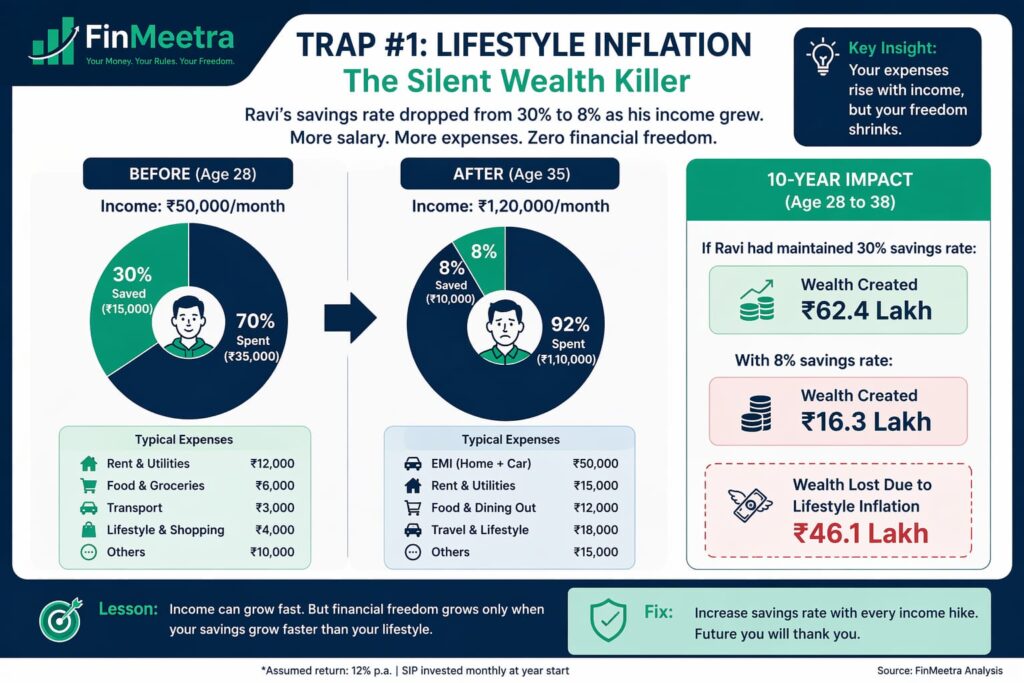
Every raise feels like a milestone. Bigger flat. Better car. Premium subscriptions. Latest iPhone. Each step feels ‘deserved.’ Each one quietly destroys wealth-building. 💔
Here’s what lifestyle inflation looks like in real numbers:
| Year | Income | Expenses | Savings Rate |
| Age 25 | ₹50,000 | ₹35,000 | 30% |
| Age 30 | ₹1,00,000 | ₹85,000 | 15% |
| Age 35 | ₹1,80,000 | ₹1,55,000 | 14% |
| Age 40 | ₹2,50,000 | ₹2,30,000 | 8% |
Look at the pattern. Income grew 5x. But savings rate DROPPED from 30% to 8%. Total monthly savings barely grew despite 5x salary. 🤯
📊 Saving 30% of ₹50K beats saving 8% of ₹2.5L over 20 years. Discipline > Salary.
💎 Lesson: Every raise should mean bigger SIP, not bigger lifestyle. The wealthy aren’t smarter — they’re better at resisting lifestyle inflation.
Trap #2: ULIPs, Endowment & ‘Investment Insurance’
This is the trap your bank/uncle/insurance agent will never warn you about. Because they earn massive commissions on it.
ULIPs, Endowment Policies, Money-Back Plans — these are ‘investment + insurance’ products that sound smart but quietly destroy wealth.
| Product | Avg Returns | Lock-in | Commission to Agent |
| ULIPs | 6-8% (after charges) | 5 years | 2-5% per year |
| Endowment | 4-6% | 15-20 years | 35-40% Year 1 |
| Money-Back | 4-5% | 15-20 years | 30-35% Year 1 |
| Single Premium | 5-7% | 5-10 years | 6-8% one-time |
Compare to a Term Insurance + Equity Mutual Fund SIP combination:
| Metric | ULIP/Endowment | Term + MF SIP |
| Returns over 20 years | 5-7% | 12-14% |
| ₹10,000/month for 20 years | ₹50-60 Lakh | ₹95 Lakh-₹1.2 Cr |
| Insurance coverage | ₹5-10 Lakh | ₹1 Crore+ |
| Liquidity | Locked | High |
₹40+ LAKH wealth gap. Over a single product decision. Most Indians have 2-3 such policies. Total damage? Often ₹50+ Lakh over a career. 💔
I’ve covered why Direct Plans matter more than fund choice in detail. But before even Direct Plans, you need to STOP buying insurance-as-investment products.
💎 Lesson: Insurance and investment should NEVER be mixed. Buy pure Term insurance for protection. Buy Mutual Funds for wealth. Separate. Always.
Trap #3: The ‘Safety’ Lie of FDs and Savings Accounts
‘I keep ₹15 Lakh in FDs for safety,’ Ravi told me proudly. I winced.
FDs feel safe. They ARE safe — from market crashes. But they’re DEFINITELY NOT safe from inflation:
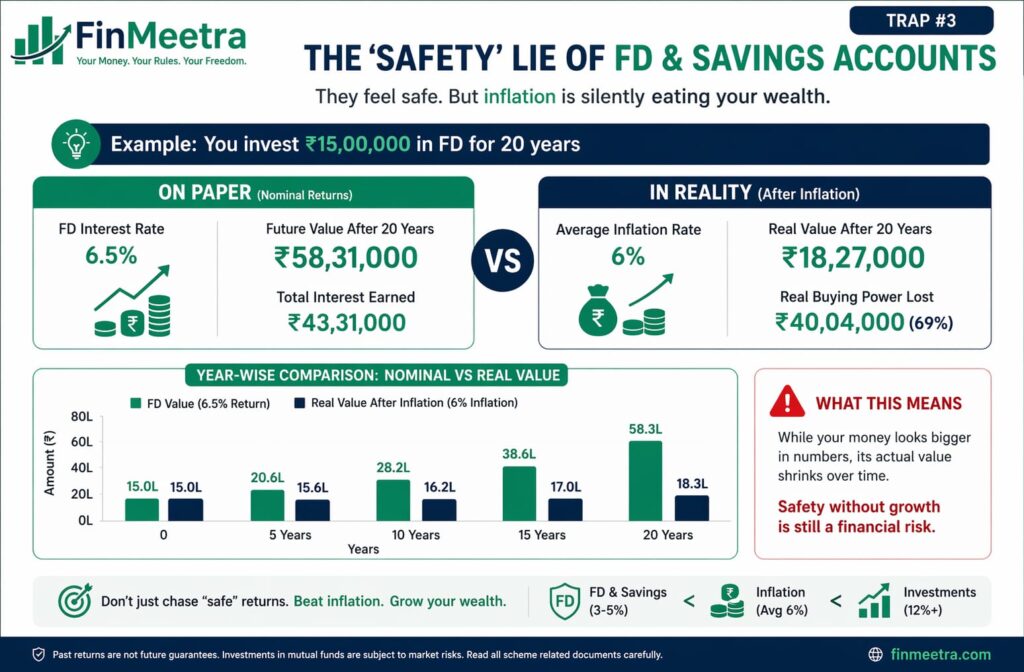
| Year | FD Value | Real Value (Inflation Adjusted) |
| Year 0 | ₹15,00,000 | ₹15,00,000 |
| Year 5 | ₹21,00,000 | ₹15,75,000 |
| Year 10 | ₹29,50,000 | ₹16,50,000 |
| Year 20 | ₹58,00,000 | ₹18,00,000 |
After 20 years, ₹15 Lakh in FDs becomes ₹58 Lakh on paper. But in REAL purchasing power? Just ₹18 Lakh. You barely grew your money.
Compare to ₹15 Lakh in equity (lump sum):
| Year | Equity Value | Real Value |
| Year 0 | ₹15,00,000 | ₹15,00,000 |
| Year 10 | ₹46,50,000 | ₹26,00,000 |
| Year 20 | ₹1.45 Cr | ₹45,00,000 |
Same ₹15 Lakh. Equity vs FD. 20 years. Real wealth gap: ₹27 LAKH. 🤯
📊 FDs are emergency funds, not wealth-builders. Indians lose lakhs by treating FDs as ‘safe investment.’ They’re a safe place to PARK money, not GROW it.
💎 Lesson: Use FDs for emergency funds (6-12 months expenses). Anything more in FDs = silent wealth destruction. Move excess to equity SIPs.
Trap #4: Over-Reliance on EPF for Retirement
Every salaried Indian has EPF. We trust it implicitly. ‘It’ll be enough.’ That belief is destroying retirements quietly. 💔
| Assumption | Value |
| Starting age | 25 |
| Starting salary | ₹50,000/month |
| Salary growth | 10%/year |
| EPF contribution | 24% of basic |
| EPF return | 8.25% |
| Inflation | 6% |
By age 60, your EPF corpus would be approximately ₹2.1 Crore. Sounds great, right? Now adjust for inflation:
| Metric | Value |
| EPF Corpus at 60 (nominal) | ₹2.1 Crore |
| Real Value (today’s purchasing power) | ₹46 Lakh |
| Monthly retirement income (4% withdrawal) | ₹15,000-30,000 |
| Current lifestyle needs | ₹60,000-1,00,000+ |
₹15-30K monthly retirement income for someone used to ₹80K-1L+ lifestyle? That’s a financial cliff. Not retirement. 🚨
EPF alone is NOT enough. Pair it with Step-Up SIPs and aggressive equity allocation.
💎 Lesson: EPF is the foundation, NOT the ceiling. Most Indians retire poor because they trust EPF as a complete solution. It isn’t.
Trap #5: No Step-Up SIPs (The Frozen Wealth Trap)
I see this in 90% of high-earning Indians. They start ₹5K SIP at 25. Salary triples by 35. Triples again by 45. But the SIP? Still ₹5K.
| Strategy | Total Invested | Final Corpus | Inflation-Adjusted |
| Flat ₹10K SIP for 30 years | ₹36 Lakh | ₹3.5 Crore | ₹62 Lakh |
| ₹10K SIP with 10% step-up | ₹98 Lakh | ₹9.2 Crore | ₹1.6 Cr |
| Difference | +₹62 Lakh invested | +₹5.7 Cr wealth | +₹1 Cr real |
₹1 CRORE difference in REAL wealth. Just by stepping up SIP 10% yearly — barely matching salary growth. 🤯
📊 A flat SIP for 30 years = retire middle-class. A step-up SIP for 30 years = retire wealthy. Same effort. Different discipline.
💎 Lesson: Don’t ‘set and forget’ your SIP. Step it up 10% every year on your birthday. Set a calendar reminder. Single highest-impact financial habit.
Trap #6: Real Estate as ‘Investment’
‘I bought a flat. It’s appreciating. That’s my retirement plan.’ I hear this from high-earning Indians constantly. Let me show you why it’s dangerous.
| Metric | Real Estate | Equity Mutual Funds |
| 10-year CAGR (Indian context) | 5-7% | 12-13% |
| Liquidity | Low (months to sell) | High (T+1 day) |
| Transaction Cost | 8-12% | 0.1-0.5% |
| Maintenance | Yes | None |
| Rental Yield | 2-3% | N/A |
₹50 Lakh in real estate vs ₹50 Lakh in equity over 20 years:
| Asset | 20-Year Value | Real Return |
| Real Estate (6% CAGR) | ₹1.6 Crore | 2x growth |
| Equity (12% CAGR) | ₹4.8 Crore | 9.6x growth |
₹3.2 CRORE wealth gap. From ONE allocation decision. 🤯
I’m not saying don’t buy a house — buy one for LIVING. But don’t treat real estate as your primary wealth-building vehicle.
💎 Lesson: Buy real estate for shelter. Buy equity for wealth. Don’t confuse the two.
Trap #7: The ‘I’ll Start Investing Later’ Trap
This is the deadliest trap. And the most common.
‘I’ll start when my salary crosses ₹1.5 LPM.’ ‘After the home loan.’ Every excuse delays compounding by years.
| Starting Age | Monthly SIP | 60-Year Corpus |
| Age 25 | ₹10,000 | ₹3.5 Crore |
| Age 30 | ₹10,000 | ₹2.1 Crore |
| Age 35 | ₹10,000 | ₹1.2 Crore |
| Age 40 | ₹10,000 | ₹65 Lakh |
Starting just 5 years later cuts your corpus by 40%. Starting 15 years late = 80% less wealth. Time is the SINGLE biggest factor in wealth-building.
📊 At age 25, time is your biggest asset. At age 45, you can’t buy back lost time — not even with a 3x salary.
💎 Lesson: Start NOW. Even ₹2,000/month. Don’t wait for the ‘right amount.’ Compounding rewards starting, not optimizing.
The Real Solution: The 4-Pillar Retirement Framework
Here’s the simple structural fix that separates retire-rich Indians from retire-poor ones:
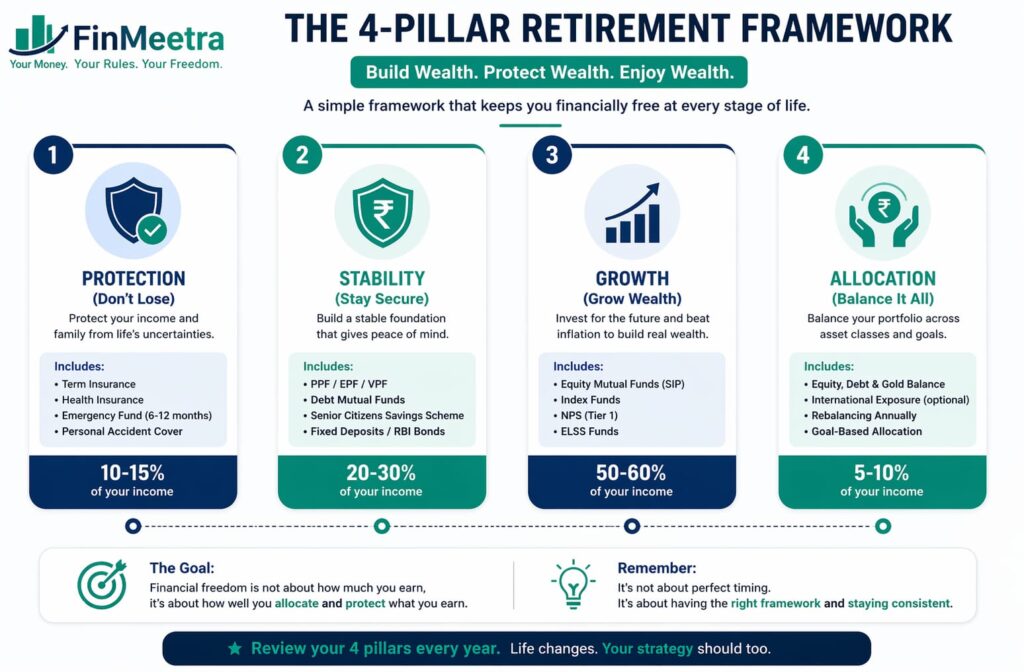
| Pillar | Purpose | Tools |
| 🛡️ Pillar 1: Protection | Insurance | Term + Health insurance only |
| 🏦 Pillar 2: Stability | Safe assets | EPF, PPF, NPS Tier-1 |
| 📈 Pillar 3: Growth | Wealth building | Equity SIPs via Direct Plans |
| ⚖️ Pillar 4: Allocation | Risk balance | Asset allocation by age |
All 4 pillars matter. Most Indians focus only on Pillar 2 (EPF) and Pillar 1 (mixed wrong with investment). Result: weak Pillar 3 = poor retirement.
For Pillar 3, use Direct Plan platforms (Groww, Zerodha Coin, Kuvera, INDmoney, MF Central) — all free, all SEBI-regulated. Skip your bank for mutual funds.
The 7-Trap Summary
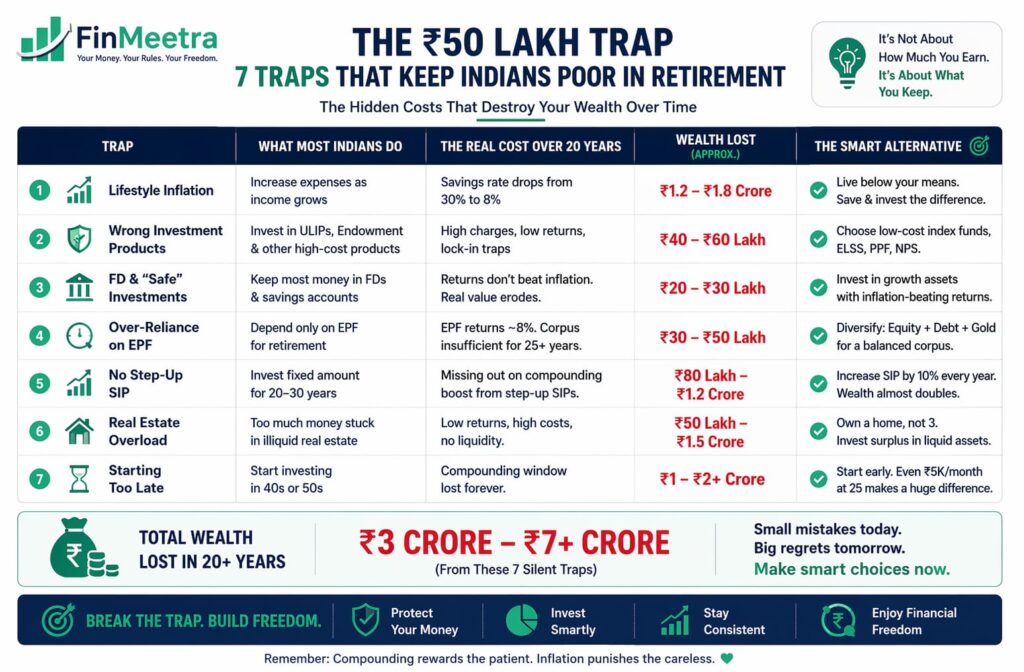
| Trap | Estimated Cost Over Career |
| Trap #1: Lifestyle Inflation | -₹50-80 Lakh |
| Trap #2: ULIPs/Endowment | -₹25-40 Lakh |
| Trap #3: Excess FDs | -₹20-35 Lakh |
| Trap #4: EPF Over-Reliance | Hidden inadequacy |
| Trap #5: Flat SIPs | -₹50 Lakh-1 Cr |
| Trap #6: Real Estate Over-Allocation | -₹1-3 Cr |
| Trap #7: Delayed Start | -40-80% of corpus |
| 💔 TOTAL Wealth Lost | ₹3-7+ CRORE |
Read that range again. ₹3-7+ CRORE. That’s the gap between Indians who retire wealthy and Indians who retire poor — across the SAME income brackets. It’s not about earning more. It’s about avoiding these 7 silent traps.
Key Takeaways
✅ Earning well doesn’t make you retire well — lifestyle inflation kills wealth-building.
✅ Insurance and investment should NEVER be mixed. Term + MF SIP separately.
✅ FDs are emergency funds, not wealth-builders. Stop parking excess money there.
✅ EPF is the foundation, not the ceiling. Add aggressive equity SIPs.
✅ Step-Up SIPs by 10% yearly = the single highest-impact retirement habit.
✅ Real estate is for living, not wealth-building. Equity beats it dramatically over 20+ years.
✅ Time > Salary. Starting at 25 with ₹5K beats starting at 35 with ₹15K.
✅ Use Direct Plan platforms (Groww, Zerodha Coin, Kuvera, INDmoney, MF Central) — never your bank.
✅ The retire-rich Indians don’t earn more. They avoid the silent traps.
Frequently Asked Questions
Q: How much retirement corpus do I really need in India?
A: Calculate your current monthly expenses, adjust for inflation (6%/year) until retirement age, then multiply by 25-30 years. For ₹60K current expenses retiring at 60, that’s typically ₹8-12 Crore total corpus needed. Most Indians dangerously underestimate this.
Q: Is EPF enough for retirement in India?
A: Almost never. EPF alone gives roughly ₹2 Crore corpus by age 60 — which equals just ₹40-50 Lakh in today’s purchasing power. That’s NOT a comfortable retirement for most lifestyles. You need aggressive equity SIPs alongside EPF.
Q: Should I buy a ULIP or endowment policy for tax saving?
A: No. These products give 4-7% returns over decades while charging massive commissions. A simple Term Insurance + ELSS Mutual Fund combination gives you better insurance coverage AND 2-3x better returns. Always separate insurance from investment.
Q: How much should I save for retirement at age 30?
A: A 30-year-old should ideally invest 30-40% of income for retirement. For ₹1 LPM salary, that’s ₹30-40K monthly across Equity SIPs (60%), EPF/PPF (30%), and Gold (10%). Step-up by 10% yearly.
Q: Is real estate a good retirement investment in India?
A: Real estate has its place for shelter, but not as primary wealth-building. Equity mutual funds historically outperform real estate by 2-3x over 20+ years in India, with much higher liquidity and lower transaction costs.
Q: What’s the best mutual fund category for retirement?
A: For long-term retirement (15+ years away), Flexi Cap or Index Funds are ideal. As you approach retirement (within 5-7 years), gradually shift to Balanced Hybrid or Conservative Hybrid funds.
Q: Should I rely on NPS for retirement?
A: NPS is good as a supplementary retirement vehicle, especially for tax savings (extra ₹50K deduction under 80CCD-1B). But it has compulsory annuity at 60. Use NPS for 20-30% of retirement portfolio, not the main vehicle.
Q: How do I avoid lifestyle inflation as my salary grows?
A: Three principles: (1) Increase your SIP by the SAME amount as your salary hike. (2) Avoid expensive long-term commitments. (3) Track your ‘savings rate’ yearly — if it’s dropping despite raises, you’re trapped in lifestyle inflation.
Related Articles You’ll Love
The Power of Compounding — How ₹5,000/Month Grows into ₹1.76 Crores
Step-Up SIP — Multiply Your Wealth Without Multiplying Effort
Asset Allocation Strategy — Equity, Debt & Gold Split
Index Funds vs Active Funds — Which Wins in India?
The ₹30 Lakh Mistake Most Indians Don’t Know They’re Making
I Tracked My SIP for 10 Years — The Hidden Truth
Useful External Resources
AMFI India (Official MF Data) — https://www.amfiindia.com
SEBI Investor Education — https://investor.sebi.gov.in
EPFO Official Portal — https://www.epfindia.gov.in
NPS Trust — https://npstrust.org.in
Groww (Direct fund investment) — https://groww.in
Zerodha Coin (Direct MF) — https://coin.zerodha.com
Kuvera (Goal-based investing) — https://kuvera.in
MF Central (Government-backed) — https://www.mfcentral.com
────────────────────────────────────────────────────────────
📩 ENJOYED THIS BLOG? HERE IS WHAT YOU CAN DO NEXT:
💬 Leave a Comment — Which of the 7 traps hit closest to home? Share your retirement planning concerns.
📧 Subscribe to FinMeetra Newsletter — Real data-backed money insights every week.
📊 Download Free Retirement Corpus Calculator (Excel) — Find your exact target in 60 seconds.
📱 Share This Blog — If this opened your eyes, share it with someone earning ₹1 LPM+.