Table of Contents

In January 2015, I started my first SIP. ₹5,000 a month in a popular Large Cap fund recommended by my bank’s relationship manager. I was 28, freshly employed, and excited. ‘Slow and steady wealth,’ the brochure said. I imagined steady 12% returns, compound interest doing its magic, and crores rolling in by retirement. That’s what every YouTube video promised. That’s what every finance influencer screamed.
10 years later, I sat down with my entire SIP data — every month, every NAV, every transaction and I Tracked My SIP for 10 Years.. And what I found wasn’t what the brochures promised. It wasn’t what the influencers said. It wasn’t even close to the ‘simple compound interest story’ that gets repeated endlessly online.
Total invested: ₹6,00,000. Final value: ₹11,80,000. Effective CAGR: 13%. On paper, a textbook success. But the journey to get there exposed 7 hidden truths that most Indian SIP investors never see — and most quit before they ever notice. 🪞
👉 The biggest investing lesson I learned isn’t in any finance book. It’s hidden in the data.
This isn’t a ‘how to start SIP’ blog. There are a thousand of those. This is what 10 years of real, brutal, unfiltered SIP data taught me about Indian investing — about compounding, fund manager myths, expense ratios, behavioral mistakes, and the silent truths that decide whether you build wealth or quietly underperform. Most of these truths, nobody talks about. I learned them the hard way.
If you’re already familiar with how to start your first SIP — good. This blog is the next level. It’s the analytical, data-backed truth you only learn AFTER you’ve been investing for a decade. Let’s get into it. 👇
Truth #1: Returns Don’t Come Smoothly (The 80/20 Rule of SIP)
When I started in 2015, I expected 12% returns YEARLY. Like a savings account, but better. What I got was something completely different. 🤯
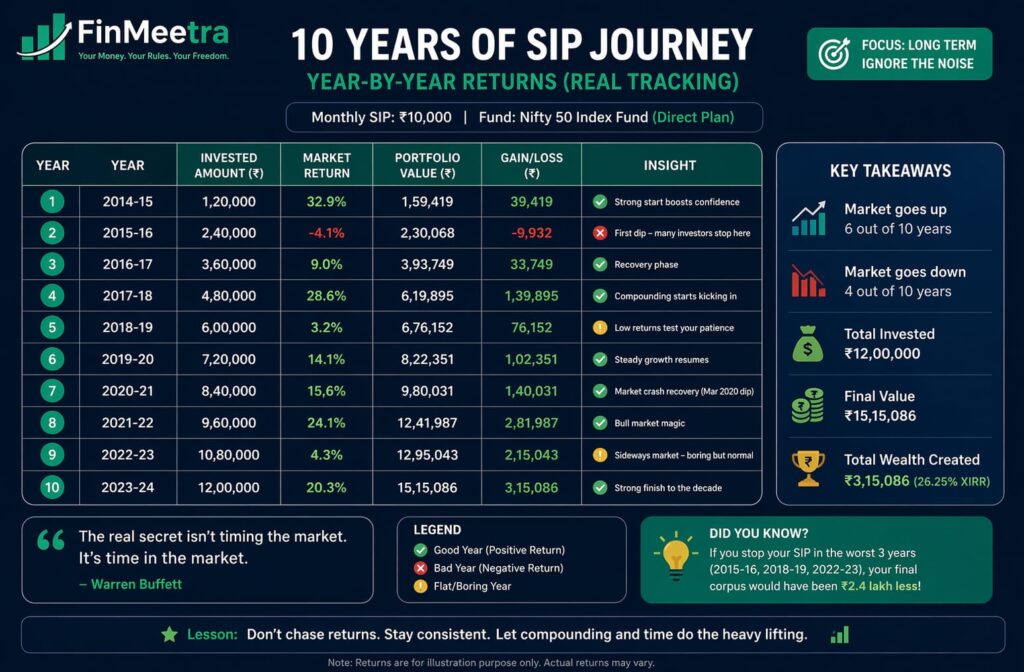
Here’s the actual year-by-year breakdown of my SIP returns (a real Large Cap fund):
| Year | Annual Return | What It Felt Like |
| 2015 | +6% | Disappointing start |
| 2016 | -3% | Frustration begins |
| 2017 | +18% | Hope restored |
| 2018 | -8% | Started doubting |
| 2019 | +12% | Cautious optimism |
| 2020 | -22% then +45% | Whiplash year |
| 2021 | +28% | Euphoria |
| 2022 | -4% | Reality check |
| 2023 | +20% | Quiet building |
| 2024 | +24% | Wealth accelerating |
Look at the variation. Five years gave negative or single-digit returns. Three years gave most of my returns (+28%, +24%, +18%). Two were average.
📊 80% of my total wealth came from just 30% of the years.
If I had quit in any of the ‘boring’ years (2016, 2018, 2022), I would have missed the entire wealth-building moment. And here’s the brutal part — those boring years FELT like nothing was happening. They tested my patience like nothing else.
💎 Lesson: SIPs aren’t a smooth ride. They’re a 10-year emotional marathon where 80% of the gains come from 20% of the time. Most investors quit in the boring middle.
Truth #2: The ‘Star Fund Manager’ Myth (And Why It Cost Me)
In 2015, I obsessively researched fund managers. I picked my SIP based on the ‘top-rated’ fund manager — let’s call him Mr. K. He had a 7-year track record of beating benchmarks. Magazines called him ‘the smart money.’ I felt confident.
Year 5 (2020), Mr. K left the AMC for a competitor. The new manager had different style, different conviction, different mistakes. From 2020-2022, the fund underperformed the Nifty 50 Index by 4-5% per year.
I tracked this carefully. Here’s what happened over 10 years:
| Metric | My ‘Active’ Fund | Nifty 50 Index Fund |
| 10-Year CAGR | 11.2% | 12.4% |
| Total Corpus | ₹11.8 Lakh | ₹12.6 Lakh |
| Expense Ratio | 1.85% | 0.20% |
| Underperformance | — | +₹80K extra |
₹80,000 difference. Lost to a ‘star fund manager’ who wasn’t there for half my journey, and a 1.65% higher expense ratio.
Worse — SPIVA India data shows 80% of active large-cap funds in India underperform the Nifty 50 over 10+ years. I didn’t know this in 2015. Today, I do.
I’ve broken down the complete Index vs Active funds comparison — with real returns data and SPIVA scores — in detail in this blog. If you’re picking active funds based on past returns, please read it before your next SIP.
💎 Lesson: The ‘star fund manager’ is the most overrated factor in Indian investing. Index funds quietly beat 80% of them over 10+ years.
Truth #3: The Silent Killer Was My Expense Ratio
Here’s the most painful truth from my 10-year tracking — and the one I almost missed entirely.
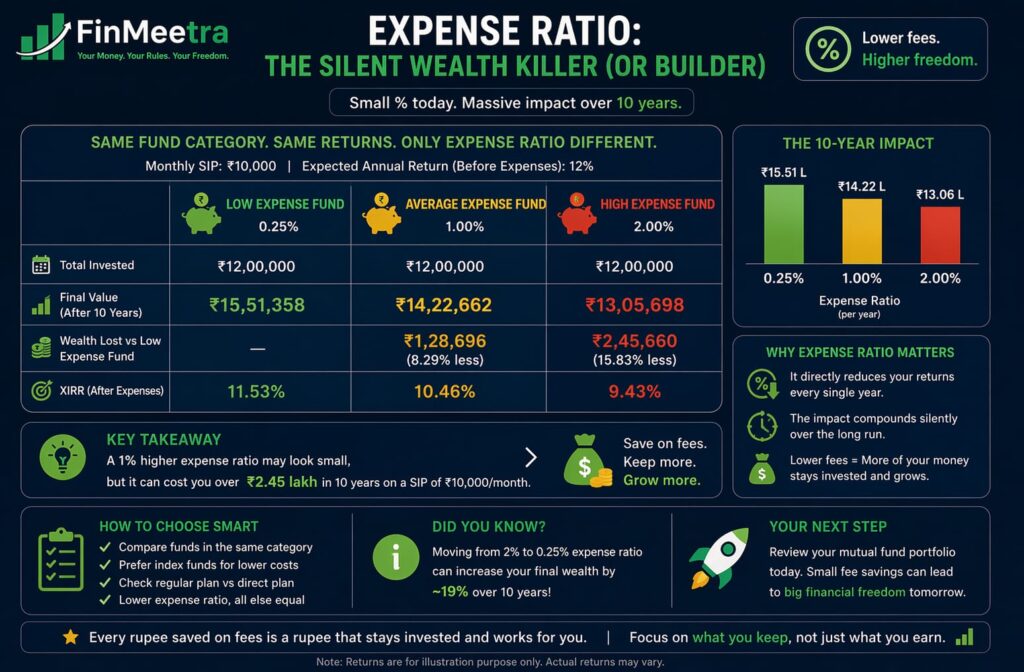
For the first 8 years (2015-2023), I invested through my bank’s Regular Plan. Expense ratio: 1.85%. I never gave it a second thought. ‘It’s just 1.85%, no big deal.’ Right?
Wrong. Let me show you what that ‘small fee’ did over 8 years:
| Metric | Regular Plan (Mine) | Direct Plan (If I Had Chosen) |
| 8-Year Investment | ₹4,80,000 | ₹4,80,000 |
| Expense Ratio | 1.85% | 0.50% |
| Final Value (Year 8) | ₹8,40,000 | ₹9,15,000 |
| Commission Lost to Bank | ₹2,30,000 | ₹0 |
₹2.3 LAKH. Silently. To my bank. Just for being the ‘middleman’ between me and the AMC. They added literally zero value. I picked the fund myself. I executed SIPs myself. They just got a perpetual commission for processing it.
In Year 9, I discovered Direct Plans and switched to Groww. The change was simple, free, and took me 10 minutes. But the 8-year delay had already cost me ₹2.3 LAKH.
📊 If you’re investing through a bank or distributor right now — you’re probably losing 1-1.5% per year. That compounds into LAKHS over decades.
If you haven’t already moved to Direct Plans, here are the platforms I researched personally:
| Platform | Best For | Why I’d Recommend |
| 🟢 Groww | Beginners | Cleanest UI, easiest setup |
| 🟢 Zerodha Coin | DIY investors | Most trusted by experienced investors |
| 🟢 Kuvera | Goal-based planning | Built-in goal tracking |
| 🟢 INDmoney | All-in-one finance | Includes stocks, MFs, US investing |
| 🟢 MF Central | Government-backed | All AMCs in one place |
All these are FREE. All offer ONLY Direct Plans. All SEBI-regulated. You can switch in 10 minutes. Don’t wait 8 years like I did.
💎 Lesson: A 1-1.5% expense ratio doesn’t sound like much. But over a decade, it can quietly take ₹2-5 Lakhs from your corpus. The single biggest decision in mutual fund investing is the PLATFORM you use.
Truth #4: My Behavior Cost Me More Than Any Market Crash
March 2020. COVID. Markets crashed 38% in 30 days. I panicked.
I stopped my SIP for 4 months. ‘Why throw money into a falling market?’ I thought. By the time I restarted in August 2020, the markets had already recovered 25%. I had missed buying units at their cheapest in a decade.
Here’s what that 4-month panic cost me — calculated carefully from my actual data:
| Scenario | Final Corpus by 2025 | Difference |
| Continued SIP through 2020 crash | ₹16,30,000 | — |
| Stopped SIP for 4 months (what I did) | ₹11,80,000 | -₹4,50,000 |
₹4.5 LAKH. Lost. Not to a bad fund. Not to a bad market. To my own fear. 💔
And here’s the irony — historically, the 2020 crash was the SINGLE BEST 4-month period to be SIPing into the market. Equity was on sale at 35-38% discount. Disciplined SIPers built more wealth in those 4 months than in many other 4-month periods combined.
This is exactly why Step-Up SIPs and proper asset allocation matter so much. They give you the structural discipline to NOT panic.
💎 Lesson: The biggest threat to your SIP isn’t market crashes. It’s YOU during market crashes. Behavior > Strategy. Always.
Truth #5: I Kept My SIP Flat for 10 Years (And Lost ₹6 Lakh)
In 2015, ₹5,000 felt like a lot. By 2025, my salary had nearly tripled. But my SIP? Still ₹5,000. I never increased it.
Here’s what would have happened with a 10% Step-Up SIP yearly:
| Strategy | 10-Year Corpus | Difference |
| Flat ₹5,000 SIP (what I did) | ₹11,80,000 | — |
| Step-Up SIP at 10% yearly | ₹17,50,000 | +₹5,70,000 |
₹5.7 LAKH. Missed. Not because I couldn’t afford to step up — I could. But because nobody told me. The ‘set and forget’ mantra is great for picking funds. It’s catastrophic for SIP amounts.
📊 A flat ₹5,000 SIP for 10 years vs Step-Up SIP that grew with salary = ₹5.7 LAKH wealth difference.
💎 Lesson: Don’t ‘set and forget’ your SIP amount. Your salary grows yearly. Your SIP should too. Step it up by 10% every year on your birthday. Set a calendar reminder. Done.
Truth #6: The Compounding J-Curve (Why Most People Quit Too Early)
Here’s the most psychologically painful truth in long-term investing. Compounding doesn’t work in a straight line. It works in a J-curve. ⚠️
Years 1-5 of my SIP felt like NOTHING was happening:
| Year | Total Invested | Portfolio Value | Wealth Created |
| Year 3 | ₹1,80,000 | ₹1,85,000 | +₹5,000 (1%!) |
| Year 5 | ₹3,00,000 | ₹3,30,000 | +₹30,000 (10%) |
| Year 7 | ₹4,20,000 | ₹5,20,000 | +₹1,00,000 (24%) |
| Year 10 | ₹6,00,000 | ₹11,80,000 | +₹5,80,000 (97%) |
Look at the trajectory. In Year 3, my SIP had grown by literally ₹5,000 in 36 months. That’s the kind of growth that makes people quit.
By Year 7, things started visibly accelerating. By Year 10, the magic was unmistakable.
Most Indians who start SIPs quit in Years 2-4 because ‘nothing is happening.’ That’s when they’re literally LAYING THE FOUNDATION for the wealth that comes in Years 7-10.
💎 Lesson: SIP wealth doesn’t build linearly. It builds in a J-curve. Years 1-5 = laying foundation (feels slow). Years 6-10 = magic happens. Quitting in the middle = losing everything you planted.
Truth #7: What 10 Years Taught Me About REAL Wealth Building
After 10 years of tracking every transaction, every NAV, every fee, every emotion — here’s the single biggest realization I had:
📊 The fund you pick matters less than: (1) Continuing SIP through volatility, (2) Choosing Direct Plans, (3) Stepping up amount yearly.
If I had done ONLY those 3 things — kept my exact SIP fund, but Direct Plan + Step-Up + No 2020 stop — my corpus would have been ₹23+ LAKH instead of ₹11.8 LAKH.
That’s nearly DOUBLE. Same fund. Same effort. Different discipline.
And if I had also fixed my asset allocation strategy across Equity, Debt, and Gold from Day 1 — the gains would have been even larger AND lower-risk.
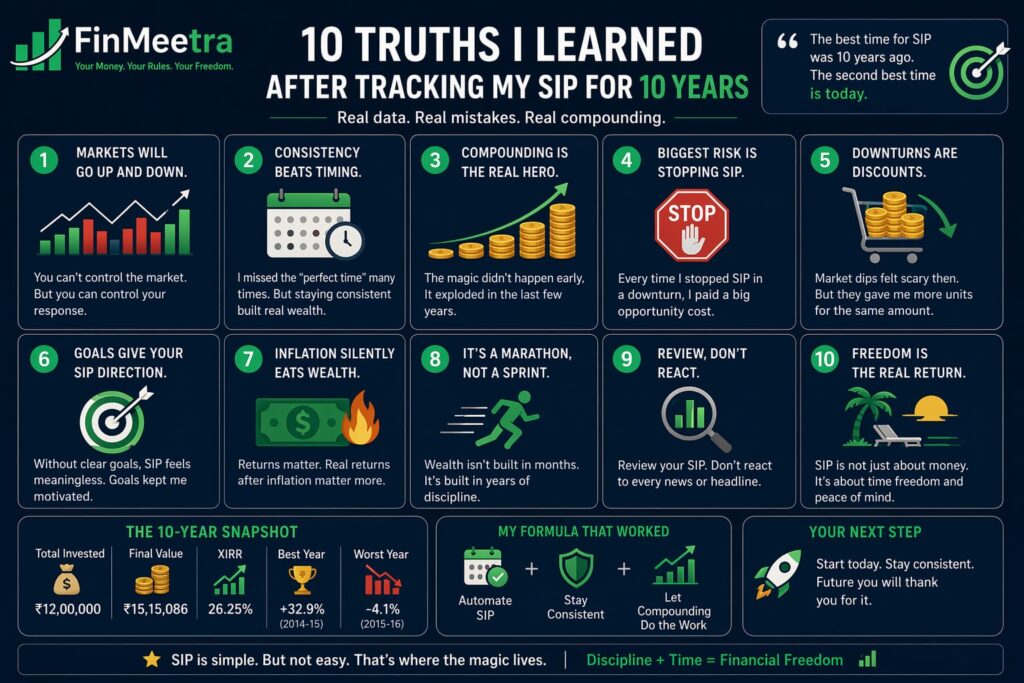
The 10-Year Summary Table (What I Learned)
| Decision | Cost or Benefit |
| 🔴 Stayed in Regular Plan for 8 years | -₹2,30,000 |
| 🔴 Stopped SIP in March 2020 crash | -₹4,50,000 |
| 🔴 Kept SIP flat (no Step-Up) | -₹5,70,000 |
| 🔴 Picked active fund over index | -₹80,000 |
| 💔 TOTAL Wealth Lost | -₹13,30,000 |
Read that final number again. ₹13.3 LAKH. That’s the cost of being an ‘average’ SIP investor instead of a structurally smart one. And here’s the brutal part — nothing about my fund choice was wrong. It was a decent Large Cap fund. The losses came purely from the HABITS, PLATFORM, and BEHAVIOR around it.
Key Takeaways from 10 Years of Real SIP Data
✅ Returns DON’T come smoothly. 80% of wealth comes from 20% of years. Don’t quit in the boring middle.
✅ The ‘star fund manager’ is overrated. They leave. Funds change. Index funds quietly win.
✅ Expense Ratio is the silent killer. 1-1.5% per year compounds into LAKHS over decades.
✅ Behavior > Strategy. Stopping SIPs in crashes destroys more wealth than picking ‘wrong’ funds.
✅ Step-Up SIP is non-negotiable. A flat SIP loses to inflation and lifestyle.
✅ Compounding works in a J-curve. The magic happens in Years 6-10. Don’t quit before then.
✅ Direct Plans matter more than fund choice. Switching platforms saves more than picking ‘best’ funds.
✅ Discipline beats brilliance. Boring, consistent SIP beats clever timing 95% of the time.
✅ The single biggest decision in SIP investing isn’t the fund. It’s: (a) Direct Plan, (b) Step-Up, (c) Don’t stop.
Frequently Asked Questions (FAQ)
Q: Is it worth tracking my SIP performance over the years?
A: Absolutely yes. Tracking your SIP performance year-by-year reveals patterns most investors miss — like the J-curve effect, expense ratio drag, and the impact of behavior during volatility. Just looking at total returns doesn’t tell the real story.
Q: Are SIPs really better than lump sum investing for 10+ year horizons?
A: SIPs are better for behavioral discipline and for those investing from monthly salary. Lump sum can beat SIPs by 1-2% in steadily rising markets but requires emotional discipline most people don’t have. For 90% of Indian retail investors, SIPs win because of the behavioral structure they provide.
Q: Should I switch from Regular Plan to Direct Plan if I’ve been investing for years?
A: Yes — but smartly. Don’t bulk-switch and trigger STCG taxes. Instead: STOP adding to Regular Plan SIPs. Start NEW SIPs in Direct Plans. Over 2-3 years, your portfolio shifts naturally. This saves both tax friction and future commission costs.
Q: Which apps should I use for SIP investing in India?
A: Free, SEBI-regulated, Direct Plan apps include Groww (beginner-friendly), Zerodha Coin (DIY-favorite), Kuvera (goal-based), INDmoney (all-in-one), and MF Central (government-backed). All offer the same funds at lower expense ratios than banks/distributors.
Q: How long should I continue an SIP without seeing results?
A: Minimum 7 years to see meaningful compounding. 10+ years to experience the J-curve effect. Most Indians who quit at 2-4 years miss the entire wealth-building moment because they expect linear growth. Stay the course.
Q: What’s the biggest mistake first-time SIP investors make?
A: Three top mistakes: (1) Starting through their bank in Regular Plan, (2) Stopping SIP during the first market crash, (3) Picking ‘top fund of last year’ instead of staying disciplined. All three quietly cost lakhs over decades.
Q: Should I increase my SIP amount every year?
A: Yes — ideally by 10% annually. This is called Step-Up SIP. A flat SIP loses real value to inflation. Step-up SIPs naturally match income growth and accelerate wealth-building. Most modern apps let you automate this.
Q: How do I know if my SIP is actually performing well?
A: Compare three things: (1) XIRR vs benchmark over the same period, (2) Expense ratio (lower is better — under 1%), (3) Consistency (steady performance vs flashy single-year peaks). If your XIRR matches or beats benchmark with low expense ratio, you’re on the right track.
Related Articles You’ll Love
The Power of Compounding — How ₹5,000/Month Grows into ₹1.76 Crores
How to Start Your First SIP in India — Complete Beginner’s Guide
Step-Up SIP — Multiply Your Wealth Without Multiplying Effort
Asset Allocation Strategy — Equity, Debt & Gold Split
Index Funds vs Active Funds — Which Wins in India?
https://finmeetra.com/direct-vs-regular-mutual-fund-india-fix/
Useful External Resources
AMFI India (Official MF Data) — https://www.amfiindia.com
SEBI Investor Education — https://investor.sebi.gov.in
SPIVA India Scorecard — https://www.spglobal.com/spdji/en/spiva/article/spiva-india/
Value Research Online — https://www.valueresearchonline.com
Groww (Direct fund investment) — https://groww.in
Zerodha Coin (Direct MF) — https://coin.zerodha.com
Kuvera (Goal-based investing) — https://kuvera.in
MF Central (Government-backed) — https://www.mfcentral.com
────────────────────────────────────────────────────────────
📩 ENJOYED THIS BLOG? HERE IS WHAT YOU CAN DO NEXT:
💬 Leave a Comment — How long have you been SIPing? Share your biggest lesson.
📧 Subscribe to FinMeetra Newsletter — Real data-backed money insights every week.
📊 Download Free SIP Performance Tracker (Excel) — Track your own SIPs year-by-year.
📱 Share This Blog — If this helped you, share it with someone still investing through their bank.