
Table of Contents

Last year, I checked my friend Rajesh’s mutual fund portfolio. He’d been investing ₹15,000/month for 8 years through his bank’s relationship manager — the same person who handled his salary account, FDs, and home loan. ‘Slow and steady,’ he said with pride. Total invested: ₹14.4 lakhs. Current value: ₹24 lakhs. By all accounts, he was doing great.
I asked one simple question: ‘Are these Direct Plans or Regular Plans?’ He had no idea what that meant. I checked his statements — every single fund was a Regular Plan. By that one decision alone, Rajesh had already lost ₹3.8 LAKHS to hidden commissions in 8 years. By the time he retires at 60, that loss balloons to ₹30+ LAKHS. For absolutely nothing — same fund, same SIP, same effort. 💔
👉 90% of Indian mutual fund investors are in ‘Regular Plans’ through banks/distributors — and don’t even know it.
This is the silent mutual fund trap costing Indians crores over their lifetimes. It’s not about choosing the wrong fund. It’s not about market crashes. It’s about a tiny difference in expense ratio — 1-1.5% per year — that compounds into devastating wealth loss over decades. Most banks and distributors will NEVER tell you about this. Why? Because they earn commissions ONLY on Regular Plans. So they push those. Aggressively. Endlessly. 🤐
We’ve already covered how to choose the right mutual fund using a 7-filter framework. But before picking any fund, you need to fix this one thing first — your PLAN type. This post walks you through the Direct vs Regular Plan story — explains why most Indians are stuck in the wrong one — and gives you a 10-minute step-by-step fix that can save you ₹30+ lakhs. Let’s dive in. 👇
What Are Direct Plans and Regular Plans? (Simple Definition)
Every mutual fund in India comes in two flavors: Direct Plan and Regular Plan. They invest in the same stocks. They have the same fund manager. They follow the same strategy. The ONLY difference? How you buy them — and how much commission goes to a middleman.
Direct Plans are bought DIRECTLY from the Asset Management Company (AMC) — via apps like Groww, Zerodha Coin, Kuvera, MF Central, or the AMC’s own website. There’s no intermediary. No commission. No distributor fee. Expense ratio: typically 0.5-1.2%.
Regular Plans are bought THROUGH an intermediary — your bank, a relationship manager, a financial advisor, or an online broker. They earn a commission for selling you the plan. That commission gets built into a higher expense ratio of 1.5-2.5%. The extra 1-1.5%? Goes to the middleman. Every year. Forever. As long as you stay invested. 💔
Think of it like buying a movie ticket. 🎬 Buy it directly from the theater’s website? ₹250. Buy the same ticket through a third-party app with ‘convenience fee’? ₹290. Same movie. Same seat. Same time. You just paid extra for the middleman. Mutual funds work the same way — except the ‘convenience fee’ compounds over decades into LAKHS of rupees.
The Real Math — How a 1.5% Difference Costs You ₹30 Lakhs
Here’s the part that shocks every investor I show this to. Let’s run a real-world simulation. You start a ₹10,000/month SIP at age 30. You continue for 25 years until retirement at 55. The fund delivers an average 12% return. The only difference between Investor A and Investor B is the plan type. 👇
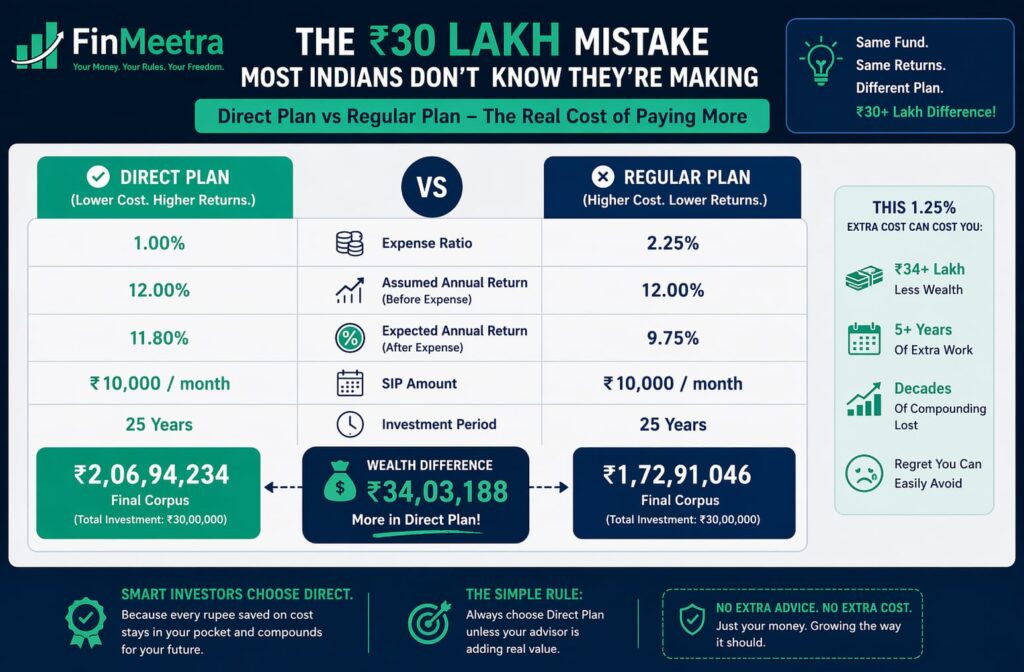
| Metric | Regular Plan | Direct Plan |
| 💸 Total Invested | ₹30,00,000 | ₹30,00,000 |
| 📊 Expense Ratio | 2.0% | 0.7% |
| 📈 Net Returns (after expenses) | 10.5% | 11.8% |
| 💰 Final Corpus | ₹1.55 Crore | ₹1.89 Crore |
| 💔 Money Lost to Commissions | ₹34 Lakh | ₹0 |
Read that last row again. ₹34 LAKHS — just gone. Quietly. Year by year. Without you ever seeing a ‘commission charge’ on your statement. The expense ratio just eats into your returns silently. Multiply this across 90% of Indian mutual fund investors, and we’re talking about TRILLIONS of rupees flowing from middle-class Indians to bank shareholders and distributor networks every decade. 🤯
📊 Indians collectively pay an estimated ₹40,000+ crores in mutual fund commissions every year — most of which is avoidable.
And here’s the twist: this isn’t a ‘low return’ problem. The fund is performing perfectly fine. The fund manager is doing their job. The market is doing its thing. You’re just leaking 1.5% in friction every year — friction that has no purpose except to enrich your distributor.
Why 90% of Indians Are Stuck in Regular Plans
If Direct Plans are so much better, why aren’t more Indians using them? The answer is simple — and infuriating. 👇
1. Banks and Brokers Push Regular Plans Aggressively
When you walk into HDFC, ICICI, SBI, or any bank to invest in a mutual fund — they will ONLY sell you Regular Plans. They literally can’t sell Direct Plans because they earn ZERO commission on those. So they push Regular Plans, often without ever mentioning that Direct Plans exist. It’s not unethical — but it’s not in your best interest either. ⚠️
2. Most Indians Don’t Know Direct Plans Exist
SEBI introduced Direct Plans in January 2013 — over 13 years ago. Yet, after a decade+, most retail investors still don’t know they exist. Why? Because there’s no profit incentive for anyone to educate them. Banks won’t tell you. Distributors won’t tell you. Even financial advisors (who earn commissions from Regular Plans) often gloss over this difference.
3. The ‘Convenience Trap’
Investing through your bank feels safer. Familiar. Easy. ‘My RM handles everything.’ But that convenience costs you 1.5% per year — which compounds into ₹30+ lakhs over decades. Convenience is the most expensive habit in personal finance. 💸
4. Switching Feels Intimidating
Even when investors learn about Direct Plans, they hesitate. ‘Will I lose money switching? Will I be charged exit loads? Is it complicated?’ Spoiler: it’s free, it takes 10 minutes, and there are no exit loads after 1 year. Most people just never get around to doing it.
And honestly, all these reasons are the same reason most Indians end up owning the wrong mutual fund categories too. Nobody educates us. Nobody simplifies it. So we trust the people pushing products — and quietly pay for it.
Real-Life Story: Rajesh vs Suman (15-Year Story)
Let me bring this to life. Meet Rajesh and Suman. Both are 35. Both started SIPs in January 2010 at ₹10,000/month. Same fund — let’s say a popular Large Cap Fund. Same fund manager. Same strategy. Different plans. 👇
🔴 Rajesh: Invested through his bank — automatically got the Regular Plan.
🟢 Suman: Researched online and chose the Direct Plan via Groww.
15 years later (January 2025), they sat down to compare. The result was eye-opening. 👇
| Metric | Rajesh (Regular) | Suman (Direct) |
| 💸 Total Invested | ₹18,00,000 | ₹18,00,000 |
| 📊 Expense Ratio | 2.10% | 0.65% |
| 📈 15-Year CAGR | 10.4% | 11.9% |
| 💰 Final Corpus | ₹38.2 Lakh | ₹45.1 Lakh |
| 💔 Difference (Lost to Commission) | — | +₹6.9 Lakh |
Same SIP. Same fund. Same time period. Same fund manager making the same investment decisions. Suman ended up with ₹6.9 Lakh extra — purely because she chose Direct over Regular. Now project this for 25 years — the gap becomes ₹30+ Lakhs. For 30 years? Over ₹50 Lakhs. 🤯
💎 Lesson: Sometimes the smartest investment decision isn’t about WHICH fund you pick. It’s about HOW you buy it. The plan type matters more than most Indians realize.
How to Fix This in 10 Minutes (Step-by-Step Guide)
Here’s the good news — switching from Regular to Direct Plans is shockingly simple. Free. Fast. No paperwork. You can do it from your phone in the next 10 minutes. Let’s walk through the exact steps. 👇
🪜 Step 1: Check What You Currently Have (2 minutes)
Open your existing mutual fund app (or check your bank statements). Look at the fund name. If it says ‘Regular Plan’ or ‘Regular – Growth’ — you’re in the wrong plan. If it says ‘Direct Plan’ or ‘Direct – Growth’ — you’re already optimized. 🎯
🪜 Step 2: Open a Direct Plan Platform (3 minutes)
Choose any of these FREE, SEBI-regulated platforms that offer ONLY Direct Plans:
| Platform | Best For | Free? |
| 🟢 Groww | Beginners, simple UI | ✅ Yes |
| 🟢 Zerodha Coin | DIY investors, popular | ✅ Yes |
| 🟢 Kuvera | Goal-based planning | ✅ Yes |
| 🟢 MF Central | All AMCs in one place | ✅ Yes |
| 🟢 ET Money | Modern UI, tracking | ✅ Yes |
| 🟢 AMC Direct (HDFC/ICICI etc.) | If you prefer single AMC | ✅ Yes |
Download the app, complete KYC (if not done already — takes 5 mins with PAN + Aadhaar), and you’re ready.
🪜 Step 3: Start Fresh SIPs in Direct Plans (3 minutes)
For new investments going forward, pick the SAME fund you currently have — but choose the ‘Direct – Growth’ option. Set up your SIP for the same amount, same date. Done. ✅ All future investments will compound at the lower expense ratio.
🪜 Step 4: Decide About Old Regular Plan Investments (2 minutes)
Now the tricky part — what about your existing Regular Plan holdings? You have three options:
Option A: Switch Immediately (Most Aggressive)
Use the ‘Switch’ option in your AMC app to move from Regular to Direct Plan of the same fund. ⚠️ Tax note: This counts as a redemption + new purchase. If held >1 year (equity), only LTCG above ₹1 lakh is taxed at 10%. If <1 year, STCG of 15% applies.
Option B: Stop Adding to Regular, Start Direct (Most Common)
Let existing Regular Plan units continue. Stop adding to them. All NEW SIPs go to Direct Plan. Over time, your portfolio naturally shifts. Zero tax friction. Recommended for most investors. ✅
Option C: Gradual Switch Over 2-3 Years
Move small portions yearly to manage tax impact. Best if you have a large Regular Plan portfolio. Slow but smooth.
And once you’ve fixed your plan type, supercharge it with Step-Up SIP — increasing your SIP by 10% annually to ride compounding even harder.
5 Common Mistakes Indians Make With Direct Plans
❌ Mistake 1: Confusing Regular vs Direct with Active vs Passive
These are different concepts. Active vs Passive is about fund management style. Direct vs Regular is about purchase route. Read our Index vs Active Funds guide for clarity.
❌ Mistake 2: Switching ALL Funds at Once Without Planning Tax
Sudden bulk switches can trigger massive STCG taxes. Plan switches based on holding period. Use Option B (stop adding) for tax-friendly transition.
❌ Mistake 3: Trusting ‘Advisors’ Who Only Sell Regular Plans
If your ‘financial advisor’ only offers Regular Plans, they’re not an advisor — they’re a distributor. Real advisors charge a fee but offer Direct Plans. Choose accordingly.
❌ Mistake 4: Ignoring AMC Direct Websites
Apps like Groww are great. But you can also go DIRECTLY to HDFC AMC, ICICI Pru, or SBI MF websites — and buy Direct Plans there. Even simpler in some cases.
❌ Mistake 5: Forgetting to Verify After Setup
After starting Direct Plans, log in once a quarter and verify the plan type on your statement. Some apps occasionally default to Regular if you click the wrong button. Trust but verify.
Key Takeaways
✅ Every mutual fund has TWO versions: Direct Plan and Regular Plan.
✅ Same fund. Same manager. Different expense ratio: 0.5-1.2% (Direct) vs 1.5-2.5% (Regular).
✅ The 1-1.5% gap compounds into ₹30+ Lakhs over 25 years on a ₹10K SIP.
✅ 90% of Indians are stuck in Regular Plans — often without knowing.
✅ Banks/distributors push Regular Plans because they earn commission on them.
✅ Direct Plans can be bought free from Groww, Zerodha Coin, Kuvera, MF Central, or AMC sites.
✅ Switching takes 10 minutes and is free (no exit load after 1 year).
✅ Smart strategy: Stop adding to Regular Plans. Start fresh SIPs in Direct Plans.
✅ Over 25 years, this single decision can save you ₹30+ Lakhs in wealth.
Frequently Asked Questions
Q: What is the main difference between Direct and Regular mutual fund plans?
A: The fund itself is identical — same stocks, same fund manager, same strategy. The only difference is the purchase route. Direct Plans are bought directly from the AMC with no middleman commission. Regular Plans are bought through banks/distributors who charge a commission of 1-1.5% per year, baked into the expense ratio.
Q: How much money do I really lose with a Regular Plan?
A: On a ₹10,000 monthly SIP for 25 years at 12% return, the difference is approximately ₹34 lakhs. On a ₹20K SIP, it’s ₹68 lakhs. On a ₹5K SIP, it’s ₹17 lakhs. The longer the time horizon and larger the SIP, the bigger the absolute loss.
Q: Will my returns improve immediately if I switch to Direct Plans?
A: Yes, but gradually. The expense ratio difference (about 1.3%) starts working in your favor from day one. You won’t see a huge jump overnight, but over 5-10 years, the lower expense compounds significantly into noticeably higher returns.
Q: Can I switch my existing Regular Plans to Direct Plans?
A: Yes. You can do this via your AMC’s website/app using the ‘Switch’ option. ⚠️ Tax note: This is treated as a redemption + repurchase. If held over 1 year (equity), only LTCG above ₹1 lakh is taxed at 10%. If under 1 year, STCG of 15% applies. Plan switches carefully.
Q: Are Direct Plans riskier than Regular Plans?
A: Absolutely not. The fund itself is identical. Same portfolio, same manager, same risk. The only difference is who you bought it from and how much commission was charged. Risk is exactly the same.
Q: Which platform should I use for Direct Plans?
A: Popular free options include Groww (easiest for beginners), Zerodha Coin (most popular among DIY investors), Kuvera (goal-based planning), MF Central (government-backed, all AMCs), and ET Money (modern UI). You can also go directly to AMC websites like HDFC MF, ICICI Pru, or SBI MF.
Q: Why doesn’t my bank tell me about Direct Plans?
A: Because they don’t earn commission on Direct Plans. Banks and distributors only earn revenue when you buy Regular Plans. Selling Direct Plans would mean zero income for them. So they simply don’t recommend or even mention Direct Plans.
Q: Should I exit my Regular Plans immediately?
A: Not necessarily. Sudden exits can trigger capital gains tax. The smarter approach: STOP adding fresh SIPs to Regular Plans. Start NEW SIPs in Direct Plans. Let existing Regular Plan units stay. Over time, your portfolio naturally shifts. This way, you minimize tax friction while still capturing the savings.
Related Articles You’ll Love
The Power of Compounding — How ₹5,000/Month Grows into ₹1.76 Crores
How to Start Your First SIP in India — Complete Beginner’s Guide
How to Choose the Right Mutual Fund — 7-Filter Framework
Step-Up SIP — Multiply Your Wealth Without Multiplying Effort
Index Funds vs Active Funds — Which Wins in India?
Why 90% of Indians Own the Wrong Mutual Fund Category
Useful External Resources
AMFI India (Official MF Data) — https://www.amfiindia.com
SEBI Mutual Fund Categorization — https://www.sebi.gov.in
Value Research Online — https://www.valueresearchonline.com
Groww (Direct fund investment) — https://groww.in
Zerodha Coin (Direct MF) — https://coin.zerodha.com
Kuvera (Direct MF + Goals) — https://kuvera.in
MF Central (Government-backed) — https://www.mfcentral.com
────────────────────────────────────────────────────────────
📩 ENJOYED THIS POST? HERE IS WHAT YOU CAN DO NEXT:
💬 Leave a Comment — Tell us: did you know you were in Regular Plans? Drop your switch story below.
📧 Subscribe to FinMeetra Newsletter — Fresh blogs, free calculators, and weekly money insights.
📊 Download Free Direct vs Regular Calculator (Excel) — Calculate your exact loss in 60 seconds.
📱 Share This Post — If this helped you, share it with someone still investing through their bank.


Pingback: The Rs.3 Lakh Tax Saving Mistake Salaried Employees Make (With Calculator) | FinMeetra