
Table of Contents
In my previous post, I shared how my ₹3 lakh bonus journey taught me the truth about SIP vs Lump Sum. But there’s a problem I conveniently skipped: which mutual fund should you actually put that money into? Walk into any conversation about mutual funds and you’ll hear something like: ‘Just invest in Mirae Asset Large Cap’ or ‘Parag Parikh Flexi Cap is the best’ or ‘SBI Small Cap gave 38% last year, buy it now!’ And every YouTuber, every Quora answer, every WhatsApp finance group will tell you a different ‘best fund.’ So who’s right? How to Choose the Right Mutual Fund?
Here’s the uncomfortable truth: none of them are right for YOU. Because choosing a mutual fund isn’t about finding ‘the best’ — it’s about finding the right one for your specific goal, time horizon, and risk capacity. And there’s no universal best.
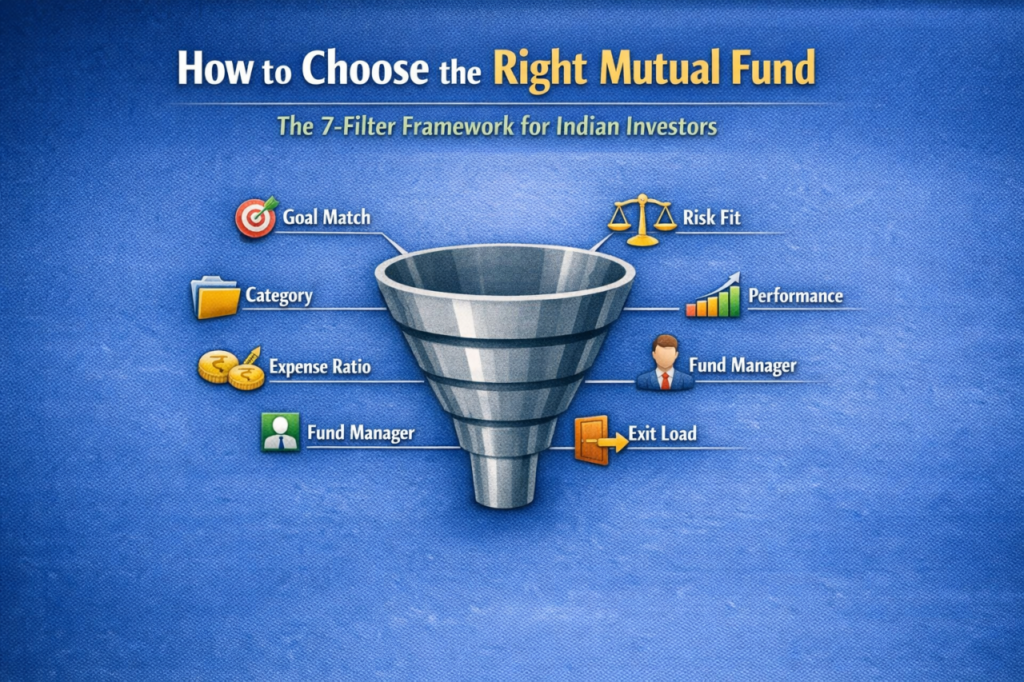
In this post, I’ll share the 7-Filter Framework that I personally use — the same methodology that SEBI-registered advisors, professional fund analysts, and sophisticated investors apply. By the end, you’ll be able to evaluate ANY mutual fund yourself, without needing to trust any influencer. You’ll know what to look for, what to ignore, and the 5 red flags that should make you run away.
What Is a Mutual Fund? (The Basics)
A mutual fund is an investment vehicle that pools money from thousands of investors and invests it in a diversified portfolio of stocks, bonds, or other securities, managed by a professional fund manager. When you ‘buy’ a mutual fund, you receive units representing your share of the pool. Each unit’s value (called NAV — Net Asset Value) goes up or down based on the underlying investments.
Here’s the simplest way to understand it:
| Concept | What It Means | Why It Matters |
| AMC (Asset Management Company) | The company managing the fund (HDFC, SBI, ICICI Pru) | Their reputation and process matter |
| Fund Manager | The person making investment decisions | Their experience drives your returns |
| NAV (Net Asset Value) | Price per unit of the fund | Updated daily based on holdings |
| AUM (Assets Under Management) | Total money the fund manages | Indicates fund size & popularity |
| Expense Ratio | Annual fee charged by the fund | Silently eats into your returns |
| Exit Load | Penalty for early withdrawal | Usually 1% if exited within 1 year |
| Category | Type of fund (Equity, Debt, Hybrid) | Determines risk and return profile |
In India, AMFI (Association of Mutual Funds in India) classifies all funds into 36 official categories. Most retail investors only need to understand 6-8 of them. We’ll decode that next.
The 7 Mutual Fund Categories That Matter
Out of 36 official AMFI categories, only these 7 cover 90% of what retail investors need. Here’s the simplified breakdown:
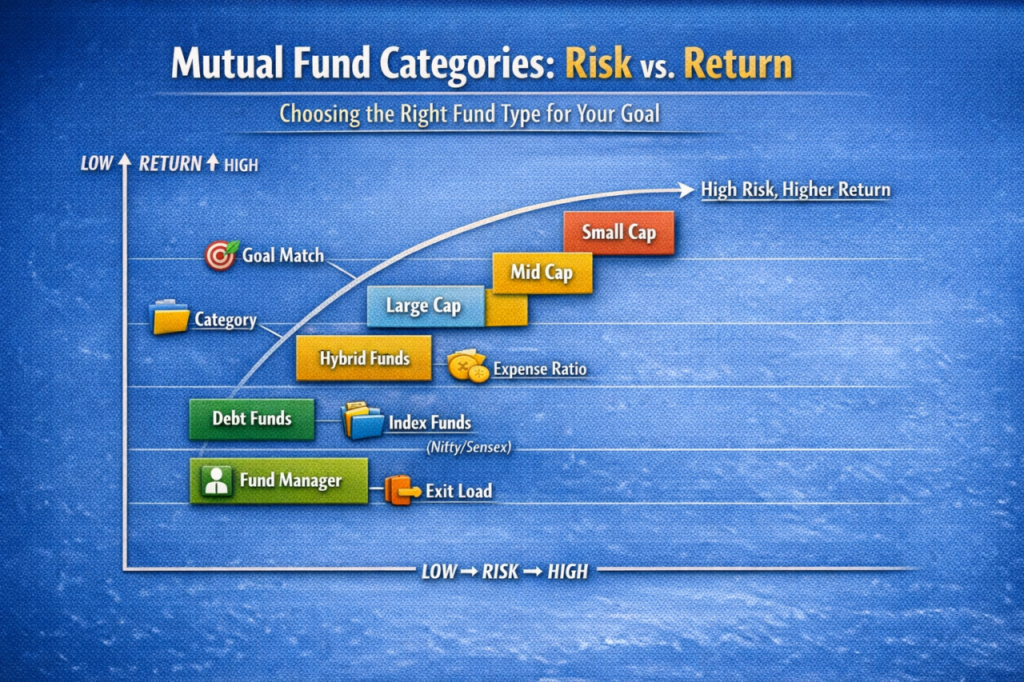
| Category | What It Invests In | Risk | Returns (Historical) | Best For |
| Large Cap Equity | Top 100 companies by market cap | Medium | 11-13% CAGR | Long-term wealth (10+ yrs) |
| Mid Cap Equity | Companies ranked 101-250 | High | 13-16% CAGR | Aggressive long-term (10+ yrs) |
| Small Cap Equity | Companies ranked 251+ | Very High | 15-18% CAGR | Very long-term, high risk |
| Flexi Cap / Multi Cap | Mix of large, mid, small | Medium-High | 12-15% CAGR | Diversified equity exposure |
| Index Funds | Tracks index (Nifty 50, Sensex) | Medium | 11-13% CAGR | Passive investors, low cost |
| ELSS (Tax Saver) | Equity + 80C tax benefit | Medium-High | 12-14% CAGR | Tax saving + wealth (3-yr lock) |
| Debt Funds | Government & corporate bonds | Low-Medium | 6-8% CAGR | Short-term goals (1-3 yrs) |
| Hybrid Funds | Mix of equity + debt | Medium | 9-11% CAGR | Balanced approach |
Key insight: Don’t get distracted by exotic categories (Sectoral, Thematic, International, FOF). For 95% of retail investors, picking from the 7 above is more than enough. The categories you avoid matter as much as the ones you choose.
The 7-Filter Framework (The Core Methodology)
Now here’s the actual framework. Apply these 7 filters in order. By the end, you’ll have 1-3 funds that genuinely fit YOUR situation — not some random ‘top performer’ list.
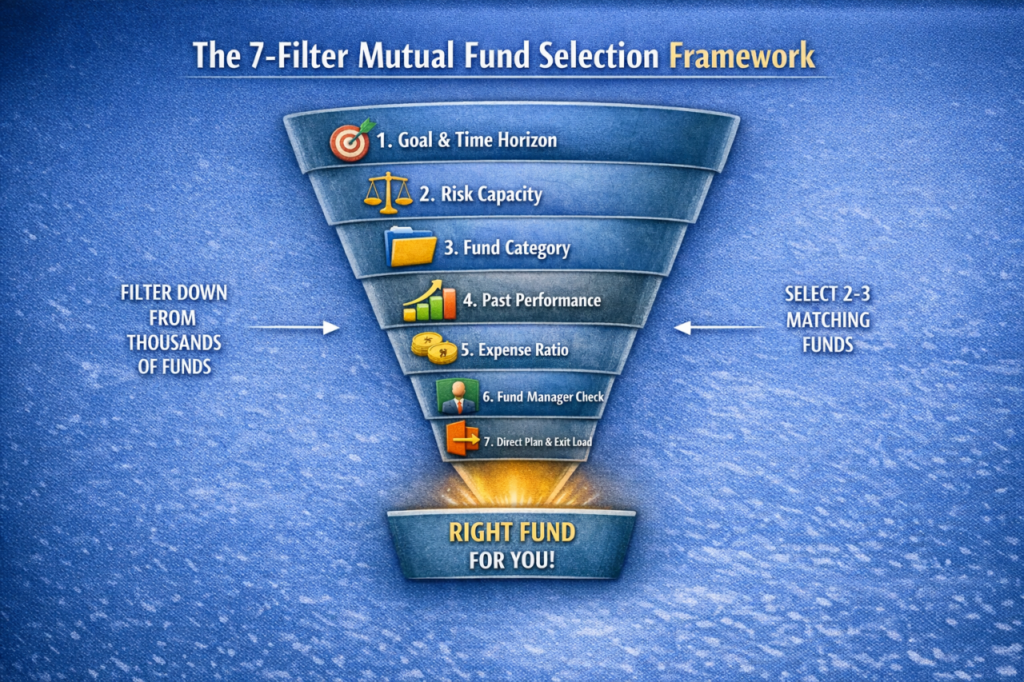
Filter 1: Match to Your Goal & Time Horizon
Your goal’s time horizon determines the fund category. This is non-negotiable.
| Your Goal | Time Horizon | Recommended Category |
| Emergency fund | 0-1 year | Liquid Fund / Ultra Short Debt |
| Vacation, gadgets | 1-3 years | Debt Fund / Conservative Hybrid |
| Car, down payment | 3-5 years | Hybrid Fund / Aggressive Hybrid |
| House, education | 5-10 years | Large Cap / Flexi Cap |
| Retirement, kids’ future | 10+ years | Large Cap + Mid Cap mix |
| Wealth creation | 15-20+ years | Flexi Cap / Mid Cap |
Common mistake: Putting a 2-year goal money into equity funds. When the market crashes (which it will), you’ll be forced to sell at a loss because your timeline doesn’t allow waiting. Always match category to time horizon.
Filter 2: Match to Your Risk Capacity (Not Preference)
Here’s a critical distinction most people miss: risk capacity ≠ risk preference. Risk preference is what you feel comfortable with. Risk capacity is what you can actually afford to lose without affecting your life. Use this self-assessment:
| Factor | Low Risk Capacity | High Risk Capacity |
| Age | Above 50 | Below 35 |
| Dependents | Family with kids | Single, no dependents |
| Emergency fund | Less than 3 months | 6+ months ready |
| Job stability | Variable income | Stable salary |
| Existing investments | First-time investor | Diversified portfolio |
| Time horizon | Less than 5 years | 10+ years |
If you have 4+ items in ‘Low Risk Capacity’ column, stick to Hybrid Funds or Large Cap Funds. If you have 4+ in ‘High Risk Capacity,’ you can include Mid Cap and Small Cap in your portfolio.
Filter 3: Choose the Right Sub-Category
Once you’ve decided ‘Equity’ or ‘Debt’ at a high level, narrow down further:
For Equity (Long-term goals):
- Beginner / 5-10 years: Large Cap Index Fund or Flexi Cap Fund
- Intermediate / 10+ years: 70% Flexi Cap + 30% Mid Cap
- Advanced / 15+ years: 50% Large Cap + 30% Mid Cap + 20% Small Cap
For Debt (Short-term goals):
- Less than 1 year: Liquid Fund or Overnight Fund
- 1-3 years: Short Duration Fund or Corporate Bond Fund
- 3+ years (debt): Banking & PSU Fund or Medium Duration Fund
Rule of thumb: Beginners should stick to 1-2 funds maximum. More funds doesn’t mean more diversification — it usually means more confusion.
Filter 4: Analyze Past Performance (With Caveats)
Past performance is the most over-relied-upon metric. Here’s how to use it correctly:
| What to Look At | What to IGNORE |
| 5-year and 10-year rolling returns | Last 1-year returns |
| Performance vs benchmark | Absolute return numbers |
| Performance vs category average | Hot last-quarter performers |
| Behavior in 2008 and 2020 crashes | YouTube ‘top 10 funds’ lists |
| Standard deviation (consistency) | One-time outlier returns |
The golden rule: A fund that beat its benchmark by 2% consistently over 10 years is far better than one that beat it by 15% one year and lagged for 4 years. Consistency > Brilliance.
Filter 5: Check the Expense Ratio (Silent Wealth Killer)
Expense ratio is the annual fee charged by the fund. It sounds small (1-2%) but compounds into massive amounts over decades.
| Fund Type | Acceptable Expense Ratio | Premium / Avoid |
| Index Funds | Under 0.30% | Above 0.50% |
| Large Cap Active | 0.50% – 1.50% | Above 1.75% |
| Mid/Small Cap | 0.70% – 1.75% | Above 2.00% |
| Debt Funds | 0.20% – 1.00% | Above 1.25% |
| ELSS Funds | 0.80% – 1.75% | Above 2.00% |
The math that shocks people:
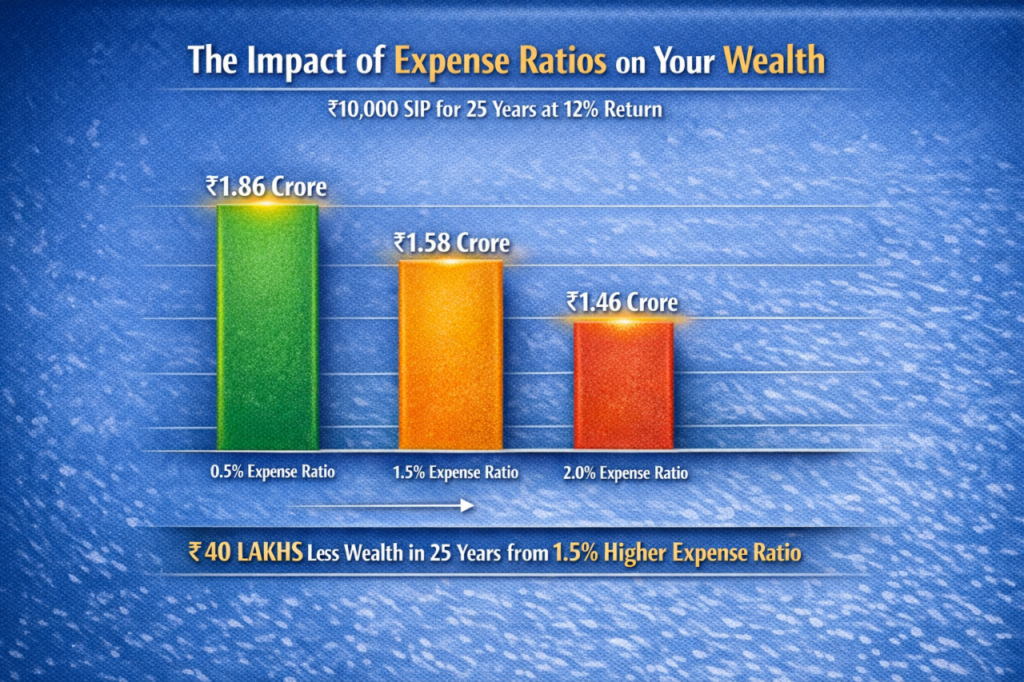
₹10,000 SIP for 25 years at 12% pre-expense return:
- At 0.5% expense ratio → Final corpus: ₹1.86 Crores
- At 1.5% expense ratio → Final corpus: ₹1.58 Crores
- At 2.0% expense ratio → Final corpus: ₹1.46 Crores
The difference between 0.5% and 2.0% expense ratio = ₹40 LAKHS less in your pocket over 25 years.
Filter 6: Evaluate the Fund Manager & AUM
The fund manager is the human making decisions with your money. Here’s what to check:
| Metric | What’s Good | What’s Bad |
| Fund Manager Tenure | Same manager for 5+ years | Frequent changes |
| Fund Manager Experience | 10+ years in industry | Newcomer with no track record |
| AUM (Assets Under Management) | ₹500 Cr to ₹50,000 Cr | <₹100 Cr or >₹75,000 Cr |
| Fund House Reputation | Established AMC (HDFC, ICICI, SBI, Mirae, Axis) | Unknown / new AMC |
| Other Funds Managed | Specialist in one category | Manages 8+ funds (focus issue) |
Critical insight: Small Cap funds with AUM above ₹15,000 Cr struggle to maintain returns because they can’t enter/exit small stocks without moving prices. For Small Cap, prefer ₹3,000-₹10,000 Cr AUM range.
Filter 7: Choose Direct Plan + Check Exit Load
This single filter can save you ₹10+ lakhs over 25 years. Here’s why:
Direct vs Regular Plans:
| Aspect | Regular Plan | Direct Plan |
| Distribution | Through brokers/advisors | Direct from AMC |
| Expense Ratio | 0.5%-1.5% HIGHER | Lower (no commission) |
| Returns | Lower (commission eats returns) | Higher (no middleman) |
| How to Access | Banks, distributors | Groww, Zerodha Coin, Kuvera |
| Best For | If you need advisor handholding | DIY investors |
Difference in real money:
- ₹10,000 SIP for 25 years at 12% net returns:
- Regular Plan (11% after commissions) → ₹1.55 Crores
- Direct Plan (12% no commission) → ₹1.86 Crores
- Extra wealth from Direct Plan = ₹31 LAKHS
Exit Load: Most equity funds charge 1% if you exit within 1 year. Always check this before investing. For ELSS, there’s a mandatory 3-year lock-in.
Direct vs Regular Plans: The ₹31 Lakh Decision
This deserves its own section because it’s the single biggest decision impact most retail investors miss. Here’s a side-by-side over different investment horizons:
| Investment | Time | Regular Plan | Direct Plan | Extra via Direct |
| ₹5,000 SIP | 10 yrs | ₹11.6 Lakhs | ₹12.3 Lakhs | +₹70,000 |
| ₹5,000 SIP | 20 yrs | ₹47.8 Lakhs | ₹54.2 Lakhs | +₹6.4 Lakhs |
| ₹10,000 SIP | 25 yrs | ₹1.55 Cr | ₹1.86 Cr | +₹31 Lakhs |
| ₹15,000 SIP | 30 yrs | ₹3.51 Cr | ₹4.41 Cr | +₹90 Lakhs |
Where to invest in Direct Plans:
- Groww — Easiest for beginners, free Direct funds
- Zerodha Coin — Most popular among DIY investors
- Kuvera — Advanced features, goal-based planning
- AMC websites — Direct from HDFC, ICICI, SBI, etc.
- MF Central — Government-backed, all AMCs in one place
When Regular Plan might be okay:
- You genuinely need personalized advice and willing to pay for it
- You don’t have time/interest to research yourself
- The commission saves you from bigger mistakes you’d make alone
For 95% of educated retail investors reading this post — Direct Plan is the clear winner.
5 Red Flags to AVOID (Funds You Should Never Buy)
Now let’s flip the coin. Here are 5 patterns that should make you immediately reject a fund:
Red Flag 1: Star Rating-Chasing
Funds that ranked #1 last year rarely repeat. SEBI’s own studies show 80% of last year’s top funds underperform in the next 3 years. Don’t chase yesterday’s winners.
Red Flag 2: Sectoral / Thematic Funds for Beginners
Pharma Fund, IT Fund, EV Fund — these are concentrated bets on single sectors. They can fall 40% in months. Diversified funds (Large Cap, Flexi Cap) are far safer for first 5 years of investing.
Red Flag 3: New Fund Offers (NFOs)
AMCs aggressively market NFOs claiming ‘new theme!’ or ‘first mover advantage!’ — but NFOs have no track record. Wait 3-5 years to see real performance before considering them.
Red Flag 4: Very High Expense Ratios (>2%)
Some active funds charge 2.25%-2.5% expense ratios. Over 20 years, this destroys returns. If a fund has >2% expense ratio AND doesn’t consistently beat benchmark, walk away.
Red Flag 5: Funds Selling Through WhatsApp / Telegram Tips
If you got fund recommendations on WhatsApp finance groups, Telegram channels, or ‘stock tips’ services — be extremely cautious. Many are paid promotions. Check SEBI registration of the recommender first.
How to Read a Mutual Fund Factsheet
Every AMC publishes a monthly ‘factsheet’ — a 1-page summary of the fund. Most investors never read it. Here’s what to look at:
| Section in Factsheet | What to Check | Why It Matters |
| Investment Objective | What the fund aims to do | Match to your goal |
| Asset Allocation | % Equity / Debt / Cash | Verify category claim |
| Top 10 Holdings | Stocks/bonds it holds | Check diversification |
| Sector Allocation | Which sectors dominate | Avoid concentration |
| Returns (1Y, 3Y, 5Y, 10Y) | Multi-year performance | Long-term consistency |
| Benchmark Comparison | Beats or lags benchmark? | Manager skill check |
| Standard Deviation | Volatility measure | Lower = more consistent |
| Sharpe Ratio | Risk-adjusted return | Higher is better |
| Portfolio Turnover | How often manager trades | Lower = more conviction |
| Expense Ratio (Direct) | Annual fee | Lower the better |
Where to find factsheets:
- AMC website (HDFC, ICICI Pru, SBI, etc.)
- Value Research Online (free for most funds)
- Morningstar India
- Groww / Zerodha Coin (fund detail page)
Real-Life Application: Priya’s Framework Decision
Remember Priya from SIP vs Lump Sum? Her ₹8 lakh bonus needed a fund decision after she chose STP. Let’s see how she applied the 7-Filter Framework:
Her Profile:
- Age 32, Software Developer, Bangalore
- Monthly Salary ₹1.5L, no dependents
- Emergency fund: 8 months ready
- Risk Capacity: HIGH
- Goal: Wealth creation, 15+ years
- Time Horizon: Long
Her 7-Filter Application:
| Filter | Decision | Reasoning |
| 1. Goal-Time | Equity, 15+ years | Long-term wealth |
| 2. Risk Capacity | Aggressive | Young, high income, no dependents |
| 3. Sub-Category | 60% Flexi Cap + 40% Mid Cap | Aggressive but diversified |
| 4. Past Performance | 10-yr consistent beating benchmark | Avoided 1-year wonders |
| 5. Expense Ratio | Below 1.5% active, below 0.30% index | Long-term compounding focus |
| 6. Fund Manager | 7+ years tenure, AUM ₹5K-25K Cr | Stability + nimbleness |
| 7. Plan Type | Direct (via Groww) | Saves ₹6+ Lakhs over 20 yrs |
Her Final Portfolio (illustrative — based on framework, not recommendation):
- 50% in a well-rated Flexi Cap Direct Fund
- 30% in a Large & Mid Cap Direct Fund
- 20% in a Nifty 50 Index Direct Fund
Why this worked: She didn’t pick ‘the best’ fund. She picked funds that fit HER situation. After 18 months, her ₹8L had grown to ₹9.4L. More importantly, she didn’t panic during a 12% market correction because her funds matched her conviction.
3 Mistakes That Destroy 80% of Investors’ Returns
Mistake 1: Owning Too Many Funds
Average retail investor owns 8-12 mutual funds. Why? They keep adding ‘top fund’ lists. Result: portfolio overlap, hard to track, no real diversification. Optimal: 2-4 funds across categories.
Mistake 2: Switching Funds Every Year
Each switch triggers exit load + tax + breaks compounding. Studies show ‘fund hoppers’ earn 4-5% less annually than ‘fund stickers.’ Once you’ve applied the 7-Filter Framework, stay with the fund for 5-10 years minimum.
Mistake 3: Reviewing Too Often
Checking your portfolio daily induces emotional trading. SEBI’s behavior research shows daily checkers earn 3% less per year than quarterly checkers. Recommended review frequency: Once every 6 months.
Frequently Asked Questions
Q: Should I invest in active funds or index funds?
A: For most retail investors in India, a mix of both works best. Allocate 60-70% to a Flexi Cap or Large Cap active fund, and 30-40% to a Nifty 50 Index fund. Index funds give you guaranteed market returns at ultra-low expense (0.1-0.3%); active funds give a chance to beat the market. Pure passive (100% index) is great if you want simplicity.
Q: How many mutual funds should I have in my portfolio?
A: For most investors, 2-4 funds is the sweet spot. One Large Cap or Flexi Cap (core holding), one Mid Cap (growth), and optionally one Index fund (passive) or one Debt fund (stability). Owning 8+ funds creates portfolio overlap without adding diversification benefit.
Q: Is it safe to invest in mutual funds in India?
A: Yes, mutual funds in India are regulated by SEBI (Securities and Exchange Board of India) and are among the safest investment vehicles. Your money is held by independent custodians, not the AMC. However, ‘safe to invest’ doesn’t mean ‘guaranteed returns’ — equity funds can lose value short-term, but historically they outperform inflation and other asset classes over 10+ years.
Q: What is the difference between Direct and Regular mutual funds?
A: Direct plans are sold directly by the AMC (no intermediary), while Regular plans involve a distributor/broker who earns commission. Direct plans have lower expense ratios (0.5-1.5% lower), which translates to ₹10-30+ lakhs more wealth over 20-25 years. For DIY investors, Direct is almost always better.
Q: How do I check past performance of a mutual fund?
A: Use AMFI India website (official source), Value Research Online, Morningstar India, or platforms like Groww/Zerodha Coin. Always look at 5-year and 10-year rolling returns, comparison with benchmark and category average, and behavior during 2008 and 2020 market crashes. Ignore 1-year returns — they’re noisy.
Q: What is expense ratio and why does it matter?
A: Expense ratio is the annual fee charged by a fund for managing your money. It’s deducted from the fund’s NAV daily, so you don’t see it as a separate charge — but it compounds. The difference between 0.5% and 2.0% expense ratio is ~₹40 lakhs over 25 years on a ₹10,000 SIP. Always choose Direct Plans for lower expense ratios.
Q: Should I invest in NFOs (New Fund Offers)?
A: Generally no, especially as a beginner. NFOs have no track record, no historical data to evaluate, and AMCs aggressively market them. Wait 3-5 years to see real performance before considering. Established funds with 5-10 year track records are almost always better choices.
Q: How often should I review my mutual fund portfolio?
A: Every 6 months is ideal. Quarterly is acceptable. Daily or weekly review leads to emotional decisions and underperformance. During a 6-month review, check: (1) Is the fund still matching its mandate? (2) Has the fund manager changed? (3) Has expense ratio increased? (4) Is the fund still in line with your goal? Don’t switch unless 2+ red flags exist.
Related Articles You Need to Know Before Investing
- The 50-30-20 Rule — The Simplest Budgeting Framework That Actually Works
- Emergency Funds — How Much You Really Need and Where to Keep It
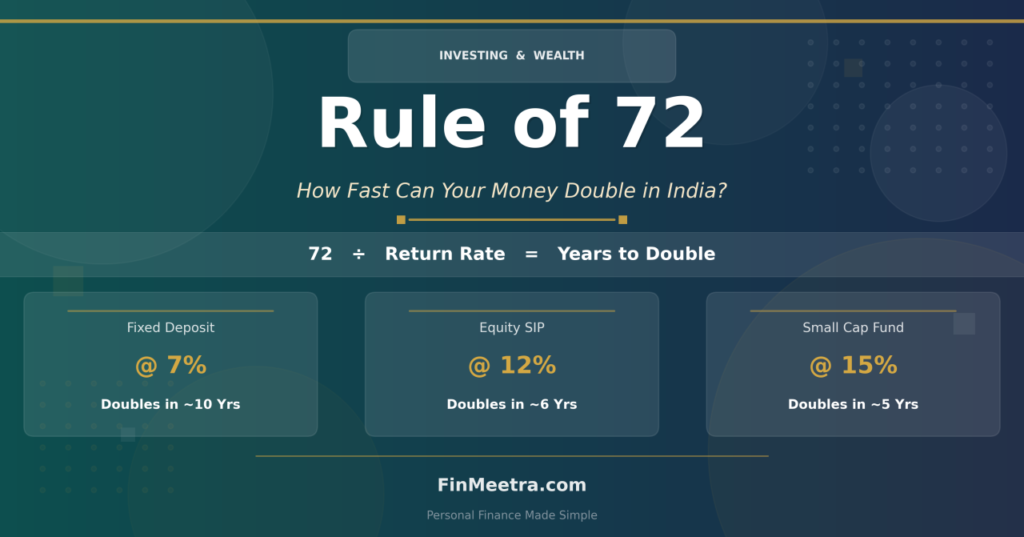
- The Rule of 72 — The Mental Math Shortcut Every Investor Should Know
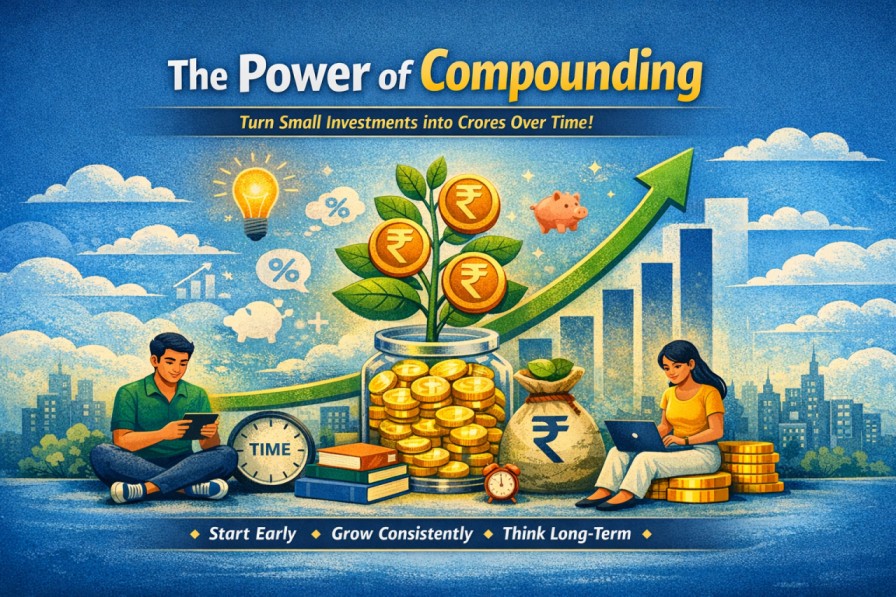
- The Power of Compounding — How ₹5,000/Month Grows into ₹1.76 Crores
- How to Start Your First SIP in India — Complete Beginner’s Guide (2026)
- SIP vs Lump Sum — Which Investment Strategy Actually Wins?
Key Takeaways
- ✅ There’s no ‘best’ mutual fund — there’s only ‘right fund for YOUR situation.’ Stop chasing YouTube fund picks.
- ✅ The 7-Filter Framework filters down thousands of funds to 2-4 that genuinely fit your goal, risk, and time horizon.
- ✅ Match category to time horizon — Equity for 5+ years, Hybrid for 3-5 years, Debt for less than 3 years.
- ✅ Expense ratio matters more than you think — 1.5% difference = ₹30+ lakhs less wealth over 25 years.
- ✅ Direct plans are almost always better than Regular plans for DIY investors. Save lakhs over decades.
- ✅ 2-4 funds is optimal — owning 8+ funds creates overlap without diversification.
- ✅ Ignore 1-year returns — they’re noise. Focus on 5-year and 10-year rolling returns.
- ✅ Avoid 5 red flags: Star-rating chasing, NFOs, Sectoral funds for beginners, >2% expense ratios, WhatsApp tip funds.
- ✅ Review every 6 months, not daily — daily checking leads to emotional decisions.
- ✅ The framework gives you confidence — once you apply it, you can evaluate ANY fund yourself.

Pingback: Index Funds vs Active Funds: Which Wins for Indian's 2026? | FinMeetra