
(The salary slip decoding guide every Indian employee should read before accepting an offer, planning EMIs, choosing tax regime or celebrating a CTC hike.)
Quick Answer
Hidden salary deductions are the salary components that reduce your real in-hand income even though your CTC looks attractive. In India, these usually include income tax, employee PF, professional tax, employer PF included in CTC, gratuity accrual, insurance premiums, variable pay, bonus uncertainty, notice-period recoveries, meal cards, transport deductions and other company-specific benefits.
The dangerous part is not that these deductions exist. Many are useful. PF builds retirement money. Gratuity rewards long service. Insurance protects you. Tax funds government services. The problem is that most employees compare jobs using CTC, while their real life runs on monthly bank credit.
That gap is where confusion begins. Your offer letter says one thing. Your salary slip says another. Your bank account says the truth.
Rahul Thought He Got a Great Salary. Then His First Payslip Arrived.
Rahul switched jobs in Hyderabad. His old CTC was ₹14 LPA. The new company offered ₹20 LPA. On paper, it looked like a huge jump. He mentally converted it into ₹1.67 lakh per month and started planning life around that number.
A better apartment. A car upgrade. Bigger SIPs. Maybe even a foreign trip next year. The offer looked like the moment his money stress would finally end.
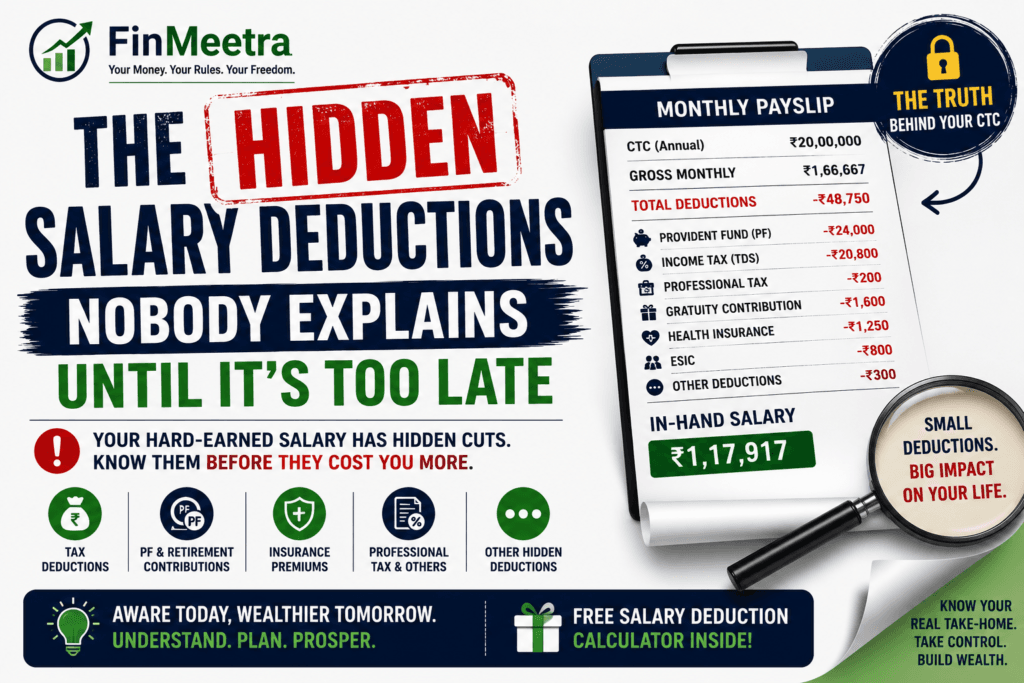
Then the first salary hit his bank account. It was not ₹1.67 lakh. It was not even close. After variable pay, PF, tax, professional tax and other deductions, the actual monthly credit felt much smaller than the excitement in the offer letter.
Rahul was not cheated. He simply misunderstood the game. CTC is not salary. CTC is the employer’s cost. Your life does not run on CTC. Your life runs on cash flow.
If this already sounds familiar, it connects directly to FinMeetra’s 20 LPA Salary Reality, where we showed why a high salary can still feel tight when fixed costs and savings rate are weak.
The CTC Illusion: Why Your Salary Looks Bigger Than It Feels
CTC means Cost to Company. It is not the amount you receive. It includes several items that may not enter your bank account every month. Some are benefits. Some are statutory deductions. Some are future payouts. Some are conditional. Some are pure accounting entries.
| CTC Component | Does It Come Monthly? | What Employees Usually Miss |
| Basic Pay | Yes | Forms base for PF, gratuity and HRA calculations |
| HRA | Yes | Can help tax under old regime if rent conditions are met |
| Special Allowance | Yes | Usually fully taxable |
| Employee PF | No, deducted | Your contribution to EPF, reduces take-home |
| Employer PF | No monthly cash | Often included in CTC as employer cost |
| Gratuity | No immediate cash | Usually payable after eligibility conditions |
| Variable Pay | Maybe | Performance/company dependent, not guaranteed monthly cash |
| Insurance Benefits | No cash | Useful benefit but still part of employer cost in many CTCs |
| Professional Tax | Deducted | State-level tax, usually small but visible monthly |
| Income Tax/TDS | Deducted | Largest deduction for many salaried employees |
This is why two people with the same ₹20 LPA CTC can receive different take-home salaries. Their basic pay, HRA, variable pay, PF policy, benefits, city, tax regime and declarations can all differ.
Before accepting an offer based only on the headline number, read FinMeetra’s Salary Hike Trap. A raise that looks big can still fail if most of the increase disappears into taxes, EMIs and lifestyle upgrades.
Deduction #1: Income Tax and TDS – The Biggest Visible Cut
For many salaried employees, tax is the largest deduction. Your employer deducts TDS based on your salary structure, declared investments, selected tax regime and projected annual income.
For AY 2026-27, salaried individuals continue to compare old and new tax regimes. The new regime generally offers lower rates with limited deductions, while the old regime allows deductions and exemptions such as HRA, 80C, 80D and others. The standard deduction is ₹75,000 under the new regime and ₹50,000 under the old regime for salaried taxpayers.
| Tax Regime | What It Usually Means | Best For |
| New Regime | Lower rates, fewer deductions, default regime | People with limited deductions or simple tax profile |
| Old Regime | Higher rates, but deductions/exemptions allowed | People with HRA, 80C, 80D, NPS, home loan deductions |
| Wrong Choice | Can reduce monthly salary unnecessarily | Anyone who blindly selects without calculating |
Do not guess your tax regime. Use FinMeetra’s Old vs New Tax Regime Calculator before finalizing declarations, especially if you have rent, ELSS, NPS, insurance premiums or home loan interest.
If you are investing only at year-end to save tax, also read Rs.3 Lakh Tax Saving Mistake. It explains why random tax-saving investments can hurt long-term wealth.
Deduction #2: Employee PF – Not Lost Money, But Locked Money
Employee PF is often misunderstood. It reduces your monthly take-home, but it is not a waste. It is forced long-term savings. Under the EPF framework, employee and employer contributions are commonly linked to 12% of basic salary plus dearness allowance, subject to rules, wage ceiling and employer policy.
The issue is psychological. Employees compare CTC with monthly bank credit and feel money is missing. But some of that missing money is actually sitting in retirement-linked accounts.
| PF Item | Impact on You | Hidden Truth |
| Employee PF | Reduces in-hand salary | Your own retirement contribution |
| Employer PF | Often included in CTC | Employer cost, not monthly cash |
| EPS Portion | Part of employer contribution may go to pension scheme | Not visible like bank salary |
| Voluntary PF | Further reduces take-home | Useful only if liquidity is comfortable |
PF is a compounding machine, but it should not be your only wealth plan. To understand why long-term growth matters, read FinMeetra’s Power of Compounding.
For retirement planning, compare your PF with your bigger requirement using How Much Money Need to Retire in India. Many employees overestimate what PF alone can do.
Deduction #3: Employer PF Included in CTC – The Silent Offer Letter Padding
This is one of the biggest reasons CTC looks better than take-home. Employer PF is a real benefit, but it is not monthly cash. When it is included in CTC, your headline salary rises while your bank credit does not rise by the same amount.
Example: If your offer increases from ₹18 LPA to ₹22 LPA, but a large part is variable pay, employer PF, gratuity and benefits, your monthly take-home may not improve as much as your mind expects.
| Offer Item | Looks Like Salary? | Reality |
| Employer PF | Yes in CTC | Benefit, not bank credit |
| Gratuity | Yes in CTC | Future payout subject to eligibility |
| Insurance premium | Yes in CTC sometimes | Protection benefit, not cash |
| Variable bonus | Yes in CTC | May be delayed, reduced or missed |
This is exactly why FinMeetra created the Salary Hike Trap article. A bigger headline CTC does not automatically create bigger freedom.
Deduction #4: Gratuity – Yours, But Not Yet
Gratuity is another component that confuses employees. It may appear inside CTC, but it is not monthly salary. Under the Payment of Gratuity Act, gratuity is generally calculated based on fifteen days’ wages for every completed year of service or part over six months, subject to eligibility and conditions.
Gratuity is valuable if you stay long enough. But if you are evaluating an offer for monthly cash flow, do not treat gratuity as take-home salary.
| Component | Employee Mistake | Correct View |
| Gratuity in CTC | Assuming it is part of monthly income | Future benefit, not monthly cash |
| Short job tenure | Ignoring eligibility risk | May not be received if you exit early |
| Higher basic pay | Only seeing lower take-home | Can improve gratuity and PF base |
A lower take-home salary is not always bad if benefits are strong. But you must know what is cash today and what is benefit tomorrow.
Deduction #5: Professional Tax – Small, But Still a Deduction
Professional tax is a state-level tax. It varies by state and is capped nationally at ₹2,500 per year under the constitutional framework. In many states, it appears as a small monthly deduction. Employees often ignore it because the amount is small, but it still explains part of the CTC-to-bank gap.
This is not the deduction that destroys wealth. But when employees are confused, every unexplained deduction creates mistrust. A good salary slip should make every rupee visible.
Deduction #6: Variable Pay – The Salary You Mentally Spend Before Receiving
Variable pay is where many employees make expensive mistakes. An offer letter may say ₹25 LPA, but ₹4 LPA could be variable. That means your fixed pay may be much lower than the headline number.
| Variable Pay % | Risk Level | What to Ask HR |
| 0%-10% | Low to moderate | Ask payout cycle and eligibility |
| 10%-20% | Moderate | Ask last 3-year average payout |
| 20%+ | High | Do not compare this with fully fixed offer |
| Joining bonus with clawback | Conditional | Check repayment clause if you resign early |
Never build EMIs around variable pay. Build EMIs around fixed monthly take-home. Treat variable pay as bonus for debt reduction, emergency fund, SIP top-up or annual goals.
If you are planning loans after a job switch, use FinMeetra’s EMI Calculator first. One wrong EMI can eat several future salary hikes.
Deduction #7: Insurance, Meal Cards, Transport, Benefits and Other Company Deductions
Some deductions are not bad. Group insurance, meal cards, transport benefits, company assets, wellness benefits and reimbursements can be useful. The problem is when employees treat all benefits as cash salary.
A ₹1 lakh annual insurance benefit is not the same as ₹1 lakh extra bank salary. A meal card is useful, but not the same as unrestricted cash. A cab benefit saves commuting cost, but it does not pay your rent.
| Benefit | Useful? | Cash Flow Warning |
| Group health insurance | Yes | Check coverage amount, parents inclusion and co-pay |
| Meal card | Yes | Limited use, not free cash |
| Transport/cab | Depends | Useful only if you would otherwise spend on commute |
| Laptop/phone benefit | Depends | May not improve monthly surplus |
| Insurance as investment | Often risky | Do not confuse tax saving with wealth creation |
For tax-saving choices, compare options using FinMeetra’s PPF vs ELSS vs NPS Calculator instead of buying products only because someone said they save tax.
If you are investing through regular plans or bank channels, check FinMeetra’s Direct vs Regular Mutual Fund article to understand how small hidden costs can become large long-term losses.
The Salary Deduction Decoder Calculator
Before reading further, decode your own salary. Enter your CTC, basic pay, variable pay, PF settings, tax regime estimate, professional tax and benefit deductions. The calculator will show your estimated monthly take-home, hidden deduction ratio and the real gap between CTC and bank credit.
Salary Deduction Decoder
Decode CTC, PF, tax, variable pay, gratuity and real take-home
CTC is not salary
CTC includes employer cost, benefits and future payouts. Bank credit is what runs your life.
Some deductions help
PF and gratuity can build long-term wealth, but they reduce monthly flexibility.
Variable pay is risky
Never plan EMIs or rent upgrades using uncertain performance bonus.
What Your Calculator Result Means
| Hidden Deduction Ratio | Meaning | Action |
| Below 20% | Clean structure | Still verify tax and variable pay |
| 20%-35% | Normal for many salaried employees | Understand each deduction before planning EMIs |
| 35%-45% | High deduction load | Check variable pay, PF, gratuity and benefit padding |
| Above 45% | CTC illusion zone | Negotiate fixed pay or reconsider offer structure |
The goal is not to eliminate every deduction. The goal is to understand which deductions build your future and which deductions only reduce your flexibility.
Rahul’s Salary Slip: Before and After Understanding Deductions
| Metric | Before Understanding | After Understanding |
| CTC | ₹20 LPA | ₹20 LPA |
| Expected monthly income | ₹1.67 lakh | No longer uses CTC/month |
| Actual bank credit | ₹1.18 lakh | ₹1.18 lakh |
| Variable pay treatment | Assumed guaranteed | Treated as annual bonus only |
| PF and gratuity | Felt like loss | Understood as long-term benefit |
| EMI decision | Planned car upgrade | Postponed until fixed cash improves |
| Monthly SIP | ₹10,000 | ₹25,000 after leak cleanup |
Rahul did not suddenly earn more. He simply stopped making decisions based on imaginary money. That alone changed his financial behavior.
If your salary feels strong but your wealth is not growing, revisit FinMeetra’s 20 LPA Salary Reality guide after using this calculator.
The 5-Step Salary Slip Audit Every Employee Should Do
Step 1: Separate CTC, Gross Salary and Net Salary
CTC is employer cost. Gross salary is earnings before deductions. Net salary is what reaches your bank. Never mix these three.
Step 2: Mark Every Deduction as Cash Loss or Future Benefit
Tax and professional tax are cash outflows. Employee PF is locked saving. Employer PF and gratuity are benefits. Variable pay is uncertain cash. This classification removes confusion.
Step 3: Calculate Fixed Monthly Take-Home
Ignore variable pay while planning EMIs and monthly expenses. Your fixed take-home should carry your life.
Step 4: Check Savings Rate After Real Take-Home
A person with ₹1.2 lakh take-home and ₹10,000 SIP has an 8.3% investment rate. That is weak for long-term financial freedom.
If you do not know how to structure monthly money, start with FinMeetra’s Monthly Budget Rule of 50-30-20. It gives a simple budget framework for salaried employees.
Step 5: Convert Every Future Raise into Investments First
If your CTC increases but your SIP stays the same, your future is not improving enough. Every salary hike should first increase investments, then lifestyle.
For this, combine FinMeetra’s How to Start Your First SIP with the
Step-Up SIP Calculator. This shows how increasing SIP with salary can multiply long-term wealth.
Salary Deduction Mistakes That Cost Employees Lakhs
| Mistake | Why It Hurts | Better Move |
| Comparing only CTC | Ignores variable and benefits | Compare fixed take-home |
| Ignoring tax regime | Can overpay tax | Use tax calculator before declarations |
| Treating variable as monthly income | Creates EMI risk | Use variable for goals, not fixed commitments |
| Seeing PF as waste | Undervalues retirement savings | Include PF in net worth tracking |
| Buying insurance for deduction only | Low returns and wrong protection | Separate protection and investment |
| No emergency fund | Salary delay becomes crisis | Build 3-6 months buffer |
Before aggressive investing, build your safety net using FinMeetra’s Complete Emergency Fund Guide. A high salary without cash reserve is fragile.
The 30-Day Salary Deduction Cleanup Plan
| Day | Action | Outcome |
| Day 1 | Download last 3 salary slips | Find recurring deductions |
| Day 3 | Separate CTC, gross and net salary | Know your real monthly income |
| Day 5 | Check variable pay percentage | Avoid planning life around uncertain money |
| Day 7 | Review tax regime and deductions | Prevent avoidable tax leakage |
| Day 10 | Calculate PF and gratuity benefits | Track future benefits correctly |
| Day 15 | Audit EMIs against fixed take-home | Protect monthly cash flow |
| Day 20 | Increase SIP or emergency fund from leak savings | Turn clarity into action |
| Day 30 | Create monthly salary dashboard | Monitor salary, savings and net worth |
Once deductions are clear, use the SIP Calculator to decide how much of your real take-home can be invested monthly.
Then check your larger goal using FinMeetra’s When Will You Become Financially Free guide.
Key Takeaways
✅ CTC is not salary. Your life runs on net monthly bank credit.
✅ Hidden deductions are not always bad, but they must be understood.
✅ Employee PF reduces take-home but builds long-term savings.
✅ Employer PF, gratuity and insurance can inflate CTC without increasing monthly cash.
✅ Variable pay should never be used for EMI planning.
✅ Tax regime selection can materially change take-home salary.
✅ A clean salary structure is one where cash, benefits and future payouts are clearly separated.
✅ The best employees do not just negotiate CTC. They negotiate fixed pay, clarity and flexibility.
Frequently Asked Questions
Q: Why is my in-hand salary lower than my CTC?
A: CTC includes employer costs and future/conditional benefits such as employer PF, gratuity, insurance and variable pay. In-hand salary is what remains after employee deductions, tax and other recoveries.
Q: Is PF a hidden deduction or saving?
A: Employee PF reduces monthly take-home but is not lost money. It is retirement-linked savings. Employer PF may be included in CTC but does not come as monthly bank credit.
Q: Is gratuity part of salary?
A: Gratuity can be included in CTC by employers, but it is usually not monthly salary. It is a future benefit subject to eligibility and calculation rules.
Q: What is the biggest hidden salary deduction?
A: For many employees, income tax/TDS is the biggest visible deduction. But from a CTC illusion perspective, variable pay, employer PF and gratuity often create the biggest expectation gap.
Q: Should I prefer higher basic or lower basic?
A: Higher basic can improve PF and gratuity but may reduce take-home. Lower basic can increase cash today but weaken benefits. The right answer depends on your liquidity, tax regime, job tenure and goals.
Q: Is professional tax applicable everywhere?
A: No. Professional tax is state-specific and rates vary by state, subject to the national cap. Check your state rules or salary slip.
Q: Should I compare job offers using CTC?
A: No. Compare fixed pay, monthly take-home, variable risk, PF, gratuity, insurance, notice buyout, joining bonus and location costs.
Q: Why does variable pay make salary confusing?
A: Because it increases CTC but may not come monthly or fully. It depends on company performance, individual performance and payout policy.
Q: Can salary deductions affect financial freedom?
A: Yes. If deductions and fixed commitments reduce your savings rate, your financial freedom age gets pushed further away.
Q: What should I do after decoding my salary?
A: Build an emergency fund, optimize tax regime, keep EMIs under control and invest a fixed percentage of take-home through SIP or other goal-based investments.
Related Articles You Should Read Next
• 20 LPA Salary Reality – Understand why high salary can still feel tight.
• Salary Hike Trap – See why a raise does not automatically fix money problems.
• Old vs New Tax Regime Calculator – Choose the right tax regime before salary declaration.
• Rs.3 Lakh Tax Saving Mistake – Avoid tax-saving products that do not fit your goals.
• Complete Emergency Fund Guide – Build your safety buffer before increasing risk.
• SIP Calculator – Calculate how much monthly investing can build over time.
• Step-Up SIP Calculator – Increase investments as salary grows.
• EMI Calculator – See how loans affect your monthly freedom.
• When Will You Become Financially Free – Connect salary clarity to financial freedom.
• How Much Money Need to Retire in India – Understand your bigger retirement target.
Useful External Resources
• Income Tax India – Salaried Individuals AY 2026-27
• EPFO – Employees Pension Scheme
📩 ENJOYED THIS BLOG? HERE IS WHAT YOU CAN DO NEXT:
💬 Leave a Comment – Which salary deduction surprised you the most?
📧 Subscribe to FinMeetra Newsletter – Real data-backed salary, tax and wealth insights every week.
🧮 Use the Salary Deduction Decoder – Find your real CTC-to-bank-credit gap in 60 seconds.
Disclaimer: This blog is for educational and informational purposes only. It does not constitute financial advice, tax advice, legal advice, investment recommendation or employment advice. Salary structures, tax deductions, PF, gratuity, professional tax and company policies may vary based on employer, state, salary structure, tax regime and applicable laws. Please consult a qualified tax professional, HR/payroll expert or financial advisor before making major salary, tax or job-switching decisions.
© 2026 FinMeetra.com | All Rights Reserved



Pingback: How to Stop High TDS from Reducing Your Monthly Take-Home Salary