

When Will You Become Financially Free? Rahul is 32, earns ₹18 lakh a year, lives in Hyderabad and looks financially comfortable from the outside. He has a decent job, a bike, a car EMI, a few mutual fund SIPs and a family that depends on his monthly salary. On paper, he is doing better than many people around him. But one question made him silent: if your salary stopped tomorrow, how long could your current life continue?
His answer was four months. Not four years. Not forever. Four months. That is when Rahul realised that a high salary is not the same as financial freedom. A salary gives comfort. Assets give choice. This blog is about that exact bridge: how to move from salary-dependent to financially free using real Indian numbers.
Before Rahul started calculating freedom age, he first checked whether he had a proper cash safety layer. If that foundation is weak, read FinMeetra’s Complete Emergency Fund Guide before increasing risky investments.
What Does Financial Freedom Actually Mean?
Financial freedom does not mean quitting work, sitting on a beach, or becoming a billionaire. For a normal Indian family, financial freedom simply means this: your investments generate enough yearly income to cover your yearly expenses, so your job becomes optional instead of compulsory.
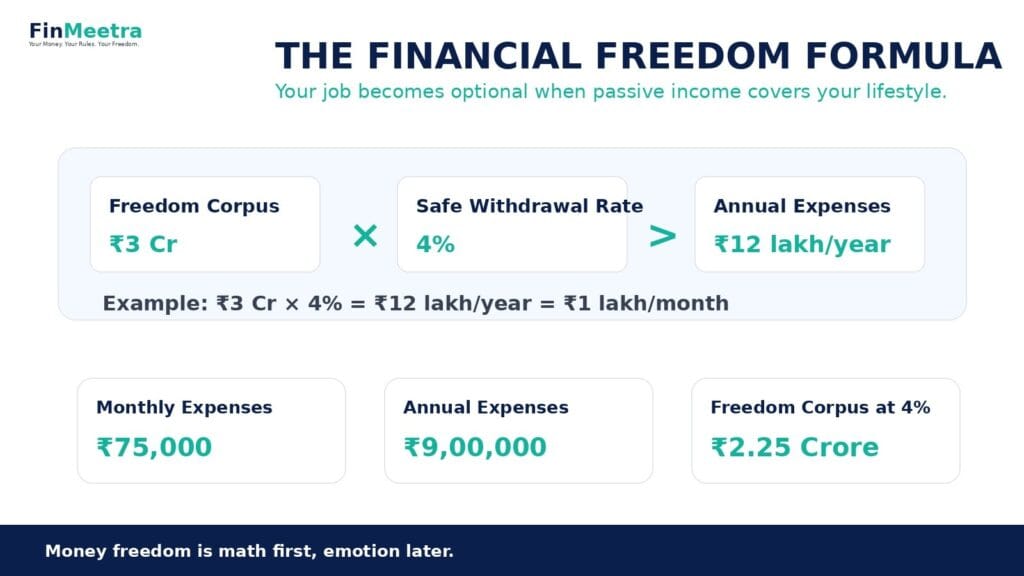
This is where compounding becomes powerful. If you are new to the math of growth, first understand how ₹5,000 per month can become a large corpus through compounding because that same engine powers financial freedom.
Financial Freedom Calculator
Find the age when your salary becomes optional
What is freedom age?
The age when your investment corpus can support your expenses using a 4% withdrawal rule.
Why inflation matters
Today’s expenses become much higher in the future. The calculator grows your expenses every year.
Why step-up matters
Increasing SIP with salary hikes can pull your financial freedom age forward by years.
Next step: strengthen your plan
Use these FinMeetra tools after calculating your freedom age.
The Real Problem: Most People Calculate Salary, Not Freedom
Most salaried people know their CTC, monthly in-hand salary, EMI, rent and SIP amount. But very few know their financial freedom number. That is like driving on a highway without knowing the destination. You may be moving fast, but you don’t know whether you are going in the right direction.
Here is the uncomfortable truth: if your expenses grow at the same speed as your salary, financial freedom keeps moving away from you. Every increment becomes a lifestyle upgrade. Better phone. Bigger rent. Costlier car. More food delivery. One foreign trip. Then another. The bank balance may grow, but the freedom gap may not reduce.
This is exactly why high earners still retire stressed. I explained this in detail in The ₹50 Lakh Trap: Why Most Indians Retire Poor Despite Earning Well where lifestyle inflation silently eats retirement wealth.
How Much Corpus Do You Need for Financial Freedom?
Start with your current monthly expenses. Multiply by 12 to get annual expenses. Then multiply annual expenses by 25. This gives a simple freedom corpus based on today’s lifestyle.
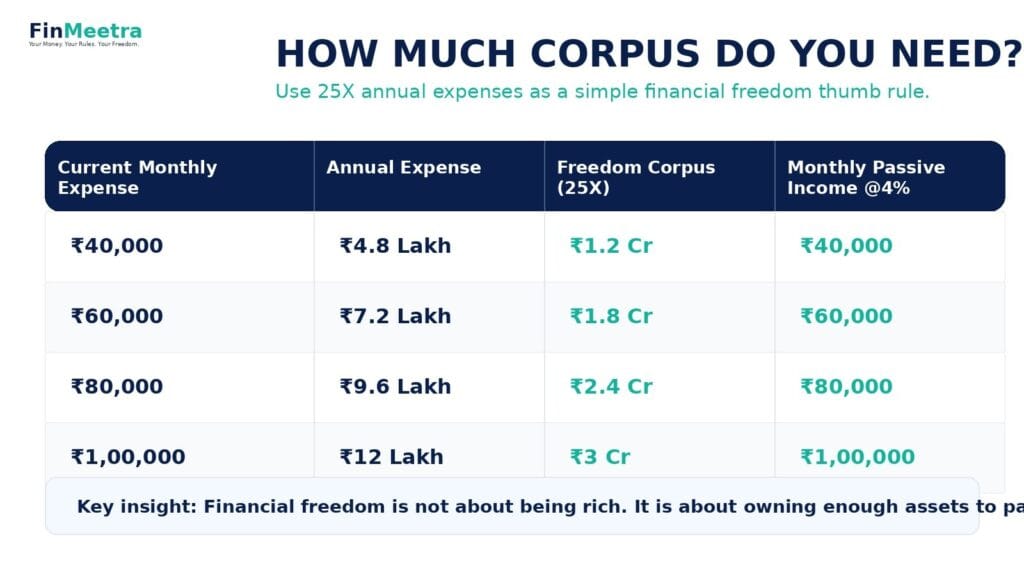
| Monthly Expense | Annual Expense | Freedom Corpus at 25X | Meaning |
| ₹40,000 | ₹4.8 lakh | ₹1.2 crore | Basic single/couple lifestyle |
| ₹60,000 | ₹7.2 lakh | ₹1.8 crore | Middle-class family lifestyle |
| ₹80,000 | ₹9.6 lakh | ₹2.4 crore | Comfortable metro lifestyle |
| ₹1,00,000 | ₹12 lakh | ₹3 crore | Premium family lifestyle |
| ₹1,50,000 | ₹18 lakh | ₹4.5 crore | High lifestyle / big city comfort |
This table is the first mirror. A person spending ₹1 lakh per month does not need a random ₹1 crore. They need roughly ₹3 crore in today’s value. And if retirement is 20 or 25 years away, inflation will make the actual future number much higher.
Inflation: The Villain Most People Ignore
Inflation is not a newspaper headline. It is the quiet bill that arrives every year. Your rent, school fees, medical bills, groceries, travel and insurance premiums rarely stay flat. Even a simple 6% inflation assumption can multiply your lifestyle cost dramatically over decades.
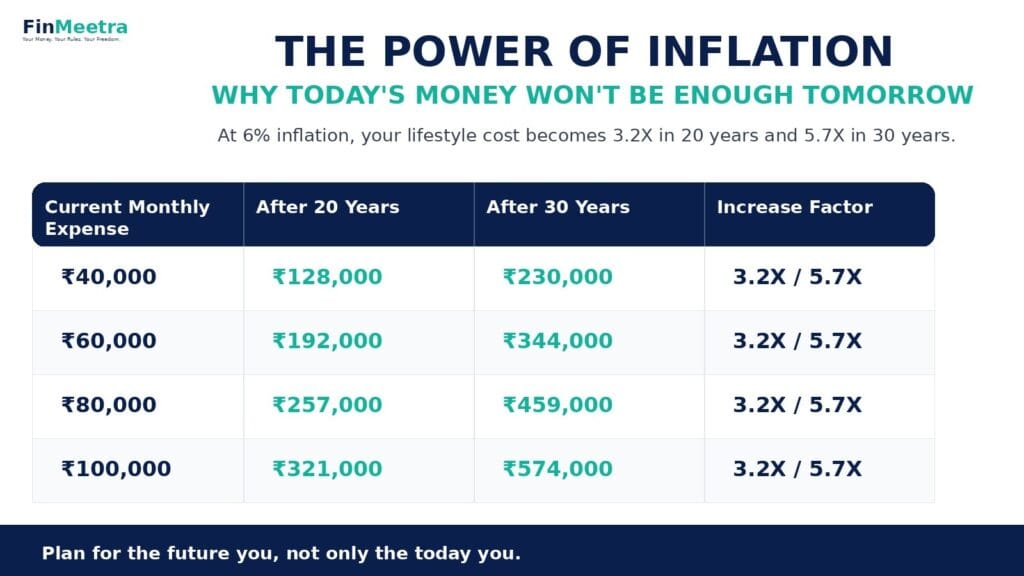
A quick way to understand money doubling is the Rule of 72. At 6% inflation, prices roughly double every 12 years. That means today’s ₹60,000 lifestyle can feel like ₹1.2 lakh in 12 years and ₹2.4 lakh in 24 years.
This is why financial freedom calculations must be reviewed every year. Your target corpus is not carved in stone. It changes when your expenses change, your family grows, your loans change, or inflation becomes higher.
Case Study: Rahul Wants Freedom by 50
Let us return to Rahul. He is 32. His annual CTC is ₹18 lakh. His monthly family expense is ₹70,000. He has ₹8 lakh already invested and invests ₹25,000 per month through SIPs. He wants to know: can I become financially free by 50?
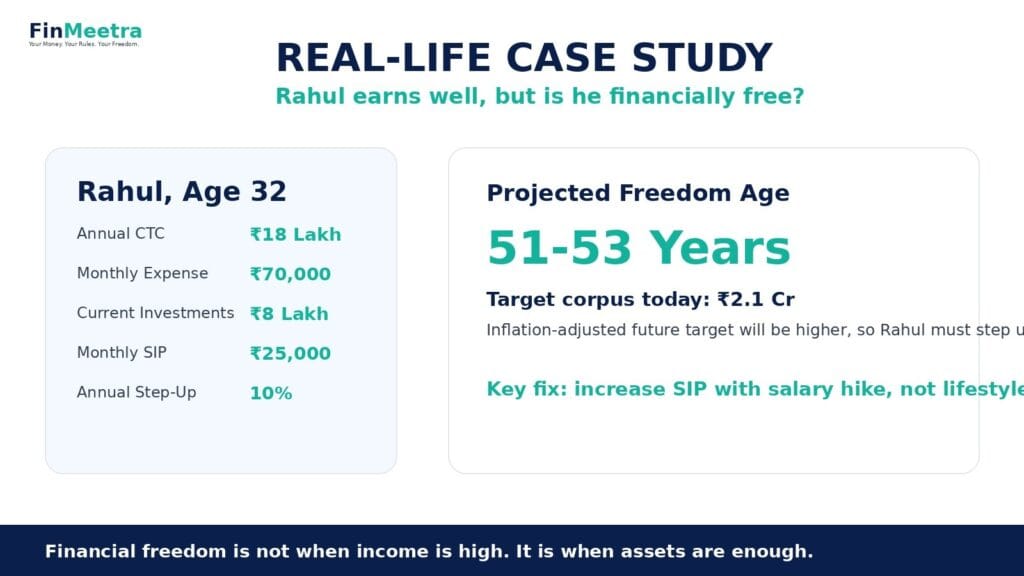
| Input | Value |
| Age | 32 years |
| Current monthly expense | ₹70,000 |
| Current investments | ₹8 lakh |
| Monthly SIP | ₹25,000 |
| Expected return | 12% |
| Annual SIP step-up | 10% |
| Freedom corpus today | ₹2.1 crore |
With a flat SIP, Rahul reaches freedom slowly. But with a 10% yearly step-up, his corpus grows much faster because every salary hike increases his investment engine. The lesson is not ‘invest more once’. The lesson is ‘invest more every year’.
If this idea feels important, read FinMeetra’s detailed Step-Up SIP guide and then use the Step-Up SIP Calculator to see the impact on your own numbers.
The 5-Step Roadmap to Financial Freedom
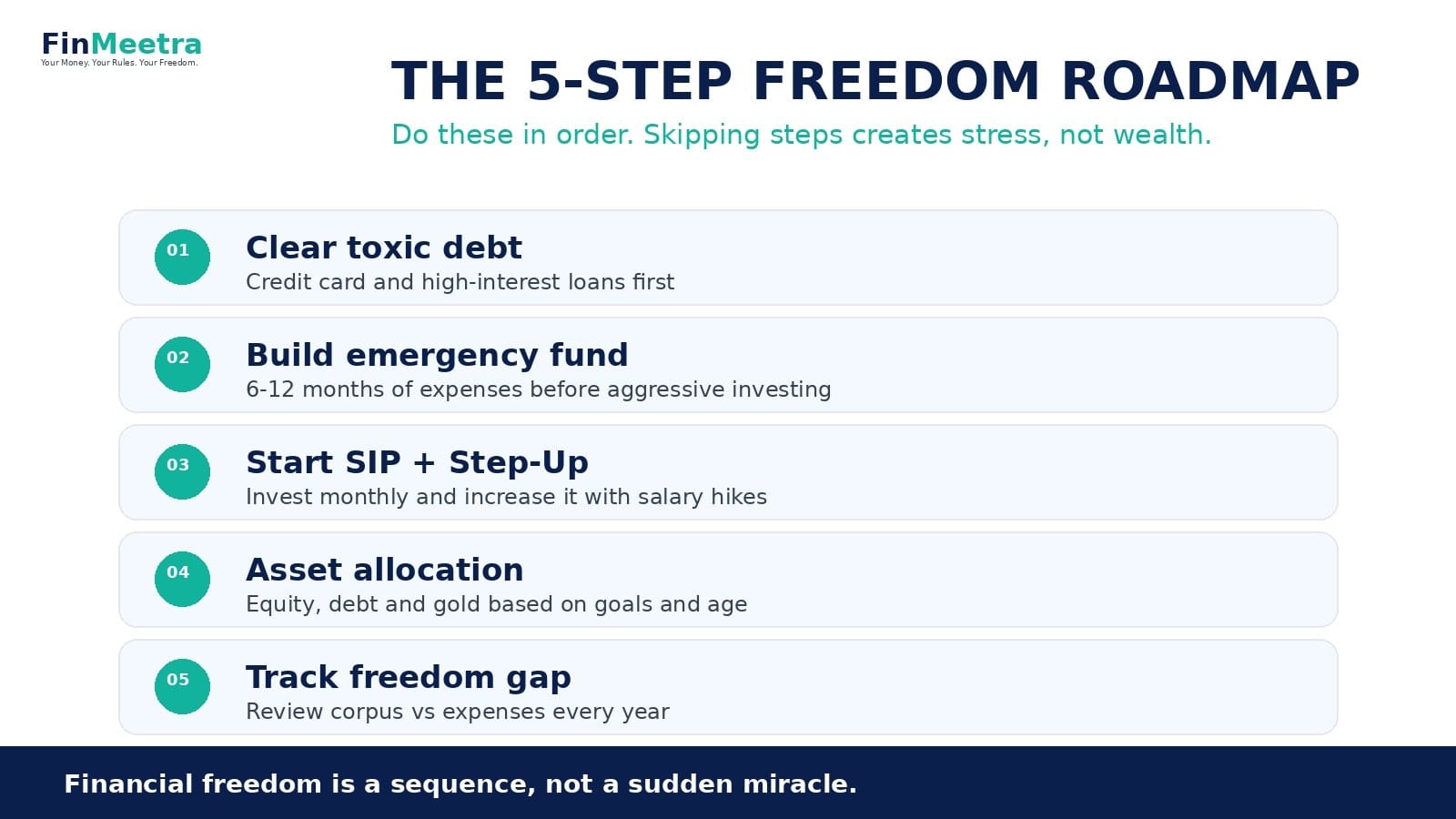
Step 1: Clear Toxic Debt First
Credit card debt and high-interest personal loans are anti-freedom products. If your loan costs 18-36% per year, and your investment may earn 10-12%, the math is obvious. Pay down toxic debt before chasing aggressive investing. A person with heavy EMIs should not copy a person with zero debt.
For loan planning and prepayment decisions, use the FinMeetra EMI Calculator to see how one prepayment can save lakhs in interest.
Step 2: Build an Emergency Fund
Your emergency fund protects your investments from being broken at the wrong time. Without it, one job loss, hospital bill, family emergency or income gap can force you to sell mutual funds during a market fall. Keep 6-12 months of expenses in savings account, FD sweep, liquid funds or a mix of safe instruments.
Step 3: Start SIPs and Step Them Up
SIP is the monthly discipline that converts income into ownership. But a flat SIP can become weak over time. If your salary grows but your SIP does not, your investment rate is actually falling. A 10% yearly step-up is one of the simplest habits for salaried employees.
If you have not started yet, read How to Start Your First SIP in India. If you already invest but don’t know whether SIP or lump sum is better, read SIP vs Lump Sum: Which Strategy Actually Wins?
Step 4: Choose the Right Funds and Allocation
Financial freedom is not about randomly buying five mutual funds. Your portfolio needs structure. Equity builds long-term wealth. Debt gives stability. Gold can protect against shocks. The right split depends on age, goal timing and risk tolerance.
This is why you should read Asset Allocation Strategy: Equity, Debt and Gold Split before blindly adding more funds. Many investors also pick the wrong fund category, which I covered in 90% of Indians Own the Wrong Mutual Fund Category.
Step 5: Track Your Freedom Gap Every Year
Once a year, calculate: current corpus, target corpus, monthly SIP, expected return and estimated freedom age. This one review keeps your lifestyle, SIP and goals aligned. Without tracking, you may feel busy but remain financially stuck.
Common Mistakes That Delay Financial Freedom
| Mistake | Why It Hurts | Better Action |
| Mixing insurance and investment | ULIPs/endowment plans often reduce both coverage and returns | Buy term insurance separately and invest separately |
| Keeping excess money in FDs | Inflation reduces real value over long periods | Keep only emergency fund in safe assets |
| Flat SIP for 20 years | Investment does not grow with income | Step up SIP by 10% yearly |
| Ignoring direct vs regular plans | Expense ratio difference compounds into lakhs | Prefer direct plans where suitable |
| Buying too much house too early | Large EMI kills investment capacity | Check affordability and opportunity cost |
One silent mistake can cost lakhs over time. To understand this better, read The ₹30 Lakh Mistake Most Indians Don’t Know They’re Making about direct vs regular mutual fund plans.
And before buying a house as an emotional decision, read Buying a House at 30 Cost Me ₹1.8 Crore where the rent-vs-buy math is explained with real numbers.
Where the Financial Freedom Calculator Fits In
The calculator HTML provided separately should be embedded after this section. It should ask for age, monthly expenses, current investments, monthly SIP, step-up percentage, expected return and inflation. The output should show freedom corpus, projected corpus, estimated freedom age and gap.
This makes the blog problem-solving, not just educational. A reader can read the article, calculate their own freedom age, then move to related guides based on their weakness: emergency fund, SIP, asset allocation, tax, EMI or retirement planning.
For readers who want a ready-made Excel tool after using the online calculator, link to the free SIP Calculator Excel Toolkit as a downloadable resource.
Key Takeaways
✅ Financial freedom means your assets can fund your expenses without salary dependency.
✅ Your financial freedom number starts with annual expenses multiplied by 25.
✅ Inflation makes tomorrow’s freedom target much larger than today’s number.
✅ A flat SIP is good, but a step-up SIP is far more powerful for salaried employees.
✅ Emergency fund, debt control, SIP discipline and asset allocation must happen in sequence.
✅ Review your freedom gap once every year, especially after salary hikes or lifestyle changes.
✅ The goal is not to stop working. The goal is to make work optional.
Frequently Asked Questions
Q: What is financial freedom in simple words?
A: Financial freedom means your investments can generate enough income to cover your expenses, so you are not forced to work only for money.
Q: How much money is needed for financial freedom in India?
A: A simple thumb rule is 25 times your annual expenses. If you spend ₹9 lakh per year, you need around ₹2.25 crore today.
Q: Is ₹1 crore enough for financial freedom?
A: It depends on your expenses. ₹1 crore may be enough for someone spending ₹30,000 per month, but not for someone spending ₹1 lakh per month.
Q: What is the 4% rule?
A: The 4% rule assumes you can withdraw around 4% of your corpus each year. It is a starting point, not a guarantee.
Q: Can SIP help me become financially free?
A: Yes, if you invest consistently, step up with income and stay invested long enough. SIP is the engine; time and discipline are the fuel.
Q: Should I invest before creating an emergency fund?
A: Basic SIP can start, but aggressive investing should come after a proper emergency fund. Otherwise one crisis can break your investments.
Q: What return should I assume for financial freedom planning?
A: For long-term equity mutual funds, many people use 10-12% assumptions. Conservative planning is safer than overestimating returns.
Q: How often should I review my financial freedom plan?
A: At least once a year, or after major changes like job switch, new home loan, child birth, large medical expense or lifestyle upgrade.
Q: Is financial freedom the same as retirement?
A: No. Retirement means you stop working. Financial freedom means you can choose whether to work or not.
Q: What is the first step toward financial freedom?
A: Track your expenses and build an emergency fund. Without knowing your real spending, you cannot calculate your freedom number.
Related Articles You’ll Love
• Emergency Fund Guide – how much cash you really need
• The Power of Compounding – how small SIPs grow huge over time
• How to Start Your First SIP in India
• Step-Up SIP – multiply wealth without multiplying effort
• Asset Allocation Strategy – equity, debt and gold split
• Direct vs Regular Mutual Fund – the ₹30 lakh mistake
• How Much Money Need to Retire in India?
• Old vs New Tax Regime Calculator
• EMI Calculator with Prepayment
Useful External Resources
ENJOYED THIS BLOG? HERE IS WHAT YOU CAN DO NEXT
📊 Use the Financial Freedom Calculator HTML block in this blog and find your estimated freedom age.
📧 Subscribe to the FinMeetra Newsletter for data-backed personal finance insights.
📥 Download the Premium SIP Excel Toolkit if you want a spreadsheet-based planning tool.
💬 Leave a comment: What is your target financial freedom age?
📱 Share this blog with one salaried friend who earns well but still feels financially stuck.
Disclaimer
This blog is for educational and informational purposes only. It does not constitute financial advice, investment recommendations, tax advice or specific product advice. Calculations are based on assumptions and actual results may vary. Mutual fund investments are subject to market risks. Please consult a SEBI-registered investment advisor, tax professional or financial planner before making important financial decisions. Some links may include affiliate partnerships, clearly disclosed where applicable.



Pingback: The Salary Hike Trap: Why a 30% Raise Still Won’t Fix Your Money Problems with Calculator | FinMeetra
Pingback: The Credit Card Minimum Due Trap: Why Your Debt Doesn’t Reduce Even After Paying Every Month