
Rohan messaged me last week. If you’ve read Index vs Active Funds, you know Rohan — the 35-year-old Mumbai marketing manager who restructured his mutual fund portfolio with me. This time it wasn’t about funds. It was about his ₹40 lakh home loan.
“Bhaiya, I just got my annual bonus — ₹2 lakhs. My wife wants to put it in an FD. My brother-in-law says prepay the home loan. Does it actually matter where the money goes?”
I told him: “Give me 10 minutes. Let me show you the brutal math.” What I showed him shocked him — and it’s the same math 90% of Indian borrowers get wrong. Without prepayment, his ₹40L loan at 8.6% over 20 years costs ₹43.3 Lakhs in interest alone — more than the loan amount itself. With a simple ₹2L/year prepayment from his bonus: he saves ₹23.47 Lakhs and closes the loan 8.6 years early.
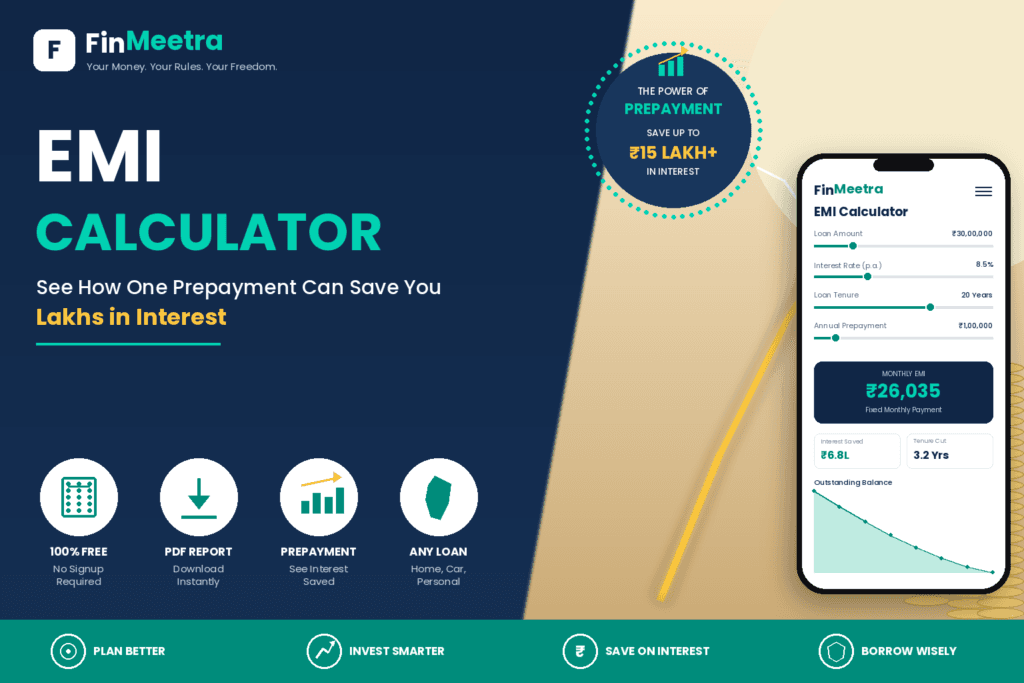
Most Indian borrowers treat their EMI as a fixed, unchangeable monthly tax. It isn’t. This calculator is the EXACT tool I used with Rohan. Plug in your loan amount, interest rate, tenure, and any prepayment you’re planning — and see the real numbers: your EMI, total interest, and exactly how much a prepayment saves you. Download a branded FinMeetra PDF report to share with your family or advisor. Let’s dive in.
We’ve covered the Index vs Active Fund debate in detail. Now let’s tackle the other side of the balance sheet — what you owe, and how to pay it off smarter, not just faster.
The FinMeetra EMI Calculator
This blog covers the complete article, explanation, and supporting data for the EMI Calculator. The interactive calculator tool (sliders, charts, and PDF download) is a separate embeddable component — built and delivered independently from this Word document — designed to sit directly below this section on your live blog page.
EMI Calculator
See how one prepayment can save you lakhs in interest
What is EMI?
Equated Monthly Installment — a fixed amount paid every month that covers both principal repayment and interest, until the loan is fully repaid.
Why Prepay?
Every rupee of prepayment goes straight to principal — cutting future interest and shortening your loan tenure, often by years.
Best Time to Prepay?
Early in the loan tenure. Interest is front-loaded in amortization — prepaying in Year 2-5 saves far more than prepaying in Year 15.
Ready to check your real loan offers?
Compare interest rates across lenders before you sign:
How Does the EMI Calculator Work?
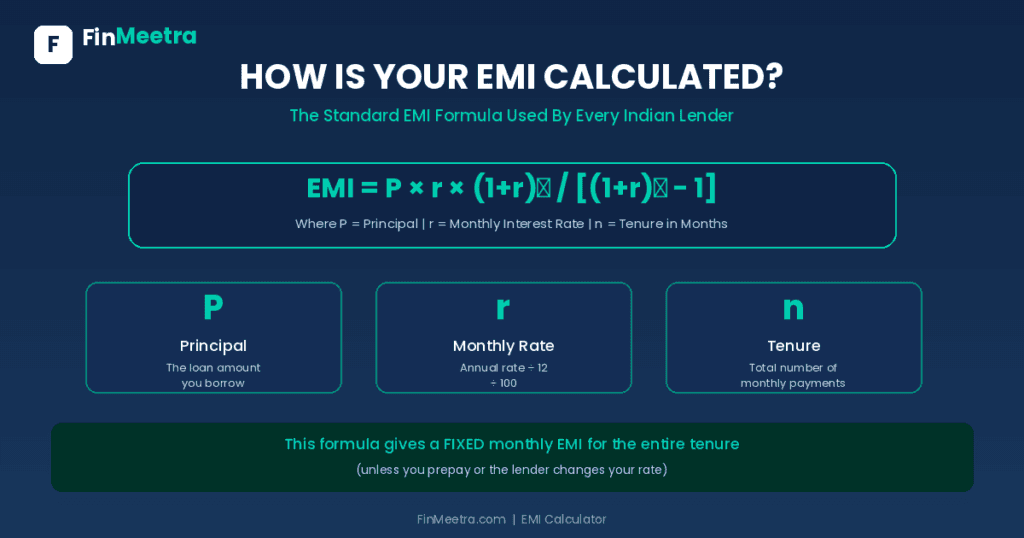
EMI (Equated Monthly Installment) is the fixed amount you pay every month toward your loan — a combination of principal repayment and interest — until the loan is fully repaid. This calculator uses the standard reducing-balance EMI formula used by every Indian bank and NBFC, then layers in a year-by-year prepayment simulation so you can see exactly how extra payments shorten your loan and cut your interest.
Input Ranges Used
| Input | Range | Default | Why This Range |
| Loan Amount | Rs.50,000 to Rs.2,00,00,000 | Rs.30,00,000 | Covers personal loans to large home loans |
| Interest Rate | 6% to 20% | 8.5% | Realistic for Indian home/car/personal loans |
| Loan Tenure | 1 to 30 years | 20 years | Standard home loan horizon in India |
| Annual Prepayment | Rs.0 to Rs.10,00,000 | Rs.0 | Matches typical bonus/lumpsum prepayment range |
Real Example: Rohan’s Prepayment Decision
Back to Rohan. He had a ₹40 lakh home loan at 8.6% for 20 years, and a ₹2 lakh annual bonus to decide what to do with. Here’s the calculator comparison I showed him:
Scenario A: No Prepayment (Brother-in-law’s FD suggestion implies this)
| Metric | Without Prepayment | (Rohan’s Original Plan) |
| Loan Amount | Rs.40,00,000 | Home loan, Bangalore |
| Interest Rate | 8.6% p.a. | Fixed for first 3 years |
| Tenure | 20 years | 240 EMIs |
| Monthly EMI | Rs.34,713 | Fixed throughout |
| Total Interest Paid | Rs.43.31 Lakhs | More than the loan itself! |
Scenario B: ₹2L/Year Prepayment (FinMeetra’s Suggestion)
| Metric | With Rs.2L/Year Prepayment | (FinMeetra’s Suggestion) |
| Loan Amount | Rs.40,00,000 | Same loan |
| Interest Rate | 8.6% p.a. | Same rate |
| Annual Prepayment | Rs.2,00,000 every year | From annual bonus |
| Actual Loan Closure | 11.4 years | 8.6 years EARLY |
| Total Interest Paid | Rs.19.84 Lakhs | Rs.23.47L SAVED! |
Same loan. Same rate. Same starting EMI. The ONLY difference: directing his ₹2L annual bonus to the loan instead of an FD. That one decision saved him ₹23.47 Lakhs, and closed his loan 8.6 years sooner. The FD, at best, would have earned him ~7% post-tax. The loan prepayment effectively “earned” him 8.6% guaranteed, tax-free.
₹23.47 Lakh difference. From ONE decision — where to put a single bonus. This is why prepayment is the most underrated wealth move for Indian home loan borrowers.
Lesson: An EMI isn’t fixed destiny. Every extra rupee toward principal compounds in your favor — but only if you actually do it. Rohan now auto-transfers 50% of every bonus to loan prepayment.
Why WHEN You Prepay Matters As Much As How Much
Here’s the part most borrowers miss: a loan’s interest is front-loaded. In the early years, most of your EMI goes toward interest, not principal — because interest is charged on the outstanding balance, which is highest at the start. This means prepaying early in your loan tenure delivers dramatically more savings than the exact same prepayment made later.
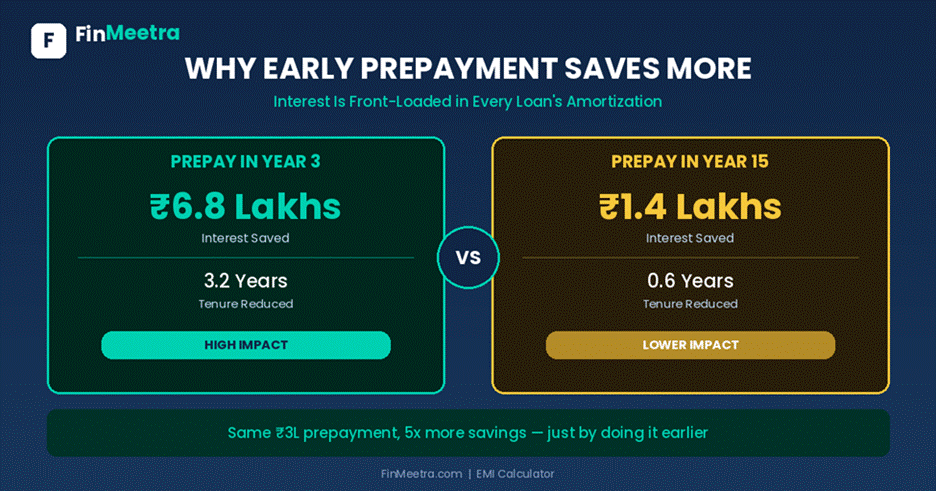
On an identical ₹3 lakh prepayment, doing it in Year 3 of a 20-year loan saves roughly 5 times more interest than doing it in Year 15. The lesson: if you’re going to prepay, do it as early as your cash flow allows.
Key Assumptions Used
| Assumption | Value | Notes |
| Compounding Frequency | Monthly | Standard for all Indian loans |
| EMI Calculation Method | Reducing Balance | Interest charged only on outstanding principal |
| Prepayment Application | Once per year | Applied directly to principal, reduces tenure |
| Prepayment Charges | Not included | Floating-rate loans: RBI mandates zero prepayment penalty |
| Processing Fees | Not included | Add separately — typically 0.5%-2% of loan amount |
| Rate Type | Fixed for projection | Floating-rate loans may vary with repo rate changes |
| Currency | Rs. Indian Rupees | All amounts in INR |
How to Use This Calculator (60-Second Guide)
- Step 1: Enter your loan amount (current outstanding or planned). Minimum ₹50,000.
- Step 2: Set your Interest Rate. Check your loan agreement or use our loan-type rate guide below.
- Step 3: Set your Loan Tenure in years. We default to 20 years (standard home loan horizon).
- Step 4: Set your Annual Prepayment — any lumpsum (bonus, increment, maturity payout) you plan to put toward the loan each year.
- Step 5: See your Monthly EMI, Total Interest, and Total Payment update in real-time.
- Step 6: Compare the outstanding balance chart with vs without prepayment — the gap is your real savings.
- Step 7: Click ‘Download PDF Report’ for a branded FinMeetra report with your inputs, results, and year-by-year breakdown to share with your family or advisor.
Interest Rates by Loan Type (2026)
Not all loans are equal. The rate you’re charged depends heavily on the loan type and whether it’s secured against an asset. Here’s what to expect across common loan categories in India today:
| Loan Type | Typical Rate (2026) | Notes |
| Home Loan | 8.0% – 9.5% | Lowest rates; tax benefits under 80C & 24(b) |
| Car Loan | 8.5% – 11% | Secured against the vehicle |
| Education Loan | 9% – 12% | Moratorium period available during study |
| Personal Loan | 10% – 18% | Unsecured; rate depends on credit score |
| Credit Card EMI | 13% – 24% | Most expensive; avoid carrying balance |
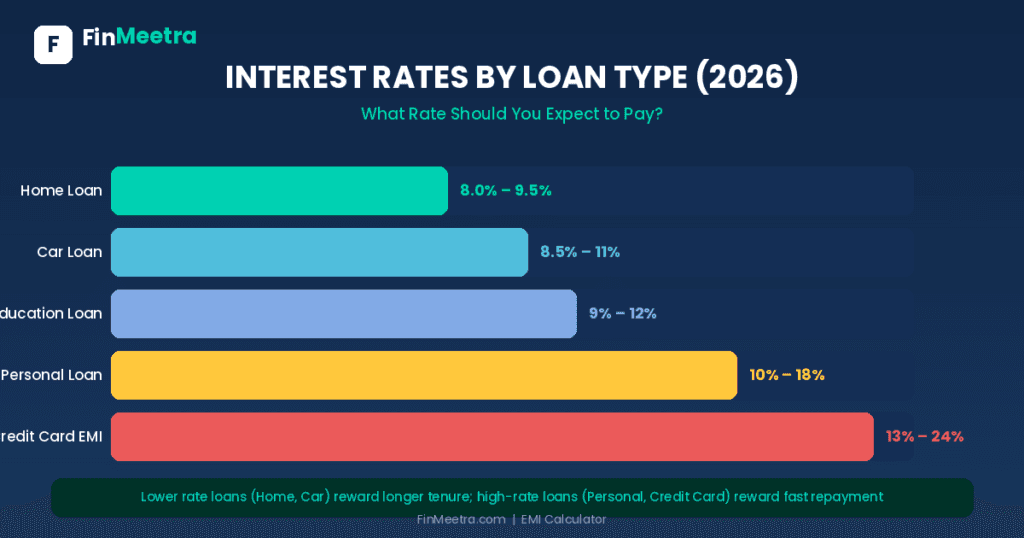
Rule of thumb: prioritize prepaying your HIGHEST interest rate loan first (usually credit card EMI or personal loan), not your home loan — even though the home loan amount looks scarier. The math favors attacking the costliest debt first.
Shorter Tenure vs Longer Tenure: The Real Tradeoff
Choosing your loan tenure is a tradeoff between monthly affordability and total cost. A shorter tenure means a higher EMI but dramatically less interest paid over the life of the loan. Here’s the same ₹30 lakh home loan at 8.5%, shown across three tenures:
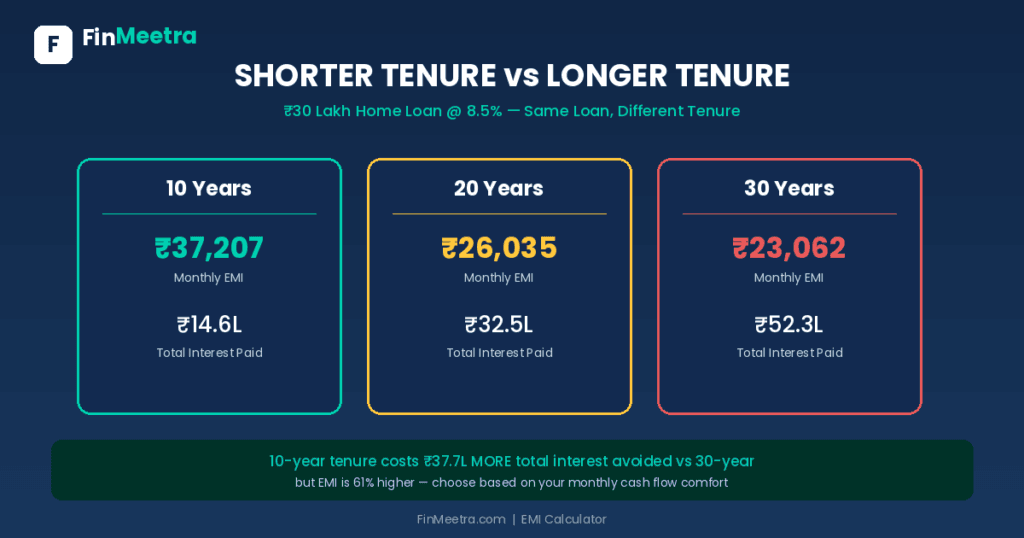
The 10-year tenure costs ₹37.7 lakhs LESS in total interest than the 30-year tenure — but the EMI is 61% higher. Choose based on what your monthly cash flow can comfortably absorb without strain, then use prepayments to bridge the gap when you have surplus cash.
FinMeetra EMI Calculator vs Other Tools
| Feature | FinMeetra | Bank Sites | Groww/PB | ET Money |
| Free to Use | Yes | Yes | Yes | Yes |
| No Signup Required | Yes | No | Yes | No |
| Prepayment Simulator | Yes | Basic only | Limited | Basic only |
| Year-wise Amortization Table | Yes | Yes | No | No |
| PDF Download | Branded | No | No | No |
| Doughnut + Line Charts | Both | One only | One only | One only |
| Tenure Reduction Insight | Yes | No | No | No |
| Educational Content | Story + Examples | No | Basic | No |
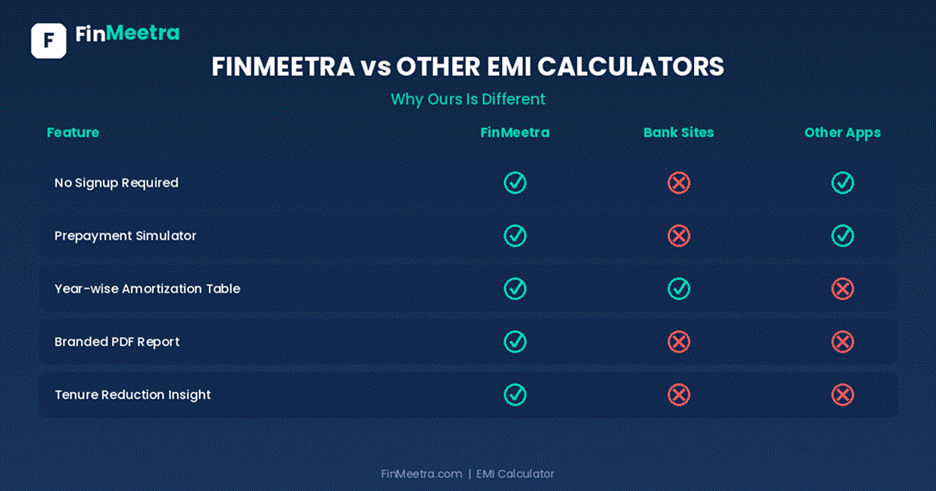
Image: FinMeetra vs Other EMI Calculators — Why Ours Is Different
FinMeetra’s EMI Calculator is the only free Indian tool that combines a true prepayment simulator, year-by-year amortization breakdown, and a branded PDF report — without forcing you to sign up. That’s why we built it.
Key Takeaways
- Your EMI is fixed, but your loan’s total cost is NOT — prepayment is the single biggest lever you control.
- A ₹40L home loan at 8.6% for 20 years costs ₹43.3L in interest — more than the loan amount itself — if left untouched.
- A ₹2L/year prepayment on the same loan saves ₹23.47L in interest and closes the loan 8.6 years early.
- Prepaying EARLY in your loan tenure saves far more than the same amount prepaid later — interest is front-loaded.
- Always prepay your highest-interest debt first (credit card EMI, personal loan) before your home loan.
- RBI mandates zero prepayment penalty on floating-rate retail loans — there’s no real reason to NOT prepay when you have surplus cash.
- Even a modest, irregular prepayment (whenever you get a bonus) beats a disciplined FD at typical post-tax FD returns.
- Use the EMI vs Tenure tradeoff consciously — shorter tenure if you can afford the EMI, longer tenure + prepayment if you need flexibility.
- Calculate YOUR exact prepayment savings using this calculator — and consider directing your next bonus toward your loan instead of a low-yield FD.
Frequently Asked Questions
Q: What is EMI and how is it calculated?
EMI (Equated Monthly Installment) is the fixed monthly amount you pay toward a loan, covering both principal and interest. It’s calculated using the reducing-balance formula: EMI = P × r × (1+r)ⁿ / [(1+r)ⁿ − 1], where P is the loan amount, r is the monthly interest rate, and n is the total number of monthly installments. Despite the EMI staying fixed, the split between principal and interest changes every month — early payments are interest-heavy, later payments are principal-heavy.
Q: Does prepaying my loan actually save money, or just shift the timeline?
It genuinely saves money — interest is calculated only on your outstanding balance, so every rupee of prepayment reduces the principal on which future interest is charged. This is real, guaranteed savings, not just a faster payoff. The earlier you prepay, the more interest you avoid, because more of the loan tenure (and therefore more interest) remains ahead of you.
Q: Is there a penalty for prepaying my home loan in India?
No. RBI rules prohibit banks and NBFCs from charging prepayment or foreclosure penalties on floating-rate retail loans (home loans, most personal loans) taken by individual borrowers. Fixed-rate loans and some non-individual borrowers may still attract a charge — always check your loan agreement, but for the vast majority of floating-rate home loans, prepayment is penalty-free.
Q: Should I prepay my loan or invest the money in mutual funds instead?
Compare your loan’s interest rate to your expected post-tax investment return. If your home loan costs 8.6% and you can reliably earn 12%+ post-tax in equity mutual funds over the long term, investing may build more wealth — but it carries market risk, while loan prepayment is a guaranteed, risk-free return equal to your interest rate. For high-interest debt (personal loans, credit cards at 12%+), prepayment almost always wins since few safe investments beat that rate after tax.
Q: What’s better — reducing my EMI or reducing my tenure after a part-payment?
Reducing tenure (keeping EMI the same) saves significantly more interest, because you stay on the accelerated repayment schedule. Reducing EMI (keeping tenure the same) gives you immediate monthly cash flow relief but saves much less interest overall. If your monthly budget can handle the current EMI, always choose to reduce tenure after a part-payment.
Q: How much should I prepay each year?
A practical approach: direct your annual bonus, tax refund, or any lumpsum windfall toward prepayment, while keeping 3-6 months of expenses as an emergency fund untouched. Even an irregular ₹1-2 lakh per year on a typical home loan compounds into lakhs of savings over the loan’s life. Avoid prepaying from your emergency fund or by stopping retirement contributions.
Q: Can I prepay a fixed-rate loan the same way as a floating-rate loan?
You can, but check your loan agreement first — fixed-rate loans (and some loans to non-individual borrowers) may carry a prepayment penalty, typically 2-4% of the prepaid amount. Floating-rate loans to individuals are penalty-free under RBI rules. Always do the math: if the penalty is smaller than the interest you’d save, prepayment still makes sense.
Q: Can I download the calculator results?
Yes — completely free. Click ‘Download PDF Report’ for a branded FinMeetra PDF with your inputs, results, year-by-year amortization breakdown, and key insights. No signup needed. Use it to compare scenarios or share with your bank, family, or financial advisor.
Blogs That Make This Calculator More Powerful
- SIP vs Lump Sum — Which Investment Strategy Actually Wins? (Data-Backed)
- Index Fund vs Active Fund — Which Really Wins? (Real 20-Year Data)
- The Power of Compounding — How ₹5,000/Month Grows into ₹1.76 Crores
- The ₹30 Lakh Mistake — Direct vs Regular Mutual Funds in India
- ₹10 Crore Retirement Roadmap — Priya’s Full Story
- Step-Up SIP Guide — The Single Habit That Multiplies Wealth 3x
Useful External Resources
- RBI — Master Direction on Lending & Prepayment Norms
- SEBI Investor Education
- BankBazaar (Compare Loan Rates)
- Paisabazaar (Loan Offers Comparison)
- CIBIL (Check Your Credit Score)
- National Housing Bank
ENJOYED THIS CALCULATOR? HERE IS WHAT YOU CAN DO NEXT:
Leave a Comment — Are you planning to prepay your loan this year? Share your numbers with the community.
Subscribe to FinMeetra Newsletter — Real money insights every week.
Share This Calculator — If this showed you a hidden saving, share it with a friend paying EMIs without a prepayment plan.



Pingback: When Will You Become Financially Free? Calculator + Real Indian Roadmap | FinMeetra