
Table of Contents
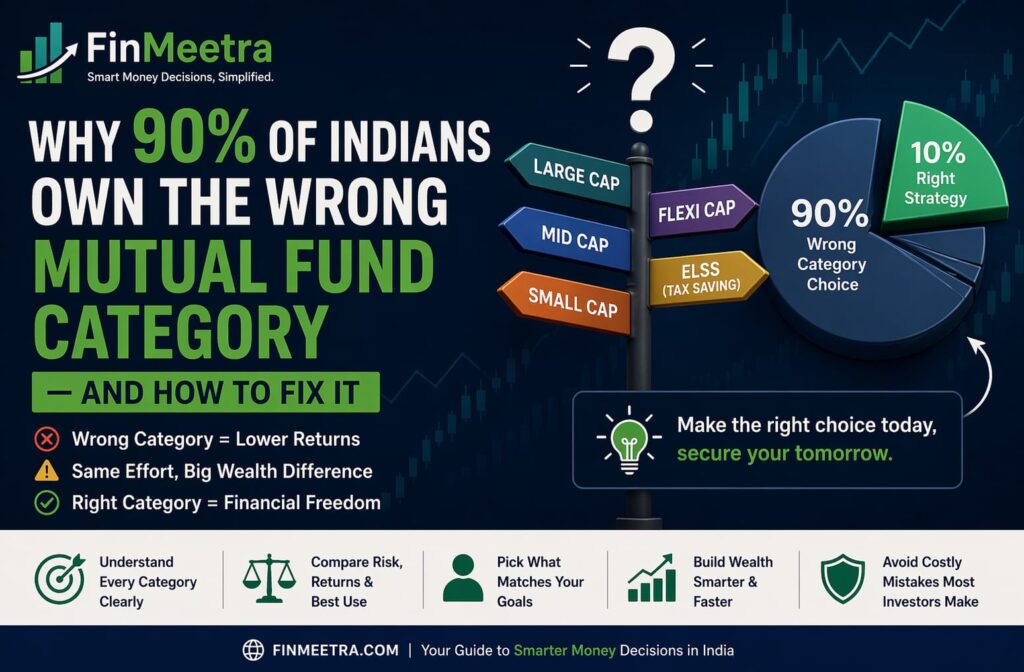
I’ve had this conversation with friends, family members, and dozens of colleagues over the last few years. Someone proudly shows me their mutual fund portfolio — usually 6 to 10 funds — and asks: ‘Am I doing this right?’ And I have to break the news, every single time: not really. They’re not investing wrong. They’re just investing in the wrong categories — often in overlapping funds that look diversified on the surface but aren’t doing much underneath.
This is the silent mistake quietly costing Indian investors lakhs over their lifetime. Not bad funds. Not market crashes. Not even fund manager mistakes. The wrong category mix. 🪞
👉 SEBI defines 36 mutual fund categories. For 95% of Indian retail investors, only 5 actually matter.
Yet most Indians own 8-12 mutual funds, scattered across overlapping categories or invested heavily in categories that don’t fit their life stage. Research from SEBI and Value Research shows that the average retail portfolio with 8+ funds has 60-70% overlap in top holdings. So you’re effectively paying 3x expense ratios for 1x exposure. Over 20 years, that’s a quiet wealth erosion of ₹15-30 lakhs. Without you even noticing. 💔
We’ve already covered how to choose the right mutual fund using a 7-filter framework. But before applying any filter, you need to understand mutual fund categories themselves. This post walks you through all 5 categories that actually matter — explains the common mistake of Why 90% of Indians Own the wrong Mutual Fund Category — and gives you a simple fix to clean up your portfolio in 30 minutes. By the end, you’ll know exactly which 2-4 funds you should own. Let’s dive in. 👇
What Is a Mutual Fund Category? (Simple Definition)
A mutual fund category is a SEBI-defined classification based on the type of companies the fund invests in. In 2018, SEBI standardized mutual fund categories to reduce confusion. Today there are 36 official categories — but for 95% of Indian retail investors, only 5 are relevant: Large Cap, Mid Cap, Small Cap, Flexi Cap, and ELSS. Each category serves a specific purpose. Each one fits a specific kind of investor.
Think of mutual fund categories like restaurant menus. 🍽️ A South Indian restaurant serves dosas and idlis. A Chinese restaurant serves noodles. A multi-cuisine restaurant offers a bit of everything. The ‘category’ tells you what to expect. Mutual fund categories work the same way — they tell you the type of stocks you’ll own, the risk level, and the return expectations. Pick the wrong category, and you’ll feel constantly out of place — even if the food (returns) is technically good.
The mistake most Indians make? They pick funds based on past returns, brand names, or ‘top fund of 2025’ YouTube videos — without understanding which CATEGORY each fund belongs to. The result: a portfolio full of overlapping funds, mismatched risk, and quiet underperformance. ⚠️
The 5 Mutual Fund Categories Every Indian Should Understand
Let’s break each one down with real numbers, real risks, and clear use cases. 👇
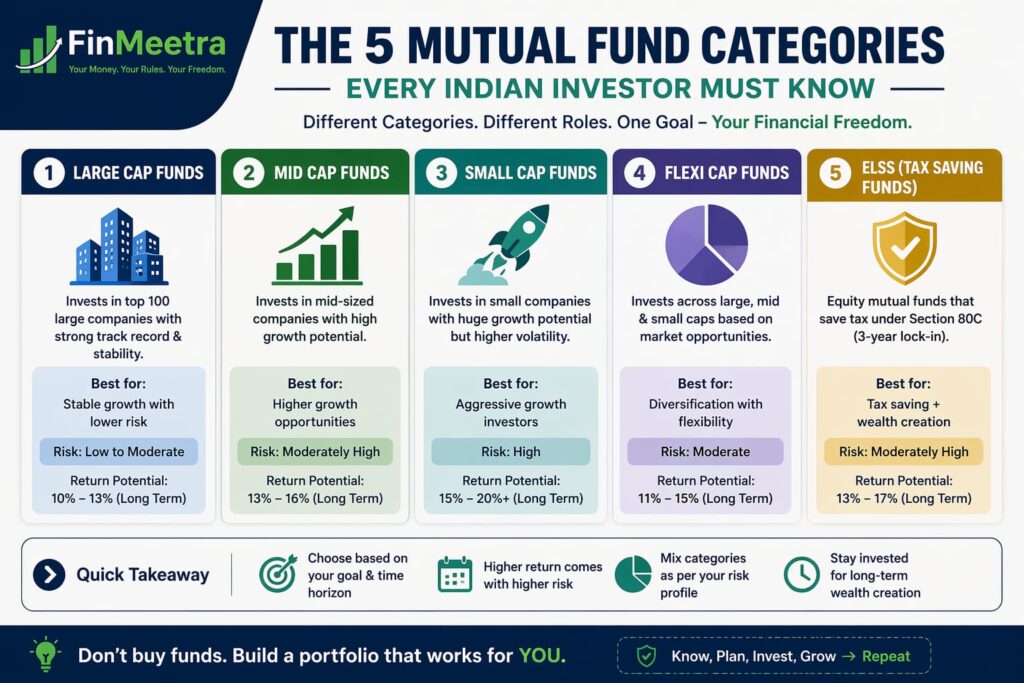
| Category | What It Invests In | Risk | Returns | Best For |
| 📊 Large Cap | Top 100 companies | Medium | 11-13% | Long-term wealth (5+ yrs) |
| 📈 Mid Cap | Companies 101-250 | Medium-High | 13-16% | Aggressive long-term (10+ yrs) |
| 🚀 Small Cap | Companies 251+ | Very High | 15-18% | Very long-term (15+ yrs) |
| ⚖️ Flexi Cap | Mix of all 3 (manager’s call) | Medium-High | 12-15% | Diversified equity |
| 🧾 ELSS | Equity + 80C tax benefit | Medium-High | 12-14% | Tax saving + wealth (3-yr lock) |
📊 Large Cap Funds — The Stability Anchor
Large Cap funds invest in India’s top 100 companies — Reliance, HDFC, TCS, Infosys, ICICI Bank, and similar giants. These are well-established, financially strong businesses with low survival risk. Returns are steady (11-13% CAGR long-term) but rarely explosive. Best for: conservative investors, beginners who want predictability, or anyone nearing major financial goals. Large Cap funds typically fall 25-35% in major crashes — much milder than Mid/Small Cap drops.
📈 Mid Cap Funds — The Growth Engine
Mid Cap funds invest in companies ranked 101-250 by market capitalization. These are mid-sized businesses — often tomorrow’s giants. Think of names like Polycab, Tata Power, or Persistent Systems. Returns are higher (13-16% CAGR), but so is volatility. A 35-45% drop in major crashes is normal. Best for: investors aged 25-40 with 10+ year horizons. You need patience because Mid Cap funds can stay flat for 2-3 years before exploding. If you can’t handle a 35% drop without panicking, skip this for now.
🚀 Small Cap Funds — The Wealth Multiplier
Small Cap funds invest in companies ranked 251+ by market cap. Highest return potential (15-18% CAGR over 15+ years) — but also brutal volatility. 50%+ drawdowns are common during crashes. Stories of 100x returns usually come from Small Caps. So do stories of 80% drops. Best for: young, aggressive investors with 15+ year horizons and no major financial dependents. Rule of thumb: don’t put more than 15-20% of your equity portfolio in Small Cap. Most Indians overdose on Small Cap during bull markets — and panic-sell at the bottom. Don’t be most Indians.
⚖️ Flexi Cap Funds — The All-Rounder
Flexi Cap is the newest category (introduced by SEBI in 2020) — and quietly the smartest for most Indian retail investors. It invests across Large, Mid, and Small Cap based on the fund manager’s view of the market. Returns: 12-15% CAGR. The advantage: one-stop diversification across all market caps in a single fund. Best for: 90% of Indian retail investors as their CORE holding. If you only own ONE mutual fund, make it a Flexi Cap. Beginners, working professionals, anyone who doesn’t want to overthink portfolio construction — Flexi Cap fits all.
Pair a Flexi Cap fund with a proper asset allocation strategy across equity, debt, and gold — and you have a beautifully simple, beautifully effective wealth-building setup.
🧾 ELSS Funds — Tax Savings + Equity Growth
ELSS (Equity Linked Savings Scheme) is the only mutual fund category that gives you tax benefits. Invest up to ₹1.5 lakh per year and reduce your taxable income under Section 80C. The catch: mandatory 3-year lock-in. Returns: 12-14% CAGR — similar to other equity funds. Best for: anyone in the Old Tax Regime who needs to save tax under 80C. ELSS gives you dual benefits — wealth growth + ₹46,800 tax saved (at 30% bracket). 🎯 Pro tip: instead of investing ₹1.5L lump sum in March, run a ₹12,500/month SIP throughout the year. Smoother. Smarter. Less stressful.
The Common Mistake — Why 90% of Indians Get This Wrong
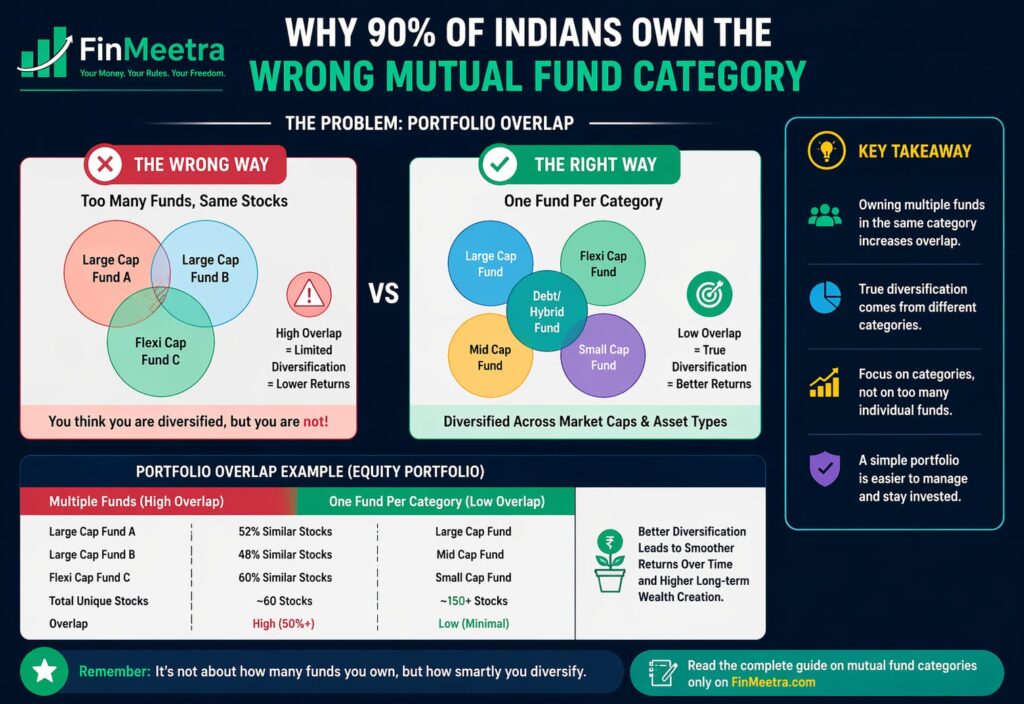
Now here’s where it gets uncomfortable. Most Indian investors don’t actually ‘pick’ a category. They accumulate funds. One year they buy what a YouTuber recommends. Next year, what a friend mentions. Then a ‘top performer of 2025’ fund. Then an ELSS for tax saving. Then another fund because the bank RM pushed it. Slowly, the portfolio becomes a graveyard of overlapping funds — without any conscious category logic.
📊 Average Indian retail investor owns 8-12 mutual funds. Optimal portfolio? Just 2-4 funds.
The cost of this ‘category chaos’ is enormous — but invisible. Multiple funds in the same category mean: (1) Same top stocks repeated across funds (60-70% overlap is common), (2) Higher cumulative expense ratios, (3) Difficulty tracking real performance, (4) Emotional decisions during volatility, (5) No real diversification benefit. You’re essentially paying 3x fees for 1x exposure. Compounded over 20 years, this can quietly cost ₹15-30 lakhs in wealth. 💔
Real-Life Comparison: Vivek vs Anjali (15-Year Story)
Let me bring this to life. Meet Vivek and Anjali. Both are 30. Both started investing ₹10,000/month in January 2010. Same SIP. Same time period. The only difference? Their category strategy. 👇
🟢 Vivek: Owned 8 mutual funds — 3 Large Cap, 2 Mid Cap, 1 Small Cap, 1 Sectoral, 1 Thematic.
🟢 Anjali: Owned just 3 mutual funds — 1 Flexi Cap (60%), 1 Mid Cap (25%), 1 ELSS (15%).
Fast forward to January 2025 — they compared portfolios. The numbers were eye-opening. 👇
| Metric | Vivek (8 funds) | Anjali (3 funds) |
| 💸 Total Invested | ₹18,00,000 | ₹18,00,000 |
| 📊 Avg Expense Ratio | 1.65% | 1.20% |
| 📉 Portfolio Overlap | 68% | 12% |
| 📈 15-Year CAGR | 10.8% | 12.6% |
| 💰 Final Corpus | ₹42.3 Lakh | ₹50.1 Lakh |
| 💔 Extra Wealth Built | — | +₹7.8 Lakh |
| 🧾 Tax Saved (ELSS) | ₹0 | ₹3.3 Lakh over 7 yrs |
Same SIP. Same time. Same effort. Anjali ended up with ₹7.8 Lakh extra corpus + ₹3.3 Lakh saved in taxes. That’s over ₹11 Lakh more — purely because she picked the right CATEGORIES, not more funds. 🤯
💎 Lesson: True diversification isn’t about owning MORE funds. It’s about owning the RIGHT 2-4 funds across the right categories. Less truly is more — quietly, beautifully, over decades.
How to Pick the Right Category for YOU (Simple Framework)
Use this age-based framework to pick the right category mix. It’s not the only right approach — but it’s a strong starting point for 90% of Indian investors. 👇
🎯 The Age-Based Category Framework
| Age Group | Recommended Mix | Total Funds |
| 🟢 25-35 (Aggressive) | 50% Flexi + 30% Mid Cap + 20% Small Cap | 3-4 funds |
| 🟢 35-45 (Balanced) | 60% Flexi/Large + 30% Mid Cap + 10% ELSS | 3 funds |
| 🟢 45-55 (Conservative) | 70% Large + 20% Flexi + 10% ELSS | 2-3 funds |
| 🟢 55+ (Capital Preservation) | 80% Large Cap + 20% Hybrid | 2 funds |
🎯 Key insight: As you age, shift FROM Small/Mid Cap TO Large/Flexi Cap. This gradually protects your wealth as you approach your financial goals. Young investors can survive 50% drops. Investors near retirement cannot.
Also, if you’re new to SIP investing, start with our complete beginner’s SIP guide before adding multiple categories. Master the basics first.
📋 3 Ready-to-Use Starter Portfolios
1️⃣ Beginner Combo (Age 25-35):
→ 70% in Flexi Cap Fund (core)
→ 30% in Nifty 50 Index Fund (low-cost passive)
Total: 2 funds. Simple. Effective.
2️⃣ Tax-Saving Combo (Anyone in Old Tax Regime):
→ 60% in Flexi Cap Fund (core)
→ 25% in Mid Cap Fund (growth)
→ 15% in ELSS Fund (tax saving)
Total: 3 funds. Tax efficient. Wealth-building.
3️⃣ Aggressive Combo (Age 25-30, 15+ year horizon):
→ 50% in Flexi Cap Fund (core)
→ 30% in Mid Cap Fund (growth)
→ 20% in Small Cap Fund (wealth multiplier)
Total: 3 funds. High risk. High reward. Patience required.
5 Category Mistakes Most Indians Quietly Make
❌ Mistake 1: Owning Too Many Funds
5+ funds = portfolio overlap, higher fees, no extra diversification. Stick to 2-4 funds max. Less is more — always.
❌ Mistake 2: Chasing Last Year’s Top Category
Small Cap was hot last year? Avoid the FOMO now. Categories rotate. Yesterday’s winner often becomes tomorrow’s underperformer. Stay disciplined.
❌ Mistake 3: Picking Funds Based Only on Returns
Use the 7-filter mutual fund framework instead. Look at expense ratio, fund manager tenure, and consistency.
❌ Mistake 4: Mixing Index and Active Funds Randomly
Pick a strategy and stick to it. Read our complete Index vs Active Funds comparison before deciding.
❌ Mistake 5: Forgetting Step-Up SIPs
Even the best category combo loses to inflation if your SIP stays flat. Apply Step-Up SIP to compound your wealth quietly.
Key Takeaways
✅ SEBI defines 36 mutual fund categories — but only 5 matter for 95% of Indian investors.
✅ The 5 essential categories: Large Cap, Mid Cap, Small Cap, Flexi Cap, ELSS.
✅ Average Indian owns 8-12 mutual funds. Smart investors own just 2-4.
✅ Portfolio overlap of 60-70% is the silent reason most Indians underperform.
✅ Flexi Cap is the best ‘core’ category for most beginners — one-stop diversification.
✅ ELSS adds a unique tax benefit (₹1.5L deduction under Section 80C) with 3-yr lock-in.
✅ Use age-based framework: aggressive when young, conservative near retirement.
✅ Match category to your time horizon and risk capacity — never to YouTube hype.
✅ Combine category strategy with Step-Up SIPs + asset allocation for compounding magic.
Frequently Asked Questions
Q: How do I know if my mutual fund category is wrong?
A: Check three things: (1) Do you own more than 4 funds? (2) Are 2+ funds in the same category? (3) Does the category match your age and time horizon? If you answered yes to questions 1 or 2, or no to question 3 — your category mix likely needs fixing.
Q: Which mutual fund category is best for beginners in India?
A: Flexi Cap funds are widely considered the best starting point for Indian beginners. They give diversified equity exposure (Large + Mid + Small caps) in a single fund. The manager actively adjusts the mix based on market conditions. A Nifty 50 Index Fund is another excellent beginner-friendly option for ultra-low cost.
Q: What’s the difference between Multi Cap and Flexi Cap funds?
A: Multi Cap funds must hold a minimum of 25% in each of Large, Mid, and Small caps (SEBI mandate). Flexi Cap funds have NO such restriction — the manager can shift 100% to any cap based on view. Flexi Cap is more flexible; Multi Cap is more rigid. Most experts prefer Flexi Cap.
Q: How many mutual funds should I own?
A: 2-4 funds is optimal for most Indian retail investors. Owning 5+ funds creates portfolio overlap without adding real diversification. Ideal mix: 1 core fund (Flexi/Large Cap), 1 growth fund (Mid/Small Cap), and optionally 1 ELSS or 1 Index Fund.
Q: Should I exit funds I already own to fix my category mix?
A: Not necessarily. Sudden exits can trigger capital gains tax. Better approach: STOP adding to overlapping funds. Start fresh SIPs in the right categories. Over 2-3 years, your portfolio naturally shifts toward the optimal mix without tax friction.
Q: Can I invest in all 5 mutual fund categories at once?
A: Technically yes, but not recommended. Flexi Cap already covers Large, Mid, and Small Cap. Adding all 5 categories creates redundancy. Instead, pick 2-4 funds across complementary categories — like Flexi Cap + Mid Cap + ELSS for a tax-efficient, well-diversified mix.
Q: When should I switch from Mid Cap to Large Cap funds?
A: A common strategy is to gradually shift FROM Mid/Small Cap TO Large/Flexi Cap as you approach financial goals. For retirement, start reducing aggressive allocations 5-7 years before retirement. For other goals (home, education), reduce 2-3 years before the goal date.
Q: How often should I review my mutual fund categories?
A: Once a year is ideal. Pick a fixed date (financial year-end or your birthday). Review: (1) Has any fund’s category changed (SEBI re-categorization)? (2) Is your allocation still aligned with your age? (3) Are there 2+ funds in the same category? Rebalance if needed.
Related Articles You’ll Love
The Power of Compounding — How ₹5,000/Month Grows into ₹1.76 Crores
How to Start Your First SIP in India — Complete Beginner’s Guide
How to Choose the Right Mutual Fund — 7-Filter Framework
Step-Up SIP — Multiply Your Wealth Without Multiplying Effort
Asset Allocation Strategy — Equity, Debt & Gold Split
Index Funds vs Active Funds — Which Wins in India?
Useful External Resources
SEBI Mutual Fund Categorization
Groww (Direct fund investment)
────────────────────────────────────────────────────────────
📩 ENJOYED THIS POST? HERE IS WHAT YOU CAN DO NEXT:
💬 Leave a Comment — Tell us: how many mutual funds do you currently own? Drop your portfolio breakdown for feedback.
📧 Subscribe to FinMeetra Newsletter — Fresh blogs, free calculators, and weekly money insights.
📊 Download Free Mutual Fund Category Selector (Excel) — Find your ideal 2-4 fund mix in 60 seconds.
📱 Share This Post — If this helped you, share it with someone whose portfolio has 5+ overlapping funds.

Pingback: The ₹30 Lakh Mutual Fund Mistake Most Indians Make (2026 Fix) | FinMeetra
Pingback: PPF vs ELSS vs NPS Calculator: Best 80C Investment for FY 2026-27 | FinMeetra