(The practical salary-tax section guide for employees who want to reduce TDS, protect refunds and stop buying random tax-saving products in March.)
Quick Answer
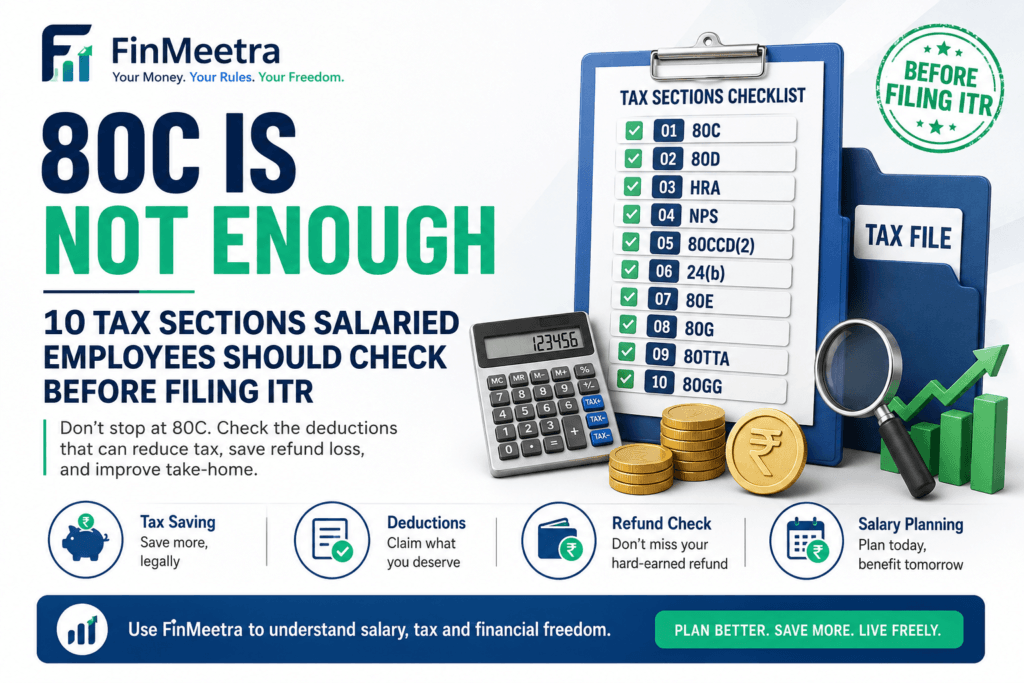
80C is important, but it is not the full tax-saving game for salaried employees. Under the old tax regime, employees can usually explore sections and exemptions such as 80C, 80D, HRA, 80CCD(1B), 80CCD(2), Section 24(b), 80E, 80G, 80TTA and other situation-specific deductions. Under the new tax regime, many Chapter VI-A deductions like 80C and 80D are generally not available, while selected benefits such as employer NPS under 80CCD(2) may still matter. So the right question is not “How do I finish 80C?” The right question is “Which tax sections actually apply to my salary, rent, insurance, loans, family and regime?”
| FinMeetra verdict If you only chase 80C, you may buy products you do not need and still miss bigger salary-tax benefits. Start with your tax regime, then check HRA, health insurance, NPS, home loan, education loan and proof readiness before making any March decision. |
Rahul Finished 80C. Still His Refund Looked Smaller.
Rahul is 30, works in Hyderabad and earns ₹18 LPA. Every year, he hears the same tax advice from office friends: “Bro, just complete 80C.” So he does what many salaried employees do. He checks EPF, buys some ELSS, pays life insurance premium and proudly reaches ₹1.5 lakh under 80C.
Then Form 16 arrives. His refund is lower than expected. His monthly TDS was also higher than it should have been. Rahul is confused. He completed 80C. What else does tax want from him? A temple offering? A payroll sacrifice? A spreadsheet with incense sticks?
The answer was boring but powerful. Rahul had missed health insurance deduction under 80D. He never checked whether employer NPS was available in his salary structure. He was paying rent but had not planned HRA correctly. His education loan interest was sitting untouched. His savings account interest was reported in AIS, but he never checked 80TTA. His 80C was full, but his tax plan was incomplete.
This is the 80C trap. It makes employees feel tax planning is finished when the real checklist has just started.
First Rule: Tax Sections Are Not the Same as Tax Saving Products
A tax section is a rule under the Income-tax Act that may allow a deduction, exemption or tax benefit. A tax-saving product is only one possible way to use a section. This difference matters because many employees treat tax planning like shopping. They ask, “Which product should I buy?” before asking, “Which section applies to me?”
For example, 80C can include EPF, PPF, ELSS, tuition fees, housing loan principal and life insurance premium. But if your employee PF already covers a large part of 80C, you may not need to buy another product just to complete the limit. At the same time, if you have health insurance premium, rent, NPS, home loan interest or education loan interest, those may sit outside the 80C conversation and still change your tax outcome.
Before you buy anything, connect this article with FinMeetra’s Rs.3 Lakh Tax Saving Mistake and PPF vs ELSS vs NPS Calculator. Those articles explain why tax saving should not become product panic.
The Big Regime Warning: Many Sections Work Mainly Under the Old Regime
This is the part employees must understand before making declarations. For AY 2026-27, the new tax regime is the default regime. Eligible non-business taxpayers can still choose the old regime while filing ITR, but payroll and Form 12BB planning must be aligned early. The old regime allows multiple deductions and exemptions, while the new regime has lower slab rates with fewer deductions.
| Do not skip this line 80C, 80D, HRA and many Chapter VI-A deductions generally help under the old regime. In the new regime, many of them may not reduce tax. Employer NPS under 80CCD(2) remains one of the important exceptions, subject to limits and employer structure. |
Use FinMeetra’s Old vs New Tax Regime Calculator before you make tax-saving investments or payroll declarations. Otherwise, you may spend money for deductions that your chosen regime does not even use.
The Salary Tax Sections Employees Forget
| Section | What It Covers | Broad Benefit | Regime Impact | Common Mistake |
| 80C | EPF, PPF, ELSS, life insurance, tuition, principal repayment | Up to ₹1.5 lakh combined with 80CCC/80CCD(1) | Old regime mostly | Do not ignore EPF already deducted from salary |
| 80D | Health insurance premium and preventive check-up | ₹25K or ₹50K buckets depending on senior citizen status | Old regime | Premium receipt, insurer name and policy number matter |
| HRA – Sec 10(13A) | Rent paid with HRA component | Least of formula values | Old regime | Rent receipt, landlord PAN if applicable and Form 12BB |
| 80CCD(1B) | Self contribution to NPS | Additional ₹50,000 | Old regime | Useful only if NPS fits your goals and lock-in comfort |
| 80CCD(2) | Employer contribution to NPS | 10%/14% of salary depending on regime/employer rules | Old and new regime relevance | Often hidden inside salary restructuring |
| 24(b) | Home loan interest | Self-occupied cap ₹2 lakh under old regime | Old regime for SOP; let-out rules differ | Interest certificate and property details |
| 80E | Interest on education loan | Interest paid, no fixed rupee cap shown in official guide | Old regime | For self or relative, bank/institution loan details needed |
| 80TTA / 80TTB | Savings bank interest / senior citizen deposit interest | ₹10K for 80TTA, ₹50K for 80TTB | Old regime | Match with AIS interest income |
| 80G | Eligible donations | Depends on donation category and qualifying limit | Old regime | Cash donation above ₹2,000 is not allowed for deduction |
| 80GG | Rent paid where HRA is not part of salary | Least of specified limits | Old regime | Form 10BA is mandatory |
The Salary Tax Section Finder Calculator
Before reading further, calculate your missing tax sections honestly. Enter your salary, tax regime, 80C, health insurance, NPS, HRA, home loan interest, education loan interest, savings interest and donation details. The calculator will show which tax sections you are using, which sections you may be missing and whether old or new regime looks better in your case.
Tax Section Check Before ITR Calculator
80C is not enough. Check 80D, HRA, NPS, home loan, education loan and more.
80C is not the full plan
After 80C, check HRA, 80D, NPS, loans, donations and interest income.
Regime decides value
Many deductions help mainly in the old regime. New regime may still win for low deductions.
Proof protects refund
Receipts, Form 16, AIS and Form 26AS should match before filing ITR.
What Your Calculator Result Means
| Result | Meaning | Action |
| Old regime wins by a large margin | Your deductions, HRA or loans are meaningful | Submit declarations and proof early |
| New regime wins | Lower slabs beat your available deductions | Do not buy products only for old-regime deductions |
| 80C gap remains | You have not used the ₹1.5 lakh bucket fully | First count EPF, tuition, principal repayment, then decide ELSS/PPF/NPS |
| 80D missing | Health insurance premium is not counted | Upload premium receipt and check family/parent buckets |
| HRA missing | Rent can help only if old regime and proof are correct | Read HRA guide and submit Form 12BB proof |
| Employer NPS opportunity | Salary structure may unlock benefit | Ask HR if 80CCD(2) option exists |
| Education loan/home loan missed | Interest deduction may be relevant | Keep certificates and enter correctly in ITR |
Section 80C: Useful, Famous and Still Not Enough
80C is famous because it is simple to remember. The combined limit for 80C, 80CCC and 80CCD(1) is ₹1.5 lakh. Salaried employees often use EPF, PPF, ELSS, life insurance premium, children’s tuition fees and housing loan principal repayment in this bucket.
But 80C has two problems. First, it gets filled quickly for employees with high EPF, tuition or housing loan principal. Second, it distracts people from other sections. If your 80C is already full, buying another tax-saving policy may not create additional deduction. It may only create another cash-flow commitment.
For a clean comparison between common 80C-style instruments, use the PPF vs ELSS vs NPS Calculator. For long-term investing clarity, also read How to Start SIP and the SIP Calculator.
Section 80D: The Health Insurance Section Employees Remember Too Late
80D is one of the most practical deductions because health insurance is not only a tax decision. It is a risk-management decision. For many salaried employees, 80D can apply to premium paid for self, spouse and dependent children, and separately for parents. The limits change depending on senior citizen status, and preventive health check-up is included within the overall bucket.
The mistake is simple. Employees often count only investments and forget protection. Then March arrives, tax planning starts, and they buy something they do not understand while ignoring the premium they already paid. If you have a health insurance receipt, do not let it sleep inside your email inbox like a forgotten office ID card.
HRA: The Salary Section That Depends on Regime, Rent and Proof
HRA can be powerful under the old tax regime, but it is not automatic. The exemption depends on actual HRA received, rent paid minus 10% of salary and 40% or 50% of salary depending on whether the rented house is in a metro city as defined for HRA purposes. The new regime generally does not allow HRA exemption.
This is why you should read FinMeetra’s Hidden HRA Benefit before selecting a regime. Same rent can create different tax results depending on salary structure and regime.
NPS: Two Different Tax Doors, One Often Missed
NPS confuses employees because there are two common doors. Self-contribution under 80CCD(1B) can give an additional deduction up to ₹50,000 under the old regime, subject to rules. Employer contribution under 80CCD(2) can be more powerful because it may remain relevant even when many other deductions do not work in the new regime, subject to salary percentage limits and employer policy.
Do not blindly do NPS only because someone said “extra ₹50,000 deduction.” NPS has lock-in, retirement rules and product structure. But also do not ignore it if your employer offers salary restructuring. It can be one of the rare places where tax planning and retirement planning shake hands without drama.
Section 24(b): Home Loan Interest Is Not the Same as 80C Principal
Home loan tax treatment has two different pieces. Principal repayment can sit inside 80C. Interest on borrowed capital is handled under Section 24(b), subject to limits and property type. For a self-occupied property under the old regime, the common cap is ₹2 lakh where conditions are met. For let-out property, the calculation and set-off rules can become more nuanced.
If your EMI is eating your salary, do not treat home loan tax benefit as “free money.” Use FinMeetra’s EMI Calculator to understand the real loan burden before celebrating a deduction.
Section 80E: Education Loan Interest Can Be a Quiet Refund Saver
80E allows deduction for interest paid on eligible education loan for higher education of self or relative. Many young employees miss it because the loan EMI feels like a personal burden, not a tax section. The principal portion does not become the hero here. The interest portion is the key.
If you are repaying an education loan, check your lender certificate. Match the interest paid with your ITR details. This one section can be the difference between “refund expected” and “tax payable” for employees who recently completed higher studies or supported family education.
80TTA, 80G, 80GG and Other Sections: Small Doors Still Matter
Not every tax section creates a huge benefit. Some sections are small, conditional or case-specific. But they matter because ITR filing is not only about large deductions. It is about not leaving valid claims unclaimed.
| Section | Who Should Check | Broad Benefit | Warning |
| 80TTA | Savings account interest for non-senior citizens | Up to ₹10,000 under old regime | Useful when AIS shows savings interest |
| 80TTB | Deposit interest for resident senior citizens | Up to ₹50,000 | Useful for parents/seniors filing return |
| 80G | Eligible donations | Depends on type of institution and qualifying limits | Keep receipt and avoid cash above ₹2,000 |
| 80GG | Rent deduction when HRA is not part of salary | Least of specified formula limits | Form 10BA mandatory |
| 80DD/80DDB/80U | Disability or specified medical cases | Flat or specified limits | Need documents, forms and eligibility check |
Case Study: How Rahul Found ₹86,000 of Missed Deductions
| Item | Before Check | After Section Review |
| Salary | ₹18 LPA | No change |
| 80C | ₹1.5 lakh already used | No extra benefit from buying more 80C products |
| 80D | ₹25,000 premium missed | Deduction restored after proof |
| HRA | Rent paid but proof incomplete | Exemption calculated after rent receipt and landlord details |
| NPS 80CCD(1B) | Not used | Considered ₹50,000 only after goal suitability check |
| Savings interest | ₹8,500 in AIS | 80TTA checked |
| Education loan interest | ₹11,000 missed | Certificate used |
| Total extra deductions found | ₹86,000+ | Tax and TDS projection improved |
Rahul did not become rich because of tax sections. He simply stopped leaking legal benefits. More importantly, he stopped buying extra products just because someone shouted “80C!” in the office cafeteria.
The 7-Step Salary Tax Section Action Plan
| Step | Action | Why It Matters |
| Step 1 | Choose old vs new regime using numbers | Regime decides whether most deductions matter |
| Step 2 | Check 80C already used through EPF and existing payments | Prevents overbuying tax products |
| Step 3 | Check HRA and rent proof | Can reduce TDS if old regime wins |
| Step 4 | Add 80D health insurance premium | Protection plus tax benefit |
| Step 5 | Check NPS self and employer contribution | Can change old vs new regime decision |
| Step 6 | Check loans: home loan, education loan, EV/home eligibility | Interest sections are often missed |
| Step 7 | Match Form 16, AIS, 26AS and proof documents before ITR | Avoids refund mismatch and tax notices |
After completing this section review, connect it with Stop Extra TDS From Salary and Form 16 Refund Check. Tax planning is not complete until payroll and ITR both tell the same story.
Tax Section Priority Order for Salaried Employees
| Priority | What to Do | Reason |
| 1 | Emergency fund and insurance first | Tax saving without financial safety is fragile |
| 2 | Use deductions already happening | EPF, tuition, existing insurance, loan interest |
| 3 | Compare old vs new regime | Do not assume old regime always wins |
| 4 | Fill gaps only with suitable products | ELSS/PPF/NPS must match your goals |
| 5 | Submit proof early | Late proof creates extra TDS shock |
| 6 | Verify Form 16 and AIS | Claims must match data trail |
If tax saving creates monthly surplus, do not let it vanish into lifestyle leaks. Use the Monthly Budget 50-30-20 Rule, build your Emergency Fund Guide and then invest through a planned SIP.
Key Takeaways
- 80C is important, but it is not the full salary tax plan.
- The old regime allows many deductions and exemptions, while the new regime has lower slabs and fewer deductions.
- HRA, 80D, NPS, home loan interest, education loan interest and 80TTA are commonly missed by salaried employees.
- Employer NPS under 80CCD(2) can matter even when many deductions do not work in the new regime, subject to limits and employer policy.
- Do not buy tax-saving products blindly just to complete 80C.
- Proof matters. Declaration without proof can become extra TDS later.
- Use the calculator before payroll declaration and again before filing ITR.
Frequently Asked Questions
Q: Is 80C enough for salaried employees?
A: No. 80C is useful, but salaried employees should also check HRA, 80D, NPS, home loan interest, education loan interest, 80TTA, 80G and other applicable sections depending on their income, expenses and regime.
Q: What is the 80C limit for salaried employees?
A: The combined deduction limit for 80C, 80CCC and 80CCD(1) is ₹1.5 lakh under the old regime, subject to conditions and eligible payments.
Q: Can I claim 80C in the new tax regime?
A: Generally, Chapter VI-A deductions such as 80C and 80D are not available in the new regime, except specified deductions such as 80CCD(2), 80CCH and 80JJAA as applicable.
Q: Which tax sections are best other than 80C?
A: The most useful sections depend on your life situation. For many salaried employees, HRA, 80D, 80CCD(1B), 80CCD(2), Section 24(b), 80E and 80TTA are worth checking.
Q: Is NPS better than ELSS for tax saving?
A: Not always. ELSS, PPF and NPS have different lock-in, risk, taxation and liquidity features. NPS can give additional deduction under 80CCD(1B) in the old regime, but it should fit your retirement plan.
Q: Can HRA and home loan both be claimed?
A: Possibly, depending on facts such as where you live, where the property is located, whether rent is actually paid and whether conditions are met. Do not assume automatically. Keep proper documents.
Q: What is the biggest tax section mistake employees make?
A: The biggest mistake is buying products to finish 80C without comparing old vs new regime and without checking existing EPF, HRA, 80D, NPS and loan-related deductions.
Q: When should I plan tax sections?
A: Start in April or May, not March. Review again after salary hike, job switch, rent change, loan repayment, bonus or family insurance purchase.
Q: Should I choose old regime if I have many deductions?
A: Maybe, but not always. You should calculate both regimes. Sometimes the new regime still wins even when some deductions exist.
Q: Can I claim missed deductions while filing ITR?
A: Some eligible deductions can be claimed while filing ITR if documents and eligibility are valid. But payroll TDS relief during the year needs timely declaration and proof submission.
Related Articles You Should Read Next
- Hidden Tax Savings in Salary Structure – Understand salary structure levers beyond basic deductions.
- Old vs New Tax Regime Calculator – Compare whether old or new regime works better before claiming deductions.
- Hidden HRA Benefit – Understand how rent and regime choice can change salary TDS.
- Stop Extra TDS From Salary – Fix declarations before payroll starts cutting too much TDS.
- Tax-Free Salary Benefits – Check food, fuel, phone bills and LTA style salary benefits.
- Form 16 Refund Check – Verify Form 16, AIS and deductions before filing ITR.
- Rs.3 Lakh Tax Saving Mistake – Avoid last-minute tax products that hurt your money.
- 20 LPA Salary Reality – Understand why high salary can still feel weak after tax and expenses.
- Financial Freedom Calculator – Convert tax savings into long-term freedom planning.
Useful External Resources
- Income Tax Department – Salaried Individuals AY 2026-27
- Income Tax Department – New Tax vs Old Tax Regime FAQs
- Income Tax India – Various Deductions under the Income-tax Act
- Income Tax India – Tax benefits due to life insurance, health insurance and medical treatment
- Income Tax Department – ITR-1 Validation Rules AY 2026-27
Enjoyed This Blog? Here Is What You Can Do Next:
- Leave a Comment – Which tax section did you discover after reading this?
- Subscribe to FinMeetra Newsletter – Real data-backed salary, tax and wealth insights every week.
- Use the Salary Tax Section Finder Calculator – Check what you are missing beyond 80C.
Disclaimer
This blog is for educational and informational purposes only. It does not constitute financial advice, tax advice, legal advice, investment recommendation, payroll advice or product recommendation. Income tax rules, deduction eligibility, limits, documents, tax regime treatment, HRA rules, NPS treatment, housing loan rules, education loan rules, donations and proof requirements may vary by financial year, employer policy, taxpayer profile and personal facts. Please verify using official Income Tax resources, Form 16, AIS/TIS, Form 26AS, employer payroll portal and a qualified tax professional before taking action.
© 2026 FinMeetra.com | All Rights Reserved