
(The practical tax declaration and payroll TDS guide every Indian salaried employee should read before January salary shock.)
Quick Answer
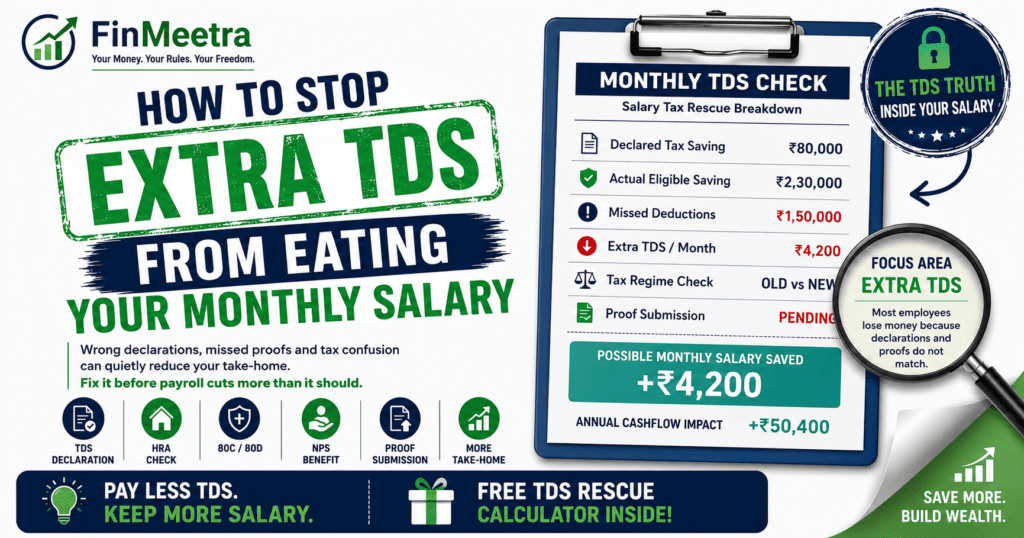
Extra TDS eats your monthly salary when your employer estimates a higher annual tax than your actual tax liability. This usually happens because you did not submit tax declarations, forgot HRA rent proof, missed 80C or 80D claims, selected the wrong tax regime, ignored NPS, failed to report previous employer income, or submitted proofs too late in the financial year. The fix is not panic in March. The fix is to compare old vs new regime, submit Form 12BB declarations correctly, upload proofs before payroll cutoff, track TDS deducted every month, and revise your declaration whenever salary, rent, bonus or job changes.
In simple words: your company is not “taking extra tax” randomly. Payroll is using the information available with it. If your information is incomplete, your monthly salary becomes the battlefield.
Priya’s January Salary Looked Wrong. The Problem Was Not Her Salary.
Priya works in Pune and earns ₹18 LPA. From April to December, her monthly in-hand salary felt stable. Then January arrived like a small financial villain wearing an HR portal badge. Her salary credit dropped by almost ₹18,000.
She checked her payslip. The culprit was TDS. Her first thought was simple: “Why is the company cutting so much tax now?”
Then she opened the tax declaration section. The truth was sitting there quietly. She had planned ELSS investment but never updated 80C. She was paying rent but had not uploaded rent receipts. She had health insurance but entered the policy amount incorrectly. She had selected old regime in April without comparing the new regime. Her employer did not know her real tax position, so payroll assumed higher taxable income and started recovering TDS in the remaining months.
This is how extra TDS eats salary. Not with one big bite. With monthly nibbles that look small until your bank balance starts wheezing.
First, Understand What Salary TDS Actually Means
TDS on salary means tax deducted at source by your employer based on your estimated annual taxable income. Every month, payroll estimates how much tax you may owe for the full year and deducts a portion from your salary. If your employer believes your final tax will be higher, monthly TDS rises. If your employer accepts your valid deductions and exemptions, TDS may reduce.
The key word is estimated. TDS is not always your final tax. It is a running estimate based on salary, bonus, declarations, proof, regime choice, previous employer income and payroll rules. Your actual final tax gets settled when you file your income tax return, but the damage to monthly cash flow happens much earlier.
This is why a salaried employee should not wait for ITR season to think about tax. Salary tax planning is a payroll-year habit, not a July filing-season hobby.
| Payroll Item | What It Means | Why It Can Cut Salary |
| Projected annual salary | Employer estimates full-year salary income | Bonus, hike or job switch can increase taxable income |
| Tax declaration | You tell employer what deductions/exemptions you plan | If not declared, payroll may ignore them |
| Tax proof | You prove what you declared | If proof is rejected, TDS can jump |
| Tax regime | Old or new regime selection | Wrong regime can increase tax silently |
| Previous employer income | Salary and TDS from earlier company | Missing it can create tax shock later |
| Remaining months | Months left in the financial year | Late correction gets recovered in fewer payslips |
Why Extra TDS Suddenly Starts Eating Monthly Salary
Most employees feel TDS pain in December, January, February and March. That is because payroll proof verification usually happens around that period. If your employer removes unverified deductions, the remaining months have to recover extra tax. A tax amount that should have been spread across 12 months suddenly gets compressed into three or four months. The result is salary shock.
Imagine your annual extra tax due to missed proof is ₹60,000. If it was deducted evenly from April, it would feel like ₹5,000 per month. But if payroll identifies the issue in January with only three months left, it can feel like ₹20,000 per month. Same tax. Different pain.
| Situation | Annual Tax Gap | Months Left | Monthly Salary Impact |
| Declaration corrected in April | ₹60,000 | 12 | ₹5,000/month |
| Declaration corrected in October | ₹60,000 | 6 | ₹10,000/month |
| Proof rejected in January | ₹60,000 | 3 | ₹20,000/month |
| Proof ignored until March | ₹60,000 | 1 | ₹60,000/month shock |
This is the same reason FinMeetra’s salary articles repeatedly say: do not judge your salary only by CTC. What matters is real monthly take-home after tax, deductions, EMIs and life. If you have not read it yet, connect this article with the ₹20 LPA Salary Reality article and the Salary Hike Trap. Extra TDS can make even a good salary feel weak.
The Extra TDS Salary Leakage Calculator
Before reading further, calculate your TDS risk honestly. Enter your annual salary, HRA, rent, old/new regime, 80C, 80D, NPS, home loan interest, declared amount, proof submitted amount, months paid and TDS already deducted. The calculator will show whether incomplete declaration is reducing your monthly salary and how much you may be able to protect.
Extra TDS Salary Leakage Calculator
Find how missed tax declaration can reduce your monthly salary
Declaration is not proof
Declaration tells payroll your plan. Proof confirms it. Missing proof can reverse the benefit.
January shock is avoidable
Late submissions force remaining months to absorb extra tax. Fix early to protect take-home.
Regime choice matters
Old regime helps only when deductions beat the new regime advantage. Compare every year.
What Your Calculator Result Means
| Result | Meaning | Action |
| Extra TDS is ₹0 to ₹10,000 | Your declarations and actual position are close | Still keep proof ready before payroll deadline |
| Extra TDS is ₹10,000 to ₹50,000 | Some claims may be missing or under-declared | Update 80C, HRA, 80D, NPS or home loan proof |
| Extra TDS is above ₹50,000 | Salary leakage risk is serious | Compare regime and submit proof urgently |
| Payroll TDS/month is much higher than correct TDS/month | Remaining months are absorbing correction | Ask payroll for revised TDS projection after proof upload |
| New regime is better | Old deductions may not help enough | Avoid forced tax-saving products just for deduction |
| Old regime is better | Deductions and HRA are valuable for you | Submit Form 12BB and proofs properly |
The 9 Mistakes That Create Extra TDS on Salary
Mistake #1: Confusing Tax Declaration With Tax Proof
Tax declaration is your promise. Tax proof is the evidence. In April or May, many companies ask employees to declare expected investments and deductions. Later, they ask for proofs. If you declared ₹1.5 lakh under 80C but submit proof for only ₹50,000, payroll may remove the remaining ₹1 lakh deduction and increase TDS.
The painful part is not only the tax. The painful part is timing. If proof is rejected late, the recovery happens in fewer months.
Mistake #2: Selecting Old Regime Without Comparing New Regime
The new regime is the default tax regime for many individual taxpayers, while eligible non-business taxpayers can generally choose the old regime every year in the return. But payroll declarations require a practical choice early in the year. Many employees select old regime because they remember 80C, HRA and LIC from older tax-saving conversations. Others select new regime because it looks simpler. Both can be wrong depending on your salary and deductions.
If you have high HRA, rent, 80C, 80D, NPS and home loan interest, old regime may still work. If your deductions are weak, new regime may give lower tax without complicated proofs. Use FinMeetra’s Old vs New Tax Regime Calculator before you commit.
Mistake #3: Not Updating HRA Proof Properly
HRA is one of the biggest old-regime salary tax levers, but it is also one of the most commonly rejected areas. Employees forget rent receipts, landlord PAN, rental agreement, payment proof or city classification. HRA exemption is not simply “rent paid.” It depends on actual HRA received, salary, city and rent paid over 10% of salary. If your annual rent exceeds ₹1 lakh, landlord PAN is commonly required by employers.
| HRA Requirement | Why It Matters | Common Problem |
| Rent receipts | Basic proof for employer | Employee uploads only one month receipt |
| Landlord PAN if applicable | Needed for higher annual rent | PAN missing or wrong |
| Rental agreement | Supports relationship and address | Agreement not renewed |
| Payment trail | Shows rent was actually paid | Cash payments without proof |
| Correct city type | Metro/non-metro affects formula | Employee selects metro incorrectly |
Mistake #4: Under-Declaring 80C Because You Do Not Count EPF
Section 80C is not only ELSS. It can include employee PF, PPF, ELSS, life insurance premium, tuition fees, tax-saving FD, principal repayment on housing loan and other eligible items subject to limits. Many salaried employees forget that their employee PF already consumes a part of 80C. Then they either under-declare or overbuy tax-saving products in March.
This is where your tax planning should connect with your investing plan. If you are confused between PPF, ELSS and NPS, use FinMeetra’s PPF vs ELSS vs NPS Calculator and read the ₹3 Lakh Tax Saving Mistake before buying random products.
Mistake #5: Forgetting 80D Health Insurance Premium
Health insurance premium under 80D is often missed because employees confuse sum insured with premium. If your policy cover is ₹10 lakh, that does not mean your deduction is ₹10 lakh. Deduction is based on eligible premium paid, subject to limits. Keep policy copy, premium receipt and payment proof ready. If parents are covered, check whether the parent deduction is separately available and whether senior citizen limits apply.
Mistake #6: Ignoring NPS Because It Feels Like Retirement Money
NPS is not for everyone, but for some employees it is a strong tax planning lever. Self-contribution under 80CCD(1B) can help under the old regime up to its applicable limit. Employer NPS contribution can be valuable in both salary structuring and tax planning, subject to limits and employer policy. The important point is not “everyone should do NPS.” The point is: do not ignore it without calculating.
Mistake #7: Missing Previous Employer Income After Job Switch
If you changed jobs during the year, your new employer may not automatically know your previous salary and TDS unless you submit the required details. If both employers give basic exemption or slab benefit independently, your final annual tax can be higher than payroll expected. This is a classic job-switch tax trap. It connects directly with FinMeetra’s Offer Letter Trap because a higher CTC can look better until tax, PF, variable pay and TDS timing enter the room.
Mistake #8: Planning Investments in March Instead of April
March tax-saving is like doing exam preparation in the parking lot outside the exam hall. Sometimes you pass. Mostly you buy the wrong thing. If your 80C is short, your emergency fund is weak and your cash flow is already tight, last-minute ELSS or insurance decisions can create another problem. Tax saving should support your financial plan, not kidnap it.
Start with your emergency fund first. Then plan insurance. Then choose investments. FinMeetra’s Emergency Fund Guide and SIP Calculator can help you convert tax-season panic into a monthly system.
Mistake #9: Not Checking Payslip TDS Every Month
Most employees check net salary, not TDS. That is a mistake. Your payslip has clues. If TDS suddenly jumps, ask why immediately. Do not wait three months. Check YTD taxable income, YTD tax deducted, proof approval status, regime selection and any bonus or arrears added. A payslip is not only a receipt. It is a monthly tax dashboard hiding in plain clothes.
The 7-Step TDS Rescue Plan for Salaried Employees
| Step | Action | Why It Works |
| Step 1 | Download latest payslip and tax projection | Find current TDS and projected annual tax |
| Step 2 | Compare old vs new regime | Avoid choosing regime by memory or WhatsApp advice |
| Step 3 | List actual eligible deductions | HRA, 80C, 80D, NPS, home loan, professional tax |
| Step 4 | Check what is declared in HR portal | Find the gap between actual and declared |
| Step 5 | Upload proof before cutoff | Prevents proof rejection and TDS jump |
| Step 6 | Ask payroll for revised TDS projection | Confirms whether salary will normalize |
| Step 7 | Track Form 26AS/AIS and Form 16 | Final check before filing ITR |
Case Study: How Priya Protected ₹54,000 of Salary Cash Flow
Priya did not “save” ₹54,000 by magic. She stopped unnecessary monthly TDS by correcting her declarations before the final payroll freeze.
| Item | Before Correction | After Correction | Impact |
| Annual salary | ₹18 LPA | ₹18 LPA | No salary change |
| Regime selected | Old regime | Old regime after comparison | Confirmed with calculator |
| 80C declared | ₹50,000 | ₹1,50,000 | ₹1,00,000 deduction gap fixed |
| HRA proof | Not uploaded | Rent receipts + landlord PAN uploaded | HRA exemption restored |
| 80D premium | Not declared | ₹25,000 declared | Health premium counted |
| Employer projected annual tax | ₹2.95 lakh | ₹2.41 lakh | ₹54,000 lower projection |
| Monthly salary impact over 3 months | ₹18,000 extra TDS risk | Salary protected | Cash flow improved |
The lesson is simple: extra TDS is often not a tax problem. It is an information timing problem. Payroll cannot give you the benefit of details you never submitted.
Tax Declaration Checklist Before Payroll Closes
| Checklist Item | Done? |
| Download payroll tax projection | ☐ |
| Compare old vs new regime | ☐ |
| Check Form 12BB / employer declaration portal | ☐ |
| Upload rent receipts and landlord PAN if applicable | ☐ |
| Confirm 80C amount including EPF, PPF, ELSS, tuition, principal repayment | ☐ |
| Upload 80D premium receipt, not only policy document | ☐ |
| Check NPS self and employer contribution eligibility | ☐ |
| Upload home loan interest certificate if claiming | ☐ |
| Submit previous employer salary and TDS details after job switch | ☐ |
| Recheck TDS in next payslip after proof approval | ☐ |
Where Should the Saved Monthly Cash Flow Go?
If correcting TDS improves your monthly salary by ₹5,000, ₹10,000 or ₹20,000, do not let the money disappear into food delivery, upgrades and “small” lifestyle leaks. Extra take-home is not automatically wealth. It becomes wealth only when you give it a job.
| Monthly Salary Protected | First Priority | Second Priority | Wealth Move |
| ₹5,000 | Build emergency fund | Avoid credit-card carry forward | Start SIP after safety |
| ₹10,000 | Split between emergency fund and debt | Increase insurance quality if needed | Step-up SIP slowly |
| ₹20,000 | Close expensive debt faster | Create 3-6 months emergency fund | Invest surplus monthly |
| ₹50,000+ | Do not inflate lifestyle immediately | Plan goals and taxes together | Build financial freedom corpus |
Once salary cash flow stabilizes, connect this with FinMeetra’s Monthly Budget 50-30-20 Rule, Emergency Fund Guide and When Will You Become Financially Free Calculator. Tax planning should not end at lower TDS. It should create better cash flow, better saving and better freedom.
Key Takeaways
✅ Extra TDS usually happens because payroll has incomplete or incorrect information.
✅ Declaration and proof are different. Declaration alone may not protect salary.
✅ Old vs new regime comparison should be done every year, not only once in life.
✅ HRA, 80C, 80D, NPS and home loan interest can affect old-regime TDS, subject to eligibility.
✅ In the new regime, many old deductions do not help, but employer NPS can still be important subject to rules.
✅ Job switchers must submit previous employer salary and TDS details to avoid year-end tax shock.
✅ Late proof submission compresses tax recovery into fewer months and creates salary shock.
✅ Use the calculator, fix declarations early and track payslip TDS every month.
Frequently Asked Questions
Q: Why is my company deducting extra TDS from salary?
A: Your employer deducts TDS based on estimated annual taxable income. If your declarations, proofs, previous employer income or regime selection are incomplete, payroll may estimate higher tax and deduct more monthly TDS.
Q: Can I stop extra TDS immediately?
A: You can reduce future payroll TDS only if your employer still allows declaration or proof updates and accepts them before payroll cutoff. Already deducted TDS may be adjusted in later payroll or refunded after ITR filing, depending on your case.
Q: What is the difference between tax declaration and proof submission?
A: Declaration is your estimate of deductions and exemptions. Proof submission is the evidence, such as rent receipts, investment statements, insurance receipts, NPS proof or home loan certificates.
Q: Does HRA reduce TDS under the new regime?
A: Generally, HRA exemption is linked to the old regime. In the new regime, many exemptions and deductions are not available. Compare both regimes before deciding.
Q: Which is better for salary TDS, old regime or new regime?
A: It depends on your income and deductions. Old regime may help if you have meaningful HRA, 80C, 80D, NPS, home loan interest and other eligible deductions. New regime may be better if you have fewer deductions.
Q: Why does TDS increase in January or February?
A: Employers often verify proof in the last quarter. If proofs are missing or rejected, payroll removes the assumed deduction and recovers extra tax in the remaining months.
Q: What should job switchers do to avoid extra TDS?
A: Submit previous employer salary, deductions and TDS details to the new employer. Otherwise, both employers may calculate tax separately and final annual tax can become higher than expected.
Q: Will extra TDS be refunded automatically?
A: If excess TDS is deducted and your final tax liability is lower, you may claim refund while filing ITR. But refund timing depends on return filing, processing and verification.
Q: Is Form 16 enough to manage TDS?
A: Form 16 comes after the year ends. To protect monthly salary, track payslip TDS and payroll projection during the year.
Q: What is the best month to plan salary tax declaration?
A: April or May is ideal. Review again after bonus, rent change, salary hike, job switch or major investment changes.
Related Articles You Should Read Next
• Hidden Tax Savings in Salary Structure — Understand the tax-saving levers inside CTC and salary structure.
• Old vs New Tax Regime Calculator — Compare which regime gives lower tax before declaring payroll choice.
• PPF vs ELSS vs NPS Calculator — Choose tax-saving investments without random March panic.
• Rs.3 Lakh Tax Saving Mistake — Avoid year-end tax products that damage long-term money decisions.
• You Earn ₹20 LPA Salary. Why Does It Feel Poor? — See how tax, EMI and lifestyle reduce real salary comfort.
• The Salary Hike Trap — A raise is useful only if post-tax cash flow improves.
• The Offer Letter Trap — Compare CTC, tax, PF, variable pay and take-home before switching jobs.
• Emergency Fund Guide — Use protected salary cash flow to build safety first.
• SIP Calculator — Turn saved TDS cash flow into long-term wealth.
Useful External Resources
• Income Tax Department – Salaried Individuals AY 2026-27
• Income Tax Department – Income and Tax Calculator
• Income Tax India – Allowances allowable to taxpayer
• Income Tax Department – New Tax vs Old Tax Regime FAQs
• India Budget – Finance Bill 2026
────────────────────────────────────────────────────────────
📩 ENJOYED THIS BLOG? HERE IS WHAT YOU CAN DO NEXT:
💬 Leave a Comment — Has your salary ever dropped suddenly because of extra TDS?
📧 Subscribe to FinMeetra Newsletter — Real data-backed salary, tax and wealth insights every week.
🧮 Use the Extra TDS Salary Leakage Calculator — Check if missed declaration is cutting your salary.
Disclaimer
This blog is for educational and informational purposes only. It does not constitute financial advice, tax advice, legal advice, investment advice, career advice or payroll advice. Income tax rules, surcharge, cess, rebates, salary structures, HRA eligibility, proof requirements, Form 12BB process, NPS limits, home loan rules, employer payroll treatment and deduction eligibility may vary by taxpayer, employer, financial year and personal circumstances. Please verify using official Income Tax resources, your employer payroll team, Form 16, Form 26AS, AIS/TIS and a qualified tax professional before taking action.
© 2026 FinMeetra.com | All Rights Reserved



Pingback: Before You File ITR, Read This Once: The Salaried Employee Checklist That Can Save Your Refund