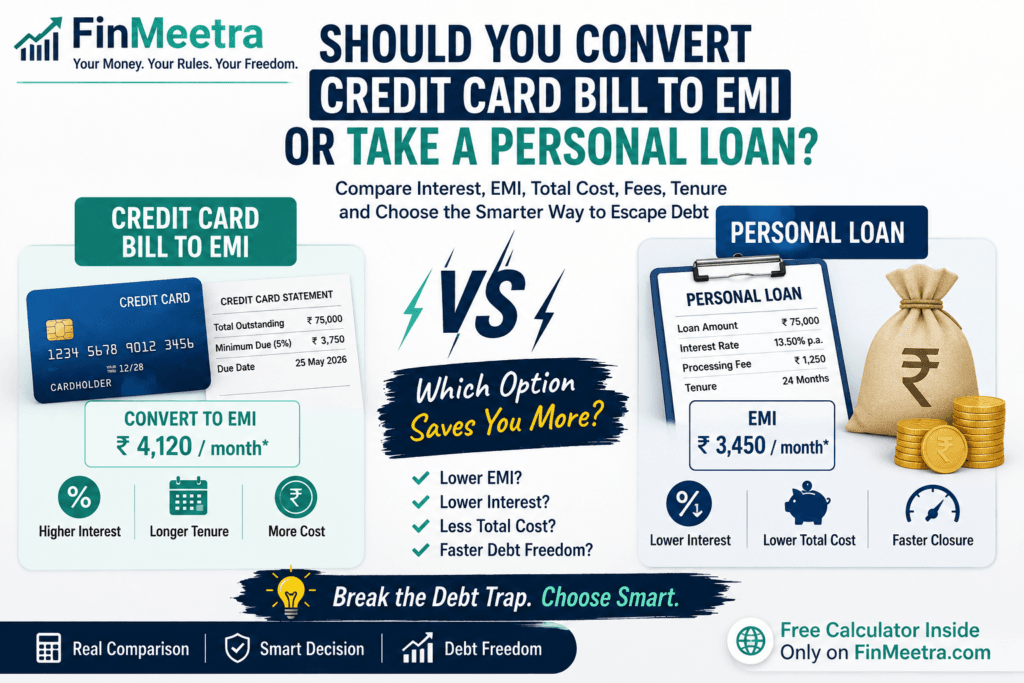
(The salaried employee guide to comparing credit card EMI, personal loan, interest cost, processing fees, tenure, CIBIL impact and monthly salary pressure.)
Quick Answer
Is it viable to Convert Credit Card bill to EMI or to take Personal loan to clear credit card? Read below
| Quick Answer If your credit card bill is too large to pay fully, converting it to EMI may reduce immediate pressure, but it is not automatically the cheapest solution. A personal loan may be better if it offers a lower effective interest rate, clear tenure, lower total cost, and you use it only to close the card debt. But if taking a personal loan frees your credit card limit and you start spending again, you have not solved debt. You have only changed the costume of the same problem. |
The right decision is not based only on the lowest EMI. You need to compare total interest, processing fees, GST, foreclosure rules, tenure, monthly affordability, and whether the new EMI helps you escape debt or simply makes the problem look neat on paper.
Before deciding, understand one thing clearly: credit card debt is not normal debt. It is expensive, fast-moving and emotionally tricky. If you are still paying only minimum due, first read FinMeetra’s Credit Card Minimum Due Trap guide so you know why the outstanding refuses to fall even after monthly payments.
Why This Decision Matters So Much for Salaried Employees
For many salaried employees, the credit card bill does not explode in one month. It builds quietly. One emergency purchase, one festive sale, one medical bill, one travel booking, one school fee payment, one month of low salary after deductions – and suddenly the card outstanding becomes bigger than monthly take-home.
Then two rescue options appear: convert the credit card bill to EMI or take a personal loan and close the card bill. Both look better than revolving credit card interest. But both also create a fixed monthly obligation. If your salary already has home loan EMI, car EMI, personal loan EMI or family expenses, one more EMI can turn your bank account into a railway platform at month-end: crowded, noisy and no seat available.
This is why the decision has to connect with real cash flow. If your salary looks good on paper but still disappears after EMI, tax and card payments, FinMeetra’s 20 LPA salary cash-flow breakdown will help you see how high income can still feel tight when fixed commitments become too heavy.
Credit Card EMI vs Personal Loan: What Are You Actually Choosing?
When you convert a credit card bill to EMI, the bank allows you to repay the outstanding in fixed monthly instalments instead of paying the full bill immediately. The EMI may include interest and processing charges. Sometimes a merchant EMI or no-cost EMI may work differently, but for debt conversion, you should assume there is a cost unless the issuer clearly proves otherwise.
When you take a personal loan to close credit card debt, you borrow a separate loan amount, use it to pay the credit card fully, and then repay the personal loan over a fixed tenure. The personal loan may have a lower annual rate than credit card revolving interest, but it may also include processing fee, GST, insurance add-ons, prepayment conditions and documentation.
| Option | What Happens | Main Benefit | Main Risk |
| Credit card EMI | Existing card bill becomes fixed instalments | Fast and convenient; no fresh loan process in many cases | May have higher interest than personal loan and keeps card limit psychology alive |
| Personal loan | New loan is taken and card bill is paid fully | Can reduce interest cost if rate is lower and discipline is strong | Can become debt swap if card spending starts again |
| Pay aggressively without conversion | You pay more than minimum due every month | No new loan; maximum flexibility | Needs strong cash-flow control and no new card spending |
| Balance transfer or lower-rate option | Debt moves to another lender/card offer | May reduce short-term interest burden | Charges and teaser rates can confuse total cost |
The FinMeetra Credit Card EMI vs Personal Loan Calculator
Use the calculator before talking to a bank representative. Enter your card outstanding, card EMI interest rate, personal loan interest rate, processing fees, GST, tenure and monthly affordability. The calculator estimates EMI, total interest, total cost, fee impact and gives a practical verdict.
Debt Clearance Order Calculator
Find which EMI or loan deserves your next extra rupee
Bring overdue current
Late or missed payments need immediate attention before optimization.
Attack toxic debt
Credit card revolving balances and app loans usually deserve priority.
Redirect freed EMI
When one loan closes, send that EMI to the next debt instead of spending it.
What Your Calculator Result Means
| Result | Meaning | Action |
| Credit card EMI cheaper | Card EMI total cost is lower than personal loan cost | Confirm interest rate, fees and whether new purchases will remain interest-free |
| Personal loan cheaper | Loan has lower total cost after interest and processing fee | Use loan only to close card debt; freeze card spending until stable |
| EMI too high for salary | Monthly obligation may damage cash flow | Increase tenure carefully or reduce lifestyle expenses before choosing |
| Tenure too long | Low EMI hides high total interest | Try higher monthly payment or part-prepayment plan |
| Debt trap risk high | You may take a loan but continue using card | Block card usage, create budget and close debt first |
| Pay directly possible | You can clear debt in 2-4 months without new loan | Avoid conversion if direct payoff cost is lower |
Do Not Choose Based Only on EMI
A lower EMI can be useful, but it can also be a beautifully wrapped trap. A ₹4,000 EMI for 36 months may feel easier than ₹9,000 for 12 months, but the longer option may cost much more in total interest. The bank account sees EMI. Your financial life sees total cost.
The better question is not: Which EMI is lower? The better question is: Which option closes the debt fastest without breaking monthly survival?
If you already use FinMeetra’s EMI Calculator, you know that tenure can quietly change the real cost of borrowing. The same thinking applies here: a small monthly EMI can still become an expensive long road.
Example: ₹1,20,000 Credit Card Outstanding
Consider a salaried employee with ₹1,20,000 credit card outstanding. The employee cannot pay it fully this month. The bank offers credit card EMI at 20% annual rate for 18 months with 1.5% processing fee. A personal loan offer is available at 14% annual rate for 18 months with 2% processing fee.
| Item | Credit Card EMI | Personal Loan | What It Means |
| Outstanding amount | ₹1,20,000 | ₹1,20,000 | Same debt base |
| Interest rate used | 20% p.a. | 14% p.a. | Loan rate looks cheaper |
| Tenure | 18 months | 18 months | Same repayment period |
| Processing fee | 1.5% | 2% | Personal loan fee may be higher |
| Monthly EMI | Higher | Lower | Loan may ease cash flow |
| Total cost | Depends on fees and EMI math | Often lower if rate gap is meaningful | Do not ignore fees |
| Behaviour risk | Card limit may reopen | Card can be paid off fully | Discipline decides final result |
In this kind of case, the personal loan may look better because the interest rate is lower. But the decision is not complete until the employee checks whether there is any foreclosure penalty, insurance add-on, GST on fees, prepayment flexibility and whether the credit card will be stopped from further use.
When Credit Card EMI Can Be Better
Credit card EMI can be useful when the amount is moderate, tenure is short, charges are transparent and you are confident that you will not continue spending on the same card. It is also convenient because the bank may already show an EMI conversion option in the app.
| Credit Card EMI May Work If | Why |
| The amount is manageable | You can close it within a short tenure without stretching salary |
| Interest rate is clearly lower than revolving credit | It stops the uncontrolled interest cycle |
| Processing fee is low | Total cost does not rise unnecessarily |
| You will not add new card spending | Debt reduction stays real |
| You need quick restructuring | No long approval process may be needed |
| Your CIBIL discipline is otherwise clean | Fixed EMI repayment can be easier to track |
But never convert just because the app shows a green button saying “easy EMI.” Easy is not the same as cheap. EMI is a payment structure. It is not a discount.
When a Personal Loan Can Be Better
A personal loan can be better when the interest rate is meaningfully lower than credit card EMI or revolving credit, the tenure is controlled, and you use the loan only to close credit card debt. It can also help psychologically because the card bill becomes zero and the repayment becomes a fixed loan schedule.
| Personal Loan May Work If | Why |
| Credit card interest is very high | Loan may reduce annual borrowing cost |
| You have multiple card balances | One structured loan may be easier to track |
| You can get a clean rate and low processing fee | Total cost may become lower |
| You will close or lock card usage | Debt does not return through fresh spending |
| You need a fixed repayment plan | Clear EMI and tenure create discipline |
| You can prepay without heavy charges | Bonus or surplus can reduce interest later |
Before taking any loan, also check whether the new EMI will affect your other goals. If the loan EMI eats your emergency surplus, revisit FinMeetra’s Emergency Fund Guide before stretching yourself too thin. A debt solution that removes all safety can become the next crisis.
The Hidden Risk: Debt Swap Without Behaviour Change
The biggest danger is not credit card EMI. It is not personal loan. The biggest danger is debt swap without behaviour change.
Debt swap means you take a new loan to close old debt, but your monthly habits remain unchanged. The credit card gets paid. The limit becomes available. Salary feels lighter for a few weeks. Then spending starts again. After a few months, you have both personal loan EMI and a new credit card outstanding. That is not consolidation. That is debt cloning.
| Debt Swap Warning Sign | What It Means | Fix |
| You plan to keep using the card normally | Debt may return quickly | Freeze non-essential card spending |
| You are borrowing to protect lifestyle | Expense base is too high | Cut spending before taking new loan |
| You choose longest tenure only for low EMI | Interest cost may rise | Pick shortest affordable tenure |
| You do not know monthly surplus | No repayment clarity | Create a written cash-flow plan |
| You already have many EMIs | New EMI may choke salary | Use debt avalanche/snowball planning |
| You are hiding debt from yourself | Stress may increase | List all debts honestly |
If your salary increases but debt still grows, pause and read FinMeetra’s Salary Hike Trap guide. More income helps only when the old leakage is repaired. Otherwise, a salary hike becomes a bigger pipe feeding the same debt hole.
Credit Score and CIBIL Impact: What to Think About
Paying credit card dues on time generally matters for credit discipline. Missing payments, rolling balances for long periods, high credit utilisation and repeated loan enquiries can hurt borrowing comfort. Converting to EMI or taking a personal loan does not automatically solve credit score risk. The real solution is timely repayment and reducing outstanding debt.
A personal loan can reduce credit card utilisation if the card bill is paid fully. But it also adds a new loan account and EMI obligation. Credit card EMI can make repayment structured, but your card limit, billing rules and available credit may be affected depending on issuer policy. Always confirm how the conversion will reflect in your statement and credit report.
| FinMeetra Rule Do not choose the option that only looks good this month. Choose the option that reduces total debt, protects monthly cash flow and prevents fresh borrowing. |
The 7-Step FinMeetra Decision Framework
| Step | Action | Why It Matters |
| Step 1 | Write total card outstanding, not just minimum due | You need the real debt number |
| Step 2 | Ask for credit card EMI rate, tenure, fees and GST | Convenience can hide cost |
| Step 3 | Ask for personal loan APR, processing fee and foreclosure rules | Low EMI alone is not enough |
| Step 4 | Compare total cost using calculator | Interest + fees decide real cost |
| Step 5 | Check salary surplus after all EMIs and expenses | A cheap loan can still break cash flow |
| Step 6 | Freeze or limit card spending until debt is closed | Prevents debt from returning |
| Step 7 | Create payoff plan and track monthly balance | Turns relief into actual recovery |
Salary Cash-Flow Test Before Choosing EMI or Loan
Before converting anything, run this simple salary test. Add your rent, household expenses, school fees, insurance, existing EMIs, credit card EMI or personal loan EMI, and monthly savings requirement. If the new EMI leaves no room for emergencies, the plan is fragile.
| Monthly Take-Home Situation | Debt Decision Risk | Suggested Approach |
| EMIs below 30% of take-home | Lower risk | Choose lower total cost option and close fast |
| EMIs 30%-45% of take-home | Moderate risk | Keep tenure realistic and cut discretionary spend |
| EMIs 45%-60% of take-home | High risk | Avoid new spending; consider counselling or restructuring |
| EMIs above 60% of take-home | Very high risk | Do not casually add EMI; speak to lender and plan aggressively |
| No emergency buffer | Cash-flow risk | Build small emergency cushion while repaying debt |
This is where a simple budget becomes powerful. Use FinMeetra’s Monthly Budget 50-30-20 Rule as a starting map, then adjust it for debt-heavy months. During debt repayment, your “wants” category may need to shrink temporarily so your future salary can breathe again.
Credit Card EMI vs Personal Loan: Decision Matrix
| Situation | Better Starting Option | Why |
| Small debt, can clear in 2-3 months | Pay directly without loan | Avoid fees and new loan account |
| Medium debt, card EMI rate reasonable | Credit card EMI | Convenient if total cost is acceptable |
| High card debt, personal loan much cheaper | Personal loan | Can reduce interest burden if card spending stops |
| Multiple cards and confusion | Structured personal loan or debt plan | Simplifies tracking but needs discipline |
| No control over spending | Neither option alone | Fix spending behaviour before debt swap |
| Very high EMI burden | Seek restructuring / professional advice | More borrowing can worsen stress |
Questions to Ask the Bank Before Saying Yes
- What is the annual interest rate or APR, not just monthly rate?
- What is the processing fee and GST on the fee?
- Will any insurance or add-on be included?
- Can I prepay or foreclose? If yes, what are the charges?
- Will the converted amount continue to block my credit card limit?
- Will new card purchases get interest-free period if old balance is converted?
- What happens if I miss one EMI?
- How will this be reported to credit bureaus?
- Can I get a repayment schedule before accepting?
- What is the total amount payable over the full tenure?
If the bank representative cannot clearly explain total cost, pause. Good debt decisions require written numbers, not phone-call confidence.
What Not to Do While Escaping Credit Card Debt
| Mistake | Why It Hurts | Better Move |
| Taking a personal loan and continuing card shopping | Debt doubles silently | Freeze card spending until loan reduces |
| Choosing longest tenure for comfort | Interest cost rises | Pick shortest affordable tenure |
| Ignoring processing fee | Total cost comparison becomes wrong | Include all fees and GST |
| Paying only minimum due while thinking about EMI | Interest continues | Decide and act quickly |
| Using emergency fund fully without plan | No safety left | Use partial fund and structured repayment |
| Borrowing from another card | Debt rotates, not reduces | Create one clear payoff plan |
A Simple Recovery Plan After Conversion
Once you choose credit card EMI or personal loan, the goal is not to feel relieved. The goal is to become free from the debt. Use this recovery plan:
- Stop all non-essential credit card spending for 90 days.
- Track every EMI and outstanding balance in one sheet.
- Pay more than EMI whenever bonus, refund or extra income comes.
- Do not take fresh debt for lifestyle spending.
- Keep a small emergency buffer so one surprise expense does not push you back to the card.
- Review progress every month and celebrate balance reduction, not only EMI payment.
When debt reduces and monthly cash flow becomes stable, connect the saved EMI amount to long-term goals. FinMeetra’s Financial Freedom Calculator can help you see how debt freedom becomes investment capacity later. Closing debt is not just about peace today. It is also about buying future choices.
Should You Use Bonus, Tax Refund or Salary Hike to Close Credit Card Debt?
Yes, if the credit card debt is expensive and you already have a small emergency cushion. High-interest debt usually deserves priority over lifestyle spending. A bonus used to close card debt may feel boring, but boring money decisions often build the most freedom.
If your salary increased recently, do not upgrade lifestyle immediately. First check whether the new salary actually improves cash flow after tax and deductions. FinMeetra’s Offer Letter Trap guide is useful if a job switch or higher CTC is tempting you to ignore the debt side of the equation.
Key Takeaways
- Credit card EMI and personal loan are both tools, not magic solutions.
- Do not compare only EMI. Compare total interest, fees, GST, tenure and prepayment rules.
- A personal loan may be cheaper if the rate is lower and you stop fresh card spending.
- Credit card EMI may be convenient but can still be costly if tenure and fees are ignored.
- Debt swap without behaviour change can create both loan EMI and fresh card debt.
- Credit score comfort depends on repayment discipline, utilisation and avoiding missed payments.
- Choose the shortest affordable repayment path, not the lowest-looking EMI.
- Build a small emergency buffer so one surprise expense does not restart the debt cycle.
- Use debt freedom to create savings, SIPs and long-term financial freedom.
Frequently Asked Questions
Q: Is it better to convert credit card bill to EMI or take a personal loan?
It depends on interest rate, fees, tenure, total cost and your salary cash flow. A personal loan may be cheaper if the rate is lower, but credit card EMI may be convenient for smaller amounts. Compare total cost before choosing.
Q: Does converting credit card bill to EMI reduce interest?
It can reduce interest compared with revolving credit card interest, but it may still carry interest and processing fees. Check the full repayment schedule before accepting.
Q: Is a personal loan good for closing credit card debt?
It can be useful if it has a lower cost and you use it only to close credit card debt. It becomes risky if you continue using the credit card and build fresh outstanding.
Q: Will credit card EMI affect my CIBIL score?
Timely repayment is important. Missed EMIs, high utilisation or repeated borrowing can affect credit health. Ask your issuer how the EMI conversion will reflect in billing and credit reporting.
Q: Should I pay minimum due or convert to EMI?
Minimum due keeps the card active but may not reduce debt meaningfully. If you cannot pay full bill, compare EMI conversion, personal loan and direct aggressive repayment.
Q: What is the biggest mistake while taking personal loan for credit card debt?
The biggest mistake is taking a personal loan, paying off the card, and then using the card again. That creates two debts instead of one solution.
Q: Can I prepay credit card EMI or personal loan?
Policies differ by lender. Always ask about foreclosure, part-payment and charges before accepting the conversion or loan.
Q: Which option has lower EMI?
Usually the option with lower interest rate or longer tenure may show lower EMI. But lower EMI does not always mean lower total cost.
Q: What if I have multiple credit cards?
List all balances, interest rates and minimum dues. Prioritize highest-cost debt and consider one structured plan only if it reduces total cost and improves discipline.
Q: What should I do after closing credit card debt?
Keep utilisation low, avoid fresh unnecessary debt, build an emergency fund and redirect freed-up EMI toward savings or investment goals.
Useful External Resources
- Reserve Bank of India – Credit card and debit card issuance and conduct guidance
- Reserve Bank of India – Credit card billing and minimum amount due disclosures
- Reserve Bank of India – Fair lending and penal charges FAQs
- Reserve Bank of India – Key Facts Statement and APR disclosure for retail loans
- TransUnion CIBIL – Credit report and score information
Related FinMeetra Guides to Read Next
If you are still paying only the minimum due, start with the Credit Card Minimum Due Trap. If you want to compare repayment schedules, use the EMI Calculator. If debt is eating your salary, rebuild your monthly plan with the 50-30-20 Budget Rule and protect yourself with the Emergency Fund Guide. Once the debt is under control, use the Financial Freedom Calculator to convert freed EMI into long-term progress.
Enjoyed This Blog? Here Is What You Can Do Next
- Leave a Comment – Have you ever converted a credit card bill to EMI or taken a personal loan to close card debt?
- Subscribe to FinMeetra Newsletter – Practical salary, tax, debt and financial freedom guides every week.
- Use the Credit Card EMI vs Personal Loan Calculator – Compare cost before choosing.
Disclaimer
This blog is for educational and informational purposes only. It does not constitute financial advice, credit advice, legal advice, tax advice, investment advice or lending advice. Credit card EMI terms, personal loan rates, processing fees, GST, foreclosure charges, credit bureau reporting, credit limit treatment, billing rules and repayment conditions may vary by bank, issuer, borrower profile, financial year and personal circumstances. Please verify all terms with your card issuer, lender, official documents and qualified professionals before taking a loan, converting a bill to EMI or making any borrowing decision.
© 2026 FinMeetra.com | All Rights Reserved