(Credit card dues, personal loan, car loan, home loan, app loans and small EMIs – the practical salaried employee guide to choosing what to close first.)
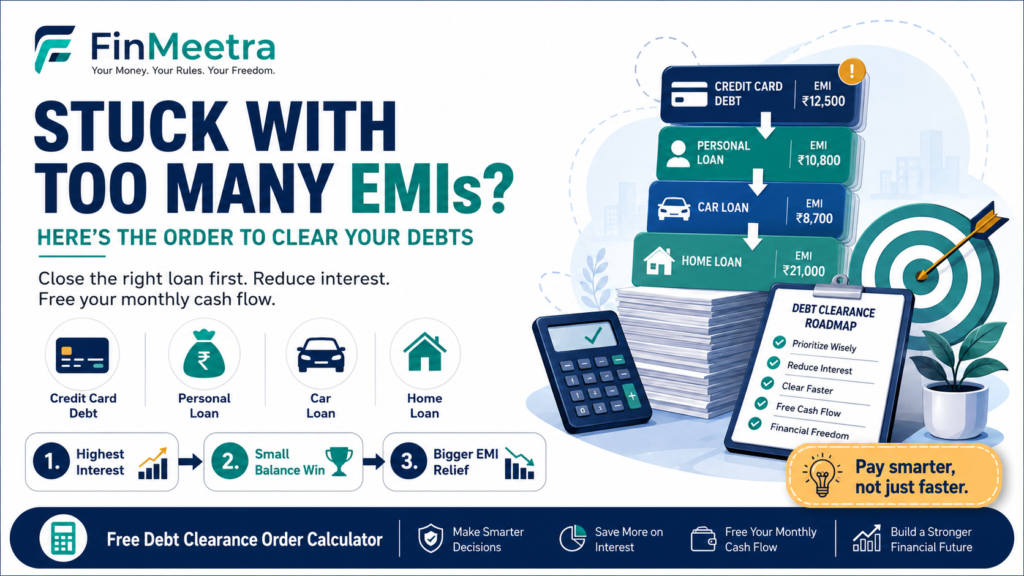
Featured Image Filename: blog40-too-many-emis-debt-order-featured.png – FinMeetra navy + green debt roadmap infographic style
Quick Answer
If you are stuck with too many EMIs, clear debts in this order: first pay anything overdue to protect your credit profile, then attack credit card revolving balances and other very high-interest debt, then expensive personal loans or app loans, then small loans that release monthly cash flow, then car or consumer loans, and finally low-cost long-term loans like home loans only after your emergency fund is stable. The right order is not always the smallest loan first. It is the debt that creates the highest combination of interest cost, stress, credit damage and cash-flow blockage.
| FinMeetra Principle Do not ask only “which loan has the smallest balance?” Ask “which debt is stealing the most future salary?” That one deserves attention first. |
Why Too Many EMIs Make Salary Feel Smaller Than It Is
A salaried employee can earn well and still feel broke when every month begins with deductions. Rent or home loan, personal loan EMI, car EMI, credit card payment, school fees, insurance, subscriptions and family expenses can turn salary day into a railway platform where everyone is waiting to collect their share.
If this sounds familiar, it connects directly with the FinMeetra guide on why a high salary can still feel poor. Income matters, but monthly cash-flow design decides whether that income feels useful.
The hidden danger is that people often clear debt emotionally. They close the smallest loan because it feels easy. They continue paying minimum due on credit cards because it looks manageable. They prepay a low-interest car loan because the outstanding is visible, while a high-interest credit card balance keeps boiling quietly in the background.
This blog gives you a practical order. It is not theory painted in neat colours. It is a field map for people who are trying to breathe inside EMI pressure.
First, Understand That Not All Debt Is Equal
Debt is not one single animal. A home loan, a personal loan, a credit card revolving balance and a buy-now-pay-later app loan may all appear as “monthly payments,” but they behave very differently.
| Debt Type | Typical Risk Level | Why It Matters |
| Credit card revolving balance | Very High | Interest can be very expensive and unpaid balances can grow quickly. |
| Overdue EMI or missed payment | Very High | Can damage credit history and attract penalties. |
| App loan / BNPL / short-term loan | High | Small-looking debt may carry high charges and aggressive collection pressure. |
| Personal loan | Medium to High | Usually unsecured, fixed EMI and higher rate than secured loans. |
| Car loan / consumer durable loan | Medium | Secured or asset-linked, but EMI still blocks cash flow. |
| Education loan | Medium | Purpose-driven loan; strategy depends on interest, moratorium and tax benefit. |
| Home loan | Lower to Medium | Long tenure, usually lower rate, but large outstanding and long commitment. |
Before building the repayment order, understand one thing clearly: if your credit card bill is not reducing despite payments, the problem may be revolving interest. Read the credit card minimum due trap before treating minimum due as a safe monthly payment.
The FinMeetra Debt Priority Formula
To decide which debt to close first, score every loan using five factors: interest rate, overdue risk, monthly EMI pressure, outstanding balance and emotional stress. The debt with the highest combined damage should usually be attacked first.
| Factor | What to Check | Why It Matters |
| Interest Rate | Which debt charges the highest annual cost? | Higher rate means faster interest leakage. |
| Overdue Risk | Any missed EMI, late fee or collection call? | Protecting credit history comes before optimization. |
| Cash-Flow Blockage | Which EMI eats monthly salary heavily? | Closing it can release breathing space. |
| Outstanding Balance | Which loan can be fully closed soon? | Small closures can create quick wins. |
| Mental Stress | Which debt keeps you anxious daily? | Stress affects discipline and decision-making. |
Most repayment advice talks only about interest rate. That is useful, but incomplete. A ₹30,000 app loan causing daily stress may need urgent closure even if a larger loan has a slightly higher mathematical interest cost. Personal finance is math plus behaviour. Ignore either one and the plan limps.
The Correct Order to Clear Debts When You Have Too Many EMIs
Use this order as your starting framework. Then adjust using your salary, emergency fund, family responsibilities and lender terms.
Step 1: Clear Overdue Payments First
If any EMI is overdue, late, bounced, or close to default, fix that first. This is not about interest saving. This is about damage control. A missed payment can create late fees, collection stress and credit report impact.
Even if another loan has higher interest, an overdue payment deserves emergency attention because it can create a bigger problem than normal interest. Make the account current first. Then start optimizing.
Step 2: Attack Credit Card Revolving Debt
Credit card debt should usually sit near the top of the repayment list. If you pay only minimum due, the unpaid amount may keep attracting finance charges. New purchases can also disturb the interest-free period. This is why credit cards feel manageable in the first month and suffocating later.
If you are wondering whether to convert a card bill to EMI or take another loan to close it, compare the real cost using the FinMeetra guide on credit card EMI vs personal loan before making the switch.
Rule: Do not continue fresh credit card spending while trying to clear old credit card debt. Otherwise you are filling a leaking bucket while admiring the water level.
Step 3: Close High-Interest Personal Loans and App Loans
After urgent credit card balances, look at personal loans, app loans, BNPL loans and short-tenure unsecured loans. These debts may not look as scary as credit card dues because they have fixed EMIs. But fixed EMI does not mean cheap EMI.
Check the interest rate, processing fee, prepayment charges and remaining tenure. If the loan is high-cost and prepayment is allowed at reasonable cost, it can become the next target.
Step 4: Use Small Loan Closure for Cash-Flow Relief
Sometimes closing a small loan first makes sense even if it is not the highest-interest loan. Why? Because it releases monthly EMI immediately and gives you extra cash flow to attack the next debt. This is the debt snowball method.
For example, if one small loan has ₹22,000 outstanding and ₹4,500 EMI, closing it can give you ₹4,500 extra every month. That money becomes your repayment weapon for the next loan.
Step 5: Review Car Loans and Consumer Loans
Car loans and consumer durable loans are usually not the first target unless the rate is high, the EMI is choking your monthly budget, or the asset is not essential. If the car EMI is manageable and credit card debt is expensive, do not prepay the car loan just because the car loan statement is easier to understand.
This is where a normal EMI calculator helps. You can check how prepayment affects tenure and total interest before sending money blindly.
Step 6: Do Not Rush to Prepay Home Loan Before Fixing Toxic Debt
A home loan is emotionally heavy because the outstanding looks huge. But it is often not the highest-cost debt. If you have credit card dues, personal loans or app loans, prepaying home loan first may be financially weak. You reduce a lower-rate loan while expensive unsecured debt keeps eating salary.
Home loan prepayment can be a good long-term wealth decision, but only after toxic debt is under control, your emergency fund exists, and your monthly cash flow is not gasping.
Debt Snowball vs Debt Avalanche: Which Should You Use?
There are two famous methods to clear multiple debts. Both can work, but they serve different personalities.
| Method | How It Works | Best For | Risk |
| Debt Avalanche | Pay highest-interest debt first while maintaining minimum EMIs on others. | People who can stay disciplined and want maximum interest saving. | Progress may feel slow if highest-interest debt has a large balance. |
| Debt Snowball | Pay smallest balance first while maintaining minimum EMIs on others. | People who need quick wins and motivation. | May cost more interest if high-rate debt is ignored too long. |
| FinMeetra Hybrid | Fix overdue first, attack credit cards, then mix high interest and quick-win closures. | Most salaried employees with real cash-flow pressure. | Needs honest tracking and no fresh debt. |
For many Indian salaried employees, the hybrid method works better than textbook purity. First protect credit health. Then kill toxic credit card debt. Then use quick closures to release cash flow. Then attack remaining high-interest loans with extra payments.
If salary improves in future, do not let the extra income disappear into lifestyle upgrades immediately. The salary hike trap explains why a raise does not automatically fix money problems unless the surplus is directed with intention.
The FinMeetra Debt Clearance Order Calculator
Use the calculator to enter your outstanding balances, interest rates, EMIs and extra monthly repayment amount. It will show a suggested debt priority order, estimated payoff direction, interest-risk ranking and whether your situation needs snowball, avalanche or hybrid action.
Debt Clearance Order Calculator
Find which EMI or loan deserves your next extra rupee
Bring overdue current
Late or missed payments need immediate attention before optimization.
Attack toxic debt
Credit card revolving balances and app loans usually deserve priority.
Redirect freed EMI
When one loan closes, send that EMI to the next debt instead of spending it.
What Your Calculator Result Means
| Calculator Verdict | Meaning | Action |
| Toxic debt first | Credit card/app loan/high-rate unsecured debt is the biggest threat. | Stop fresh usage and attack this first. |
| Cash-flow release needed | One small closure can free monthly EMI quickly. | Consider snowball-style small loan closure. |
| Avalanche recommended | Highest interest loan dominates cost. | Pay extra toward highest-rate debt. |
| Hybrid recommended | Multiple debts create both interest cost and stress. | Combine urgent cleanup, quick wins and high-rate focus. |
| Emergency fund weak | No buffer means one surprise can create new debt. | Build starter emergency fund while paying minimums. |
A Realistic Example: Why the Wrong Order Keeps You Stuck
Consider a salaried employee with ₹1.35 lakh monthly take-home and the following debts. The person wants to prepay the car loan because it feels visible. But the real leak is elsewhere.
| Debt | Outstanding | Monthly EMI / Payment | Approx Interest Risk | Priority |
| Credit card revolving balance | ₹1,20,000 | ₹12,000 paid monthly | Very High | 1 |
| App loan | ₹38,000 | ₹7,000 EMI | High | 2 |
| Personal loan | ₹4,80,000 | ₹18,500 EMI | Medium-High | 3 |
| Car loan | ₹5,20,000 | ₹14,800 EMI | Medium | 4 |
| Home loan | ₹38,00,000 | ₹34,000 EMI | Lower compared to others | 5 |
If this employee prepays the car loan first, credit card interest continues to burn cash. If the employee clears the app loan and credit card first, monthly stress reduces quickly and future surplus becomes stronger. The right order is not the most emotional order. It is the order that releases the most future salary.
Before Paying Extra, Build a Starter Emergency Fund
This sounds strange when you are in debt, but having zero buffer can push you back into debt. If every rupee goes to EMI and one medical bill, car repair or school expense arrives, the credit card comes back like a villain in part two.
Before aggressive prepayment, build at least a starter safety buffer. The emergency fund guide explains how much money you should keep based on expenses and family risk.
A practical approach: keep a small starter buffer first, continue all minimum EMIs, then use extra money for debt attack. Once high-interest debt is reduced, increase the emergency fund gradually.
Do Not Make These Debt Clearance Mistakes
| Mistake | Why It Hurts | Better Move |
| Closing low-interest loan first | High-interest debt keeps growing. | Attack toxic debt first. |
| Taking new personal loan without stopping card usage | Debt shifts but behaviour stays same. | Freeze fresh card spending first. |
| Using emergency fund fully for prepayment | One surprise creates new debt. | Keep starter buffer. |
| Paying only minimum due on credit card | Outstanding may not reduce meaningfully. | Pay more than minimum and stop new spends. |
| Ignoring prepayment charges | Savings may be lower than expected. | Check lender terms before payment. |
| No written debt list | You cannot fight what you cannot see. | List balance, EMI, rate and due date. |
The 7-Step FinMeetra Debt Cleanup Flow
| Step | Action | Why It Works |
| Step 1 | List every debt with outstanding, EMI, rate and due date. | Creates one clear map. |
| Step 2 | Bring overdue accounts current. | Protects credit history and reduces penalties. |
| Step 3 | Stop fresh high-interest borrowing. | Prevents new leaks. |
| Step 4 | Attack credit card and app loans first. | Targets toxic debt. |
| Step 5 | Close one small loan if it releases useful EMI. | Creates cash-flow oxygen. |
| Step 6 | Redirect released EMI to the next debt. | Builds payoff momentum. |
| Step 7 | Move surplus toward emergency fund and investing after debt control. | Turns recovery into financial freedom. |
Once debt pressure reduces, do not leave surplus idle without a plan. Use the financial freedom calculator to see how freed-up EMI can shorten your journey to long-term independence.
How to Decide Between Extra EMI Payment and Investment
Many people ask whether they should invest or repay debt. The simple rule is: if the debt is high-interest and stressful, repay first. If the loan is low-cost, stable and your emergency fund is healthy, investing may slowly restart.
| Situation | Better First Action | Reason |
| Credit card revolving debt | Repay aggressively | Interest cost is usually too high. |
| Personal loan at high rate | Repay faster if cash flow allows | Guaranteed saving from interest reduction. |
| Home loan only, no other debt | Balance prepayment and investing | Long-term planning matters. |
| No emergency fund | Build starter buffer | Avoid returning to credit card debt. |
| Stable surplus after debt control | Restart SIP gradually | Build wealth without stress. |
After your debt system is under control, the next chapter can be investing. Start simple with the SIP calculator instead of jumping into random products.
What If You Cannot Pay Extra Right Now?
If there is no extra money after EMIs, do not feel defeated. Your first goal is not prepayment. Your first goal is stability. Avoid new debt, stop unnecessary card usage, negotiate due dates if possible, cut one flexible expense, and use any bonus, refund or annual incentive for the highest-priority debt.
A monthly budget is not about becoming miserly. It is about finding one small surplus that can fight debt. The 50-30-20 monthly budget rule can help you rebuild cash-flow discipline without guessing.
Even ₹3,000 extra per month can matter when it is aimed at the right debt. Random payments feel good for one day. Directed payments change the next year.
Key Takeaways
• Too many EMIs should be cleared with a priority order, not emotion.
• Overdue payments come first because they can damage credit history.
• Credit card revolving debt and app loans are usually toxic and should be attacked early.
• Debt avalanche saves more interest; debt snowball gives faster motivation.
• A hybrid method works better for many salaried employees with real cash-flow pressure.
• Do not prepay low-interest loans while high-interest debt is still active.
• Keep a starter emergency fund so one surprise does not restart the debt cycle.
• Once an EMI is closed, redirect that EMI to the next debt instead of spending it.
• Debt freedom is not only about paying loans. It is about getting control over future salary.
Frequently Asked Questions
Q: Which loan should I close first if I have multiple EMIs?
First clear overdue payments, then high-interest credit card or app debt, then expensive personal loans, then small loans that release monthly EMI, and finally lower-rate long-term loans.
Q: Should I close the smallest loan first?
It can help if you need motivation or quick cash-flow relief. But if a credit card or high-interest loan is active, ignoring it may cost more.
Q: Is debt avalanche better than debt snowball?
Debt avalanche is usually better mathematically because it targets highest interest first. Debt snowball can be better emotionally because it gives quick wins.
Q: Should I prepay home loan before personal loan?
Usually no, if the personal loan rate is higher and cash flow is tight. Home loan prepayment is useful later, after toxic and high-interest debt is controlled.
Q: Should I take a personal loan to close credit card debt?
It may help only if the personal loan has lower total cost, disciplined repayment, no fresh credit card usage and manageable EMI. Otherwise it becomes debt shifting.
Q: Should I invest while having credit card debt?
High-interest credit card debt should usually be repaid before investing aggressively. The interest cost can be higher than realistic investment returns.
Q: How much emergency fund should I keep while repaying debt?
Keep at least a starter buffer first. Later build 3 to 6 months of essential expenses depending on job stability, dependents and health risks.
Q: What if I cannot pay more than EMI?
Maintain all EMIs on time, stop fresh debt, cut one flexible expense and use bonuses or refunds toward the highest-priority debt.
Q: Does closing loans improve credit score?
Timely repayment and lower credit utilization can support credit health over time, but score impact depends on your full credit profile and reporting.
Q: Can I use my bonus to close debt?
Yes, especially high-interest debt. But do not use the full bonus if you have no emergency buffer at all.
Related Articles You Should Read Next
• The Credit Card Minimum Due Trap – Understand why credit card debt may not reduce even after monthly payments.
• Should You Convert Credit Card Bill to EMI or Take a Personal Loan? – Compare debt conversion options before shifting one loan into another.
• EMI Calculator – Check how prepayment changes tenure and total interest.
• Emergency Fund Guide – Build safety so one surprise does not restart debt.
• Why ₹20 LPA Salary Does Not Feel Like It – Understand why cash flow matters more than CTC headlines.
• When Will You Become Financially Free? – Connect debt reduction with long-term freedom.
Useful External Resources
• Reserve Bank of India – Credit and debit card circular and consumer guidance
• Reserve Bank of India – Credit card FAQ on interest and unpaid balances
• Reserve Bank of India – Key Facts Statement and loan disclosure guidance
• TransUnion CIBIL – Credit score and report education resources
Enjoyed This Blog? Here Is What You Can Do Next
Leave a Comment – Which EMI is putting the biggest pressure on your monthly salary?
Subscribe to FinMeetra Newsletter – Practical salary, debt, tax, investing and financial freedom guides every week.
Use the Debt Clearance Order Calculator – Find which debt deserves your next extra rupee.
Disclaimer
This blog is for educational and informational purposes only. It does not constitute financial advice, tax advice, legal advice, credit counselling, loan advice or investment advice. Loan interest rates, processing fees, foreclosure charges, credit card finance charges, credit bureau reporting, lender policies and repayment terms vary by institution and borrower profile. Please verify details with your lender, review the latest terms and consult a qualified professional before making repayment, consolidation, borrowing or investment decisions.
© 2026 FinMeetra.com | All Rights Reserved