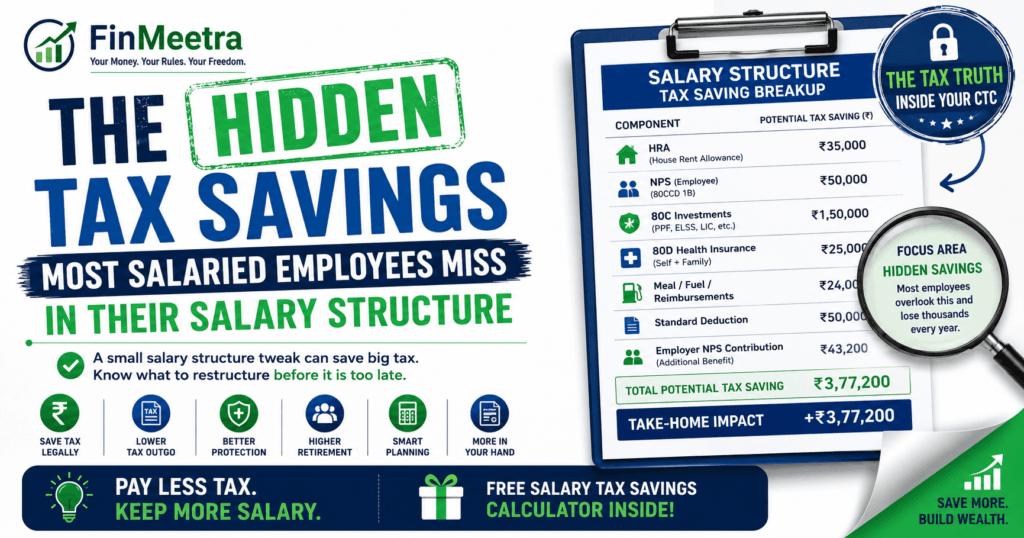
(How HRA, NPS, PF, 80C, 80D, reimbursements and regime choice can quietly change your real take-home salary.)
Quick Answer
The hidden tax savings for salaried employees are not secret loopholes. They are legal benefits and salary-structure choices that many employees ignore because they only look at CTC, monthly TDS or year-end investment proofs. The biggest missed areas are HRA exemption, employer NPS contribution, 80C planning, 80D health insurance deduction, tax-free reimbursements where allowed, professional tax, home-loan interest under old regime and choosing the correct old vs new tax regime.
The real problem is timing. Most employees start tax planning in January or March. But salary tax saving is not a March activity. It is an April activity. Once your salary structure, rent proofs, NPS choice, reimbursement bills and tax regime declaration are ignored for 9 months, your TDS becomes a slow salary thief wearing a payroll badge.
Priya Did Not Lose Money in the Stock Market. She Lost It in Her Salary Structure.
Priya is 30, works in Hyderabad and earns ₹18 LPA. Every month, around salary credit day, she opens her bank app with hope. The credit comes. Then rent, EMI, groceries, parents support, insurance and SIPs start pulling money in different directions. By the 10th of the month, the salary already looks tired.
For two years, Priya believed tax saving meant one thing: buy something in March. Sometimes ELSS. Sometimes insurance. Sometimes a random last-minute product because someone said, “tax benefit hai.”
Then she compared her salary structure with a colleague who had almost the same CTC. The colleague was paying lower tax. Not because of a magic trick. Not because of a hidden CA-only formula. The difference was basic salary, HRA usage, employer NPS, complete 80C, health insurance deduction and choosing the better tax regime.
That day Priya understood something uncomfortable: she was not underpaid only by her company. She was also under-optimized by her own salary structure.
That is the silent story of many Indian salaried employees.
First, Understand This: Tax Saving Is Not Only Investment Saving
Most salaried employees mix up tax saving with investing. Investing is one part of tax planning. But salary tax planning has three layers.
| Layer | What It Means | Common Mistake |
| Salary structure layer | How your CTC is split into basic, HRA, special allowance, PF, NPS and benefits | Accepting whatever HR gives without checking tax impact |
| Deduction layer | 80C, 80D, NPS self contribution, home loan interest and other eligible deductions | Buying random products in March instead of planning from April |
| Regime layer | Choosing between old and new tax regime based on actual numbers | Assuming new regime is always better or old regime is always better |
A salaried employee who understands only investments may still miss tax savings. A salaried employee who understands salary structure can increase real take-home without begging for a higher CTC.
The Hidden Tax Savings Calculator
Before reading further, calculate the leak honestly. Enter your annual CTC or gross salary, basic salary percentage, HRA, rent, city, 80C, NPS, 80D, home-loan interest, professional tax and reimbursements. The calculator compares old and new regime estimates and shows whether your current choice may be leaking tax.
Hidden Tax Savings Calculator
Check salary structure, HRA, NPS, 80C, 80D and old vs new tax regime impact
Regime choice first
Most deductions help only if the old regime beats the new regime. Compare before locking declarations.
Structure beats panic
HRA, NPS and reimbursements should be planned from April, not repaired in March.
Take-home matters
A smart salary structure can improve post-tax take-home without demanding a higher CTC.
Important: This calculator is an educational estimate. It does not replace Form 16, payroll calculation, return filing software or advice from a qualified tax professional. Salary structures and eligibility rules vary by employer and personal profile.
What Your Calculator Result Means
| Calculator Result | Meaning | Action |
| Old regime saves more | Your deductions, rent and salary structure are strong enough to beat the lower new-regime rates | Keep proofs ready and review declarations early |
| New regime saves more | Your deductions are not enough to justify the old regime | Avoid buying products only for tax saving |
| Small difference | Both regimes are close | Choose based on simplicity, documentation and cash-flow comfort |
| High HRA exemption | Rent and HRA are helping under old regime | Keep rent receipts, agreement and landlord PAN where needed |
| Large unused 80C | You are not fully using eligible old-regime space | Fill only with useful products like EPF, PPF, ELSS, tuition fee or principal repayment |
| Employer NPS benefit visible | Salary structure may reduce taxable income through employer NPS | Ask HR if employer NPS is available in your CTC structure |
Hidden Saving #1: Choosing the Wrong Tax Regime
The new tax regime is the default tax regime for many individual taxpayers, but eligible taxpayers can opt out and choose the old regime. This one line matters because default does not mean best for everyone.
The new regime gives lower rates and fewer deductions. The old regime gives access to deductions and exemptions such as HRA, 80C, 80D, home-loan interest and other eligible items. The right answer depends on your salary, rent, investments, insurance, home loan, NPS and employer structure.
| Employee Type | Usually Better Direction | Reason |
| No rent, no home loan, low investments | New regime may win | Lower rates and less documentation |
| High rent with HRA, full 80C, health insurance | Old regime may win | Deductions and HRA can reduce taxable income |
| Employer NPS available | Both need checking | Employer NPS can help under new regime too |
| High CTC with little deduction | New regime often looks cleaner | Old regime needs enough deductions to justify itself |
| Home loan plus rent or multiple deductions | Old regime can become competitive | But only numbers can confirm |
This connects directly with FinMeetra’s Old vs New Tax Regime Calculator. Use that as your full regime comparison tool before finalizing tax declarations.
Hidden Saving #2: HRA That Exists in Salary but Dies in Tax Planning
HRA is one of the biggest missed tax-saving areas for employees who pay rent. But HRA is not automatically tax-free. It needs the right salary component, actual rent payment, old-regime eligibility and documentation.
Under the standard HRA formula, exemption is generally the least of actual HRA received, rent paid minus 10% of salary, or 40% of salary for non-metro cities and 50% of salary for Delhi, Mumbai, Kolkata and Chennai. For this formula, salary usually means basic plus eligible DA and turnover-linked commission, if applicable.
| HRA Situation | What Happens | What To Check |
| You receive HRA and pay rent | You may claim HRA exemption under old regime | Rent receipts, agreement, landlord PAN if required |
| You receive HRA but live in own house | HRA may become taxable | Do not claim without actual rent |
| You pay rent but no HRA in salary | 80GG may be explored in old regime subject to conditions | Check eligibility carefully |
| You shifted cities mid-year | HRA needs period-wise calculation | Maintain month-wise proof |
| Rent is paid to parents | Possible, but proof and genuine transaction matter | Use bank transfer and proper documentation |
This is why offer letters and salary slips matter. A higher CTC with poor HRA structure can hurt. Read FinMeetra’s Offer Letter Trap and Before You Accept That Offer Letter before your next job switch.
Hidden Saving #3: Employer NPS Contribution Inside CTC
Employer contribution to NPS under section 80CCD(2) is one of the most powerful salary-structure levers because it can reduce taxable income while also building retirement wealth. Many private-sector employees never ask HR whether employer NPS is available. That silence can be expensive.
For many salaried employees, employer NPS works differently from self NPS contribution. Self contribution under 80CCD(1B) is generally an old-regime deduction. Employer NPS can remain relevant even in the new regime, subject to limits and employer policy. If your company offers a flexible compensation basket, this should be checked.
| NPS Type | Where It Helps | Planning Note |
| Employee self NPS | Old regime additional deduction, usually up to ₹50,000 under 80CCD(1B) | Good only if NPS fits your retirement plan |
| Employer NPS | Salary-structure deduction under 80CCD(2), useful especially when available under new regime | Ask HR if part of CTC can be routed here |
| No NPS available | No immediate NPS salary-structure benefit | Do not force it unless suitable for your goals |
NPS is not just a tax button. It is a long-term retirement product with lock-in and withdrawal rules. Use it only when it matches your retirement planning. For broader retirement thinking, read FinMeetra’s How Much Money Need to Retire in India? and the PPF vs ELSS vs NPS Calculator.
Hidden Saving #4: 80C Filled With Wrong Products or Not Filled at All
Section 80C is famous, but it is also where many employees make poor choices. Some do not use the limit fully. Others fill it with bad products just to save tax. Both mistakes hurt.
The old-regime 80C basket commonly includes EPF, PPF, ELSS, life insurance premium, tuition fees for children and principal repayment of housing loan. But the best 80C option is not the one with the loudest salesperson. It is the one that fits your liquidity, risk and goal timeline.
| 80C Option | Works Best For | Warning |
| EPF | Employees already contributing through salary | Already counted, do not double-count |
| PPF | Long-term conservative investors | Long lock-in, not for short-term goals |
| ELSS | Equity investors with 3+ year horizon | Market risk exists |
| Life insurance premium | Protection planning | Do not buy poor-return policies only for 80C |
| Tuition fees | Parents paying eligible school fees | Only eligible tuition portion counts |
| Home loan principal | Homeowners | Check overall 80C cap and documentation |
For a deeper breakdown, connect this article with FinMeetra’s Rs.3 Lakh Tax Saving Mistake and PPF vs ELSS vs NPS Calculator.
Hidden Saving #5: Health Insurance Deduction That People Remember Too Late
Health insurance is not just a tax-saving instrument. It is family risk protection. Under the old regime, section 80D can give deduction for eligible health insurance premiums for self, spouse, children and parents, subject to limits and conditions.
Many salaried employees assume employer group insurance is enough. Then one medical emergency proves the coverage was thin. Tax saving is secondary here. Protection is primary. The deduction is a useful side benefit.
| Situation | Possible Old-Regime Deduction Area | Practical Step |
| Self/family health insurance premium | 80D subject to limits | Keep premium receipts and policy details |
| Parents health insurance premium | Separate 80D bucket subject to age and limits | Check whether parents are senior citizens |
| Preventive health check-up | Part of 80D limit, subject to rules | Keep bills and do not overclaim |
| Only employer group cover | May not be enough protection | Consider personal policy based on family needs |
Hidden Saving #6: Reimbursements and Allowances Nobody Tracks Properly
Some salary structures allow tax-efficient reimbursements such as telephone/internet reimbursement, fuel reimbursement, meal benefits, books and periodicals, or LTA, depending on employer policy and tax rules. The problem is not that employees do not have these components. The problem is that they forget the bills, miss monthly upload deadlines or never ask HR whether the flexible basket exists.
Do not treat every allowance as automatically tax-free. Tax treatment depends on the component, the regime, actual spending, proof submission, employer policy and applicable rules. Under the new regime, many exemptions and allowances are restricted, so reimbursements need careful payroll confirmation.
| Component | Potential Value | Watch Out |
| Telephone / internet reimbursement | Useful for employees with genuine work-related usage | Bills and employer policy required |
| Fuel / driver reimbursement | Can help where allowed | Documentation can be strict |
| Meal card / food benefit | Small but recurring benefit | Limit and vendor conditions matter |
| LTA | Can reduce taxable salary when eligible | Block-year rules and travel proof matter |
| Books / periodicals | Role-dependent and policy-dependent | Do not claim without valid bills |
Hidden Saving #7: Professional Tax and Other Small Lines That Add Up
Professional tax is not exciting. It will not create a viral reel. But for salaried employees in states where it applies, it is often deducted from salary and can be considered under old-regime salary computation. Small lines matter because tax planning is not one giant button. It is a collection of small doors.
This is also why you should read your salary slip. If you do not know what is deducted, you cannot know what is claimable, useful, wasteful or negotiable. For this, connect this blog with FinMeetra’s salary-slip and hidden-deduction cluster, especially the hidden salary deduction article and the ₹20 LPA salary reality article.
Case Study: Same ₹18 LPA CTC, Different Tax Outcome
Let us compare Priya and Mehul. Both earn ₹18 LPA. Both live in rented houses. Both work in similar roles. But their tax outcomes are different because one planned salary structure and one only reacted to TDS.
| Metric | Priya – Unplanned | Mehul – Planned | Difference |
| Annual CTC | ₹18 LPA | ₹18 LPA | Same headline salary |
| HRA usage | Not claimed properly | Claimed with rent proof | Taxable income reduced |
| 80C | ₹70,000 used | ₹1,50,000 used | ₹80,000 extra deduction |
| 80D | Ignored | Health premium claimed | Protection + deduction |
| Employer NPS | Not asked | Available and opted | Salary structure improved |
| Regime choice | Selected default blindly | Compared old vs new | Better decision |
| March stress | High | Low | Planning beats panic |
The lesson is not that Mehul is smarter. The lesson is that Mehul had a checklist. Priya had hope. Hope is not a tax plan.
The Salary Tax Leakage Checklist
| Question | Why It Matters | Done? |
| Did you compare old vs new regime using actual numbers? | Regime choice can change final tax | ☐ |
| Is HRA included in salary and are you paying rent? | HRA can be a major old-regime exemption | ☐ |
| Do you have rent receipts, agreement and landlord PAN where required? | Proof failure can kill HRA claim | ☐ |
| Have you checked employer NPS availability? | Can reduce taxable income through salary structure | ☐ |
| Is your 80C filled with useful items, not random products? | Poor products can destroy wealth while saving tax | ☐ |
| Have you reviewed 80D for self/family/parents? | Protection and tax planning connect here | ☐ |
| Are reimbursements being claimed with bills on time? | Missed bills can turn tax-free components taxable | ☐ |
| Did you review Form 16 and AIS before filing? | TDS and actual tax may differ | ☐ |
| Did you avoid buying insurance only for tax? | Tax-saving traps are expensive | ☐ |
| Did you route real tax savings into emergency fund or SIP? | Savings should become wealth, not lifestyle leakage | ☐ |
April-to-March Action Plan for Salaried Employees
| Month / Period | What To Do | Why It Helps |
| April | Collect salary breakup, CTC structure and tax declaration window | Start before TDS damage begins |
| April-May | Compare old vs new regime with actual rent, 80C, 80D and NPS | Avoid blind default selection |
| Quarterly | Review TDS, investment proofs and reimbursement bills | Avoid March panic |
| Before job switch | Compare new offer for fixed pay, HRA, PF, NPS and tax impact | Higher CTC may not mean higher take-home |
| December-January | Close proof gaps and update payroll declaration | Prevent sudden TDS spike |
| March | Do only final cleanup, not full tax planning | Last month should not carry the whole year |
| After Form 16 | Reconcile Form 16, AIS and return filing data | Avoid under-reporting or overclaiming |
How to Ask HR Without Sounding Confused
Most employees do not ask salary-structure questions because they worry it will sound greedy or complicated. Use professional language. You are not asking for a favor. You are asking to understand your own compensation.
| Instead of Saying | Say This |
| Can you reduce my tax? | Can you help me understand which salary components are flexible and how HRA, NPS and reimbursements are treated in payroll? |
| Why is TDS so high? | Can you share the taxable salary projection and declaration assumptions used for my monthly TDS? |
| Can I change my salary breakup? | Is there an employee-flexible compensation window where HRA, employer NPS or reimbursements can be optimized within company policy? |
| Old or new regime, which is better? | Can payroll share my projected taxable income under my current declaration so I can compare regimes correctly? |
Where Should the Tax Savings Go?
Saving tax is not the finish line. It is only the money entering your side of the battlefield. If tax savings get absorbed by food delivery, impulse shopping and lifestyle upgrades, the financial improvement disappears.
| Annual Tax Saved | Monthly Equivalent | Smart Use |
| ₹12,000 | ₹1,000/month | Start or increase emergency fund |
| ₹30,000 | ₹2,500/month | Add to SIP or health insurance protection |
| ₹60,000 | ₹5,000/month | Emergency fund + SIP combination |
| ₹1,20,000 | ₹10,000/month | Debt prepayment or long-term wealth plan |
A tax saving should not become a spending permission slip. Use FinMeetra’s Emergency Fund Guide first if your safety cushion is weak. Then use the SIP Calculator or Step-Up SIP Calculator to turn tax savings into wealth.
Mistakes That Make Salaried Employees Pay Extra Tax
• Selecting the new regime only because it is default, without comparing numbers.
• Selecting the old regime only because parents or colleagues said it is better.
• Ignoring HRA even while paying rent.
• Forgetting rent receipts, rent agreement or landlord PAN requirements.
• Not checking employer NPS availability in salary structure.
• Buying traditional insurance policies only to fill 80C.
• Claiming deductions without proof or eligibility.
• Uploading reimbursement bills after the employer deadline.
• Planning tax in March instead of April.
• Using tax savings for lifestyle instead of emergency fund, debt reduction or investing.
Key Takeaways
• Hidden tax savings are usually missed because employees ignore salary structure, not because the law is secret.
• The new tax regime is default, but old regime may still help employees with strong deductions and HRA.
• HRA can be powerful when rent, documentation and salary structure are aligned.
• Employer NPS can be a valuable salary-structure lever, especially for employees using the new regime.
• 80C should be filled with useful financial products, not random last-minute purchases.
• 80D should be viewed as family protection first and tax benefit second.
• Reimbursements require discipline. Missed bills can become missed savings.
• Every salary hike or job switch should be checked for tax impact, not only CTC growth.
• Real tax planning starts in April. March is only the final audit.
Frequently Asked Questions
Q: What are hidden tax savings for salaried employees?
A: They are legal tax benefits that employees often miss inside salary structure, HRA, NPS, PF, 80C, 80D, reimbursements, home-loan interest and regime selection.
Q: Is the new tax regime always better for salaried employees?
A: No. The new regime can be better for employees with fewer deductions, but the old regime may be better for employees with HRA, full 80C, health insurance, home-loan interest and other eligible deductions.
Q: Is HRA available in the new tax regime?
A: Many HRA and allowance exemptions are restricted under the new regime. Employees should verify current rules and payroll treatment before claiming any exemption.
Q: Can employer NPS help under the new tax regime?
A: Employer NPS contribution under section 80CCD(2) can be relevant under the new regime subject to limits and employer policy. Check with payroll before restructuring CTC.
Q: Should I invest in NPS only for tax saving?
A: No. NPS is a retirement product with lock-in and withdrawal rules. Use it only if it fits your retirement plan.
Q: What is the biggest mistake in 80C planning?
A: Buying poor-return insurance or investment products only to save tax. 80C should support your goals, not trap your money.
Q: Can I claim rent paid to parents for HRA?
A: It may be possible if the rent transaction is genuine and properly documented. Use bank transfers, rent receipts and consult a tax professional for your case.
Q: What if I do not receive HRA but pay rent?
A: You may explore 80GG under the old regime if eligible, but conditions apply. Do not claim blindly.
Q: Are reimbursements automatically tax-free?
A: No. They depend on actual bills, employer policy, component type, regime and applicable rules.
Q: When should salaried employees start tax planning?
A: April. Waiting until March usually leads to poor product choices, proof gaps and TDS shocks.
Q: Can tax savings increase my monthly take-home?
A: Yes, if the saving reduces TDS or final tax outgo. But actual monthly impact depends on payroll timing and declarations.
Q: Should I consult a CA for salary tax planning?
A: If your salary is high, you have home loan, ESOPs, multiple incomes, capital gains, rent issues or complex deductions, professional advice is worth considering.
Related Articles You Should Read Next
• Old vs New Tax Regime Calculator – Use this before choosing tax regime for the year.
• Rs.3 Lakh Tax Saving Mistake – Avoid tax-saving decisions that hurt long-term wealth.
• PPF vs ELSS vs NPS Calculator – Compare common tax-saving investment options.
• 20 LPA Salary Reality – Understand why high salary can still feel low after deductions.
• Salary Hike Trap – See why a raise can disappear after tax, EMI and lifestyle inflation.
• Offer Letter Trap – Compare salary structure before accepting a higher CTC.
• EMI Calculator – Check whether extra take-home should go into loan prepayment.
• Emergency Fund Guide – Build safety before optimizing investments.
• SIP Calculator – Turn tax savings into long-term investment discipline.
• Step-Up SIP Calculator – Increase investments as salary grows.
• When Will You Become Financially Free – Connect tax saving with financial freedom goals.
Useful External Resources
• Income Tax Department – Salaried Individuals AY 2026-27
• Income Tax Department – Salary and HRA guidance
• Union Budget 2025-26 Speech – New tax regime slabs
• EPFO – EPF contribution structure
• PIB – Budget 2024 NPS employer contribution update
Enjoyed This Blog? Here Is What You Can Do Next
• Leave a comment: Which tax-saving line surprised you the most?
• Use the Hidden Tax Savings Calculator to compare your current regime and salary structure.
• Subscribe to FinMeetra Newsletter for practical salary, tax and wealth insights.
Disclaimer
This blog is for educational and informational purposes only. It does not constitute financial advice, tax advice, legal advice, investment advice, career advice or product advice. Salary structures, tax regime rules, exemptions, deductions, HRA, NPS, PF, reimbursement treatment, professional tax, surcharge, marginal relief, Form 16 reporting and employer policies can vary by year, company, state, city and individual profile. Please consult a qualified tax advisor, legal professional or financial planner before making tax, investment, salary-structure or filing decisions.
© 2026 FinMeetra.com | All Rights Reserved