
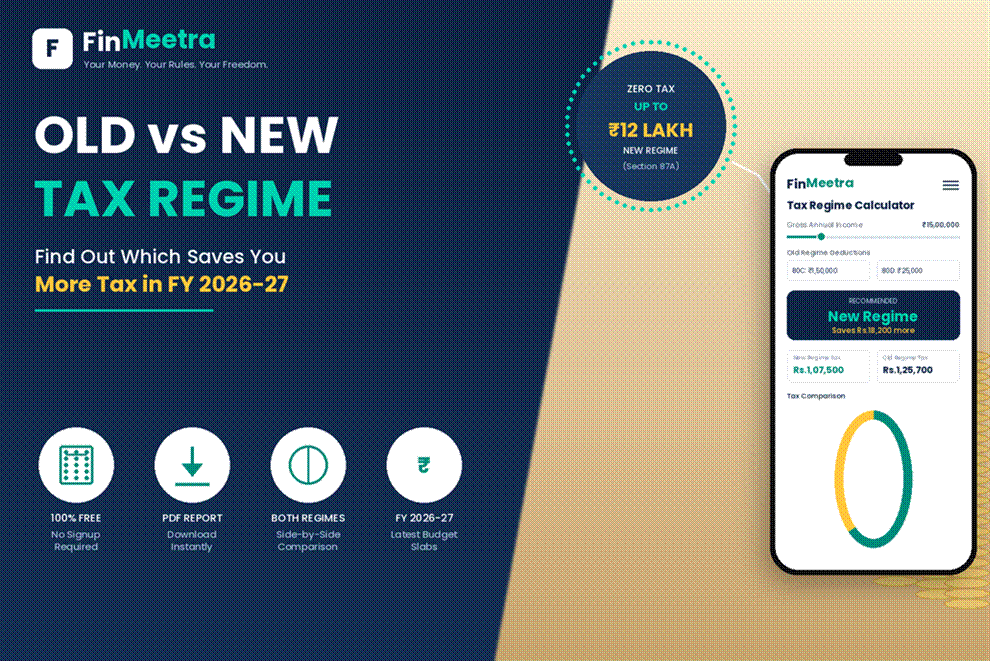
Every March, the same conversation happens in office break rooms across India: “Which regime are you on this year?” Most people answer with a shrug — they picked whatever their employer defaulted to, or copied a colleague’s choice, or just kept doing what they did last year. None of those are good reasons and because of this reasons, i have build Old Vs New Tax Regime Calculator.
Here’s the truth: choosing between the Old Vs New Tax Regime isn’t about which one is “better” in general — it’s about which one is better for YOUR specific income and YOUR specific deductions. A person earning Rs.15 lakh with a home loan and full 80C investments might save Rs.40,000+ under the Old Regime. Someone with the exact same income but no major deductions could save just as much under the New Regime. Same salary, completely opposite answer.
This calculator does the actual math for FY 2026-27 (AY 2027-28) — the latest slabs confirmed in Union Budget 2026, which kept rates unchanged from the previous year. Enter your income, add your real deductions (80C, 80D, HRA, home loan interest, NPS), and see your exact tax under both regimes side by side. No guessing, no generic advice — just your numbers.
If you’ve used our EMI Calculator or SWP Calculator before, you know the drill — plug in your numbers, get a clear answer, download a PDF if you need it for your records. Let’s get into it.
The FinMeetra Tax Regime Calculator
This blog covers the complete article, explanation, and supporting data for the Old vs New Tax Regime Calculator. The interactive calculator tool (income slider, deduction inputs, charts, and PDF download) is a separate embeddable component — built and delivered independently from this Word document — designed to sit directly below this section on your live blog page.
Old vs New Tax Regime Calculator
For Salaried Individuals — FY 2026-27 (AY 2027-28)
Which Regime Should I Pick?
If your total Old Regime deductions (80C+80D+HRA+Home Loan+NPS) cross roughly Rs.4-4.5 lakh, Old Regime usually wins. Below that, New Regime usually wins.
Can I Switch Every Year?
Yes — salaried individuals with no business income can choose a different regime every financial year when filing their ITR or declaring to their employer.
Does PF Reduce My Tax?
Your own EPF contribution counts toward the Rs.1.5L Section 80C limit (Old Regime only). Employer’s PF contribution is tax-free up to Rs.7.5L/year combined with NPS/superannuation.
Ready to file or plan your taxes?
Compare tax-saving instruments or file your return:
New Tax Regime vs Old Tax Regime: The Basics
India currently allows individual taxpayers to choose between two tax structures every year (for salaried individuals) or once in a lifetime (for those with business/professional income). The New Tax Regime offers lower slab rates but disallows almost all deductions and exemptions. The Old Tax Regime has higher slab rates but allows you to reduce your taxable income through investments, insurance, rent, and loan interest. The New Regime has been the default option since FY 2023-24 — if you don’t actively choose the Old Regime, you’re automatically taxed under the New one.
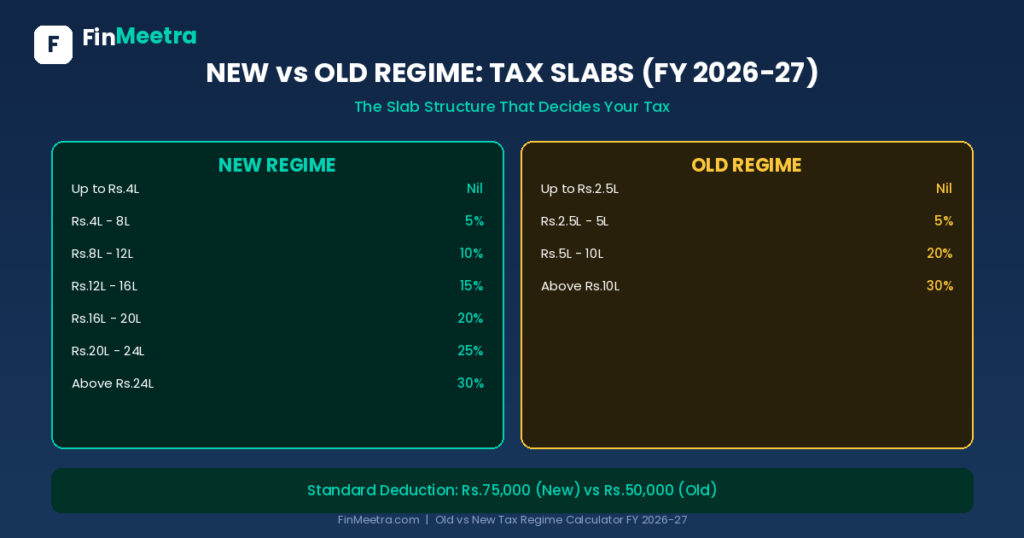
New Regime Tax Slabs (FY 2026-27)
| Annual Taxable Income | Tax Rate |
| Up to Rs.4,00,000 | Nil |
| Rs.4,00,001 – Rs.8,00,000 | 5% |
| Rs.8,00,001 – Rs.12,00,000 | 10% |
| Rs.12,00,001 – Rs.16,00,000 | 15% |
| Rs.16,00,001 – Rs.20,00,000 | 20% |
| Rs.20,00,001 – Rs.24,00,000 | 25% |
| Above Rs.24,00,000 | 30% |
Standard Deduction: Rs.75,000 for salaried taxpayers. Section 87A Rebate: if your taxable income (after standard deduction) is up to Rs.12,00,000, you get a rebate of up to Rs.60,000 — which brings your tax liability down to ZERO. This rebate does not apply to special-rate income like short-term capital gains.
Old Regime Tax Slabs (FY 2026-27)
| Annual Taxable Income | Tax Rate |
| Up to Rs.2,50,000 | Nil |
| Rs.2,50,001 – Rs.5,00,000 | 5% |
| Rs.5,00,001 – Rs.10,00,000 | 20% |
| Above Rs.10,00,000 | 30% |
Standard Deduction: Rs.50,000 for salaried taxpayers. Section 87A Rebate: available only if taxable income is up to Rs.5,00,000, capped at Rs.12,500. The Old Regime’s real strength isn’t its rebate — it’s the long list of deductions you can stack on top of the standard deduction.
Deductions Available ONLY Under the Old Regime
This is the heart of the decision. The New Regime’s lower rates only matter if you’re not already saving more through these deductions, which are unavailable (with very few exceptions) under the New Regime. See ClearTax’s deduction guide if you want to dig deeper into any specific section:
| Deduction | Max Limit | What It Covers |
| Standard Deduction | Rs.50,000 | Automatic for salaried individuals, no proof needed |
| Section 80C | Rs.1,50,000 | ELSS, PPF, EPF, life insurance premium, principal on home loan, children’s tuition fees |
| Section 80D | Rs.25,000 – Rs.1,00,000 | Health insurance premium (self/family/parents); higher limit for senior citizen parents |
| Home Loan Interest (24b) | Rs.2,00,000 | Interest paid on home loan for a self-occupied property |
| HRA Exemption | Varies | Based on rent paid, basic salary, and city of residence (metro/non-metro) |
| Section 80CCD(1B) | Rs.50,000 | Additional NPS contribution, over and above the 80C limit |
| Section 80E | No limit | Interest on education loan for self, spouse, or children |
| Section 80TTA/TTB | Rs.10,000 – Rs.50,000 | Interest on savings account (80TTA) or all deposits for seniors (80TTB) |
The Rs.4-4.5 Lakh Breakeven Rule
Across most income levels, a consistent pattern emerges: if your total Old Regime deductions (80C + 80D + home loan interest + HRA + NPS, etc.) add up to less than roughly Rs.4 lakh, the New Regime almost always results in lower tax. If your deductions cross approximately Rs.4.5 lakh, the Old Regime typically pulls ahead. Between those two points, it’s close enough that you should run the exact numbers rather than guess.
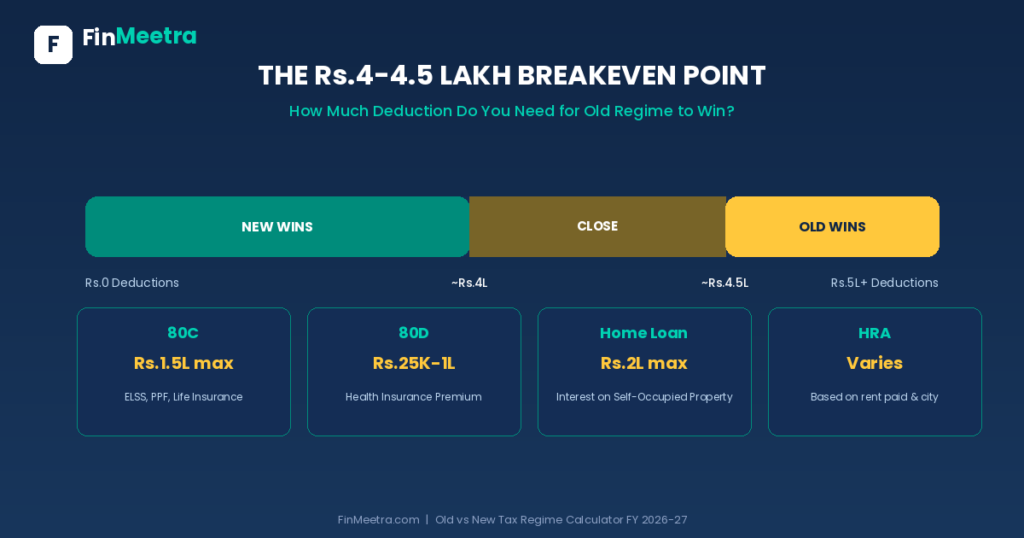
Quick gut-check: add up your 80C investments, 80D premium, home loan interest, and NPS contribution. If that total is under Rs.4 lakh, you’re very likely better off in the New Regime — even before running the calculator.
Real Example: Rs.18 Lakh Income, Home Loan + Full 80C
Consider a salaried professional earning Rs.18 lakh annually, with a home loan (Rs.2L interest claimed), full 80C investments (Rs.1.5L in ELSS + PPF), and Rs.25,000 in health insurance premium (80D) — a fairly typical profile for someone in their 30s with a home loan.
| Metric | New Regime | Old Regime |
| Gross Income | Rs.18,00,000 | Rs.18,00,000 |
| Standard Deduction | Rs.75,000 | Rs.50,000 |
| 80C + 80D + Home Loan | Not Allowed | Rs.3,75,000 |
| Taxable Income | Rs.17,25,000 | Rs.13,75,000 |
| Tax + Cess | Rs.2,40,344 | Rs.2,38,160 |
In this case, the Old Regime wins — but only by about Rs.2,184, despite Rs.3.75 lakh in deductions. This illustrates the point well: even with a home loan and maxed-out 80C, the gap has narrowed dramatically compared to a few years ago, because the New Regime’s slabs and rebate have become significantly more generous. A few years ago, this same profile would have saved tens of thousands under the Old Regime — today, it’s nearly a coin flip. You can verify this against the official Income Tax e-Filing portal calculator if you’d like a second check.
This is exactly why you should never assume your regime choice from last year is still correct. Each Budget can shift this balance — sometimes dramatically. Always recheck.
Who Should Pick Which Regime?
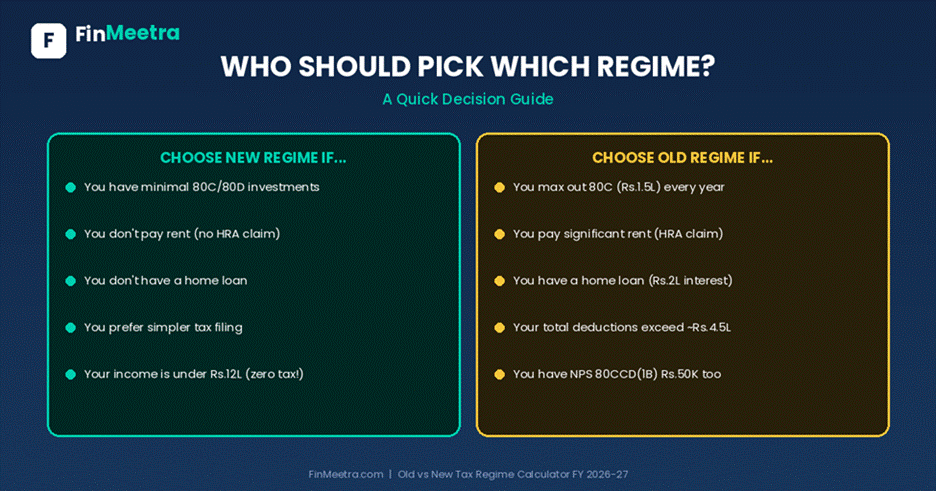
Image: Who Should Pick Which Regime — A Quick Decision Guide
| Your Situation | If YES | If NO |
| Income under Rs.12 lakh? | New Regime — likely ZERO tax via 87A rebate | Compare both regimes carefully |
| Have a home loan + max 80C? | Old Regime often wins above Rs.4.5L deductions | New Regime usually wins |
| Pay significant rent (HRA)? | Factor in HRA — Old Regime may edge ahead | New Regime simplicity wins |
| Prefer simple, no-paperwork filing? | New Regime — no proofs or investment tracking | Old Regime rewards active tax planning |
| Self-employed/professional? | Note: switching is a once-in-a-lifetime choice | Salaried can switch every year freely |
Tax Comparison Across Income Levels
To give you a quick reference point, here’s how tax compares across common income levels, assuming a typical Rs.2 lakh in Old Regime deductions (a combination of partial 80C + 80D, without a home loan):
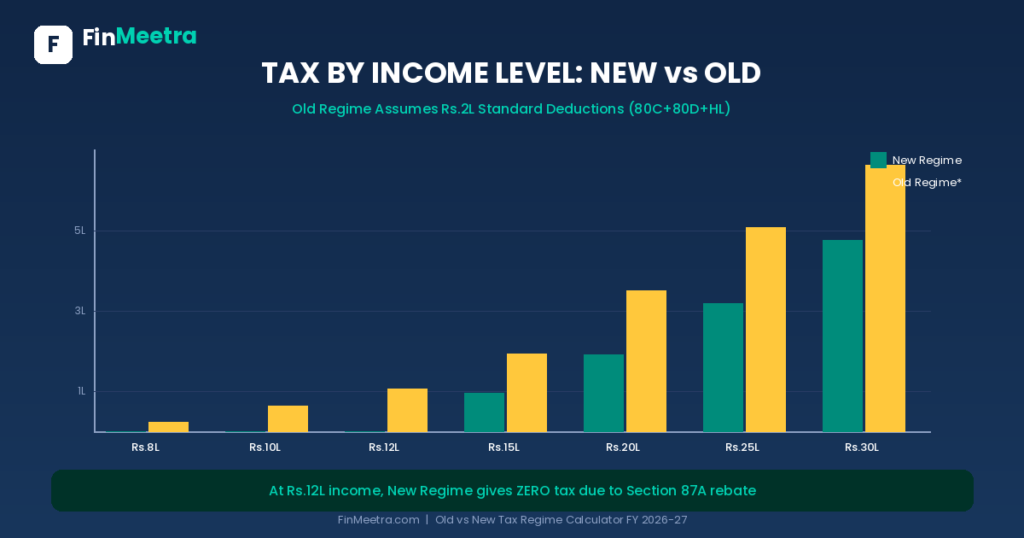
Image: Tax by Income Level — New vs Old Regime Comparison Chart
Notice that at every income level shown here — even with Rs.2 lakh in deductions — the New Regime results in lower tax. This is the modern reality post-Budget 2026: the New Regime has become genuinely competitive even for taxpayers with moderate deductions. The Old Regime only pulls ahead once deductions climb meaningfully higher, typically with a home loan in the mix.
How to Use This Calculator (90-Second Guide)
- Step 1: Enter your Gross Annual Income — your total salary or business income before any deductions.
- Step 2: Fill in your Old Regime deductions — Section 80C, 80D, HRA exemption, home loan interest, NPS 80CCD(1B), and any other deductions you’re eligible for.
- Step 3: The calculator instantly computes tax under BOTH regimes using the exact FY 2026-27 slabs.
- Step 4: See which regime saves you more, and by exactly how much — shown clearly at the top.
- Step 5: Review the side-by-side comparison chart and the detailed slab-wise breakdown table.
- Step 6: Click ‘Download PDF Report’ for a branded FinMeetra report with your inputs and full comparison — useful for discussing with your CA or for your own records.
Key Takeaways
- Budget 2026 made NO changes to tax slabs under either regime — FY 2026-27 rates are identical to FY 2025-26.
- Under the New Regime, taxable income up to Rs.12 lakh results in ZERO tax due to the Section 87A rebate (up to Rs.60,000).
- The New Regime’s standard deduction (Rs.75,000) is Rs.25,000 higher than the Old Regime’s (Rs.50,000).
- The breakeven point is roughly Rs.4-4.5 lakh in total Old Regime deductions — below that, New Regime usually wins; above that, Old Regime usually wins.
- Even taxpayers with a home loan and full 80C can find the gap between regimes has narrowed significantly compared to previous years.
- Salaried taxpayers can switch regimes every single year. Self-employed/professional taxpayers can switch only ONCE in a lifetime — choose carefully.
- Never assume last year’s choice is still correct — recalculate every year, especially after a new Budget.
- The New Regime offers simplicity (no proof, no paperwork) while the Old Regime rewards active tax planning and disciplined investing.
- Always run your exact numbers through a calculator rather than relying on rules of thumb — the breakeven point varies by income level.
Frequently Asked Questions
Q: Which tax regime is the default for FY 2026-27?
The New Tax Regime is the default. If you don’t explicitly choose the Old Regime — by informing your employer for TDS purposes, or by selecting it while filing your ITR — you’ll automatically be taxed under the New Regime.
Q: Can I switch between regimes every year?
Salaried individuals with no business income can switch between the Old and New Regime every financial year, simply by indicating their choice while filing their return (or to their employer for TDS). Taxpayers with business or professional income can switch only ONCE in their lifetime back to the Old Regime after opting for the New Regime — so this choice carries more weight for the self-employed.
Q: Did Budget 2026 change any tax slabs?
No. The Finance Minister announced no changes to income tax slabs or rates under either regime for FY 2026-27. The slabs that applied in FY 2025-26 continue unchanged. Budget 2026 instead focused on procedural changes — such as revised ITR filing deadlines and a foreign asset disclosure scheme.
Q: Is the Rs.12 lakh tax-free limit available under the Old Regime too?
No. The Rs.12 lakh zero-tax threshold (via Section 87A rebate) applies ONLY to the New Regime. Under the Old Regime, the 87A rebate is capped at taxable income up to Rs.5,00,000, with a maximum rebate of Rs.12,500.
Q: I have a home loan. Does that mean I should automatically pick the Old Regime?
Not automatically — it depends on your total deductions, not just the home loan alone. A home loan’s Rs.2 lakh interest deduction is significant, but as our real example shows, even combined with full 80C and 80D, the New Regime can still come very close or occasionally win, depending on your income level. Always calculate both regimes with your exact numbers.
Q: What happens to deductions like 80C and 80D if I choose the New Regime?
Under the New Regime, you cannot claim most common deductions — including 80C (ELSS, PPF, life insurance), 80D (health insurance), HRA exemption, and home loan interest on a self-occupied property. A small number of exceptions exist, such as the employer’s contribution to NPS under Section 80CCD(2), which remains available under both regimes.
Q: Does this calculator account for capital gains or other special-rate income?
This calculator computes tax on regular slab-rate income (salary, business income, etc.) only. Capital gains (short-term and long-term), lottery winnings, and certain other income types are taxed at special fixed rates under both regimes and are not part of this slab-based comparison. The Section 87A rebate also does not apply to such special-rate income.
Q: Are senior citizens taxed differently?
Under the Old Regime, senior citizens (60+) and super senior citizens (80+) enjoy higher basic exemption limits (Rs.3 lakh and Rs.5 lakh respectively, instead of Rs.2.5 lakh). Under the New Regime, there is no separate, beneficial slab structure for senior citizens — everyone follows the same slabs regardless of age.
Q: Should I consult a CA before deciding?
This calculator gives you an accurate, slab-based estimate for planning purposes, but a Chartered Accountant can account for nuances specific to your situation — such as capital gains, multiple income sources, TDS already deducted, advance tax obligations, or business income complexities. Use this tool to narrow down your decision, then confirm with a professional or the Income Tax Department’s official resources before filing.
Blogs That Make This Calculator More Powerful
- Blog #6: SIP vs Lump Sum — Which Investment Strategy Actually Wins? (Data-Backed)
- Blog #7: Index Fund vs Active Fund — Which Really Wins? (Real 20-Year Data)
- Blog #9: Step-Up SIP Guide — The Single Habit That Multiplies Wealth 3x
- Blog #13: The Rs.30 Lakh Mistake — Direct vs Regular Mutual Funds in India
- EMI Calculator — See How One Prepayment Saves Lakhs in Interest
- SWP Calculator — See How Long Your Retirement Corpus Really Lasts
Useful External Resources
- Income Tax Department — Official e-Filing Portal
- Income Tax Department — Official Tax Calculator
- Union Budget 2026 — Official Documents
- ClearTax — Tax Filing & Planning
- SEBI Investor Education
ENJOYED THIS CALCULATOR? HERE IS WHAT YOU CAN DO NEXT:
Leave a Comment — Which regime are you choosing this year, and why? Share your numbers with the community.
Subscribe to FinMeetra Newsletter — Real money insights every week. [Subscribe Link]
Try the next free tool — EMI Calculator to plan your loan repayments alongside your tax strategy.
Share This Calculator — If this helped you decide, share it with a friend who’s still guessing their regime.



Pingback: The Salary Hike Trap: Why a 30% Raise Still Won’t Fix Your Money Problems with Calculator | FinMeetra
Pingback: The Hidden Tax Savings Most Salaried Employees Miss in Their Salary Structure | FinMeetra