(The practical salary-structure guide for Indian employees who want more take-home without increasing CTC.)
Quick Answer
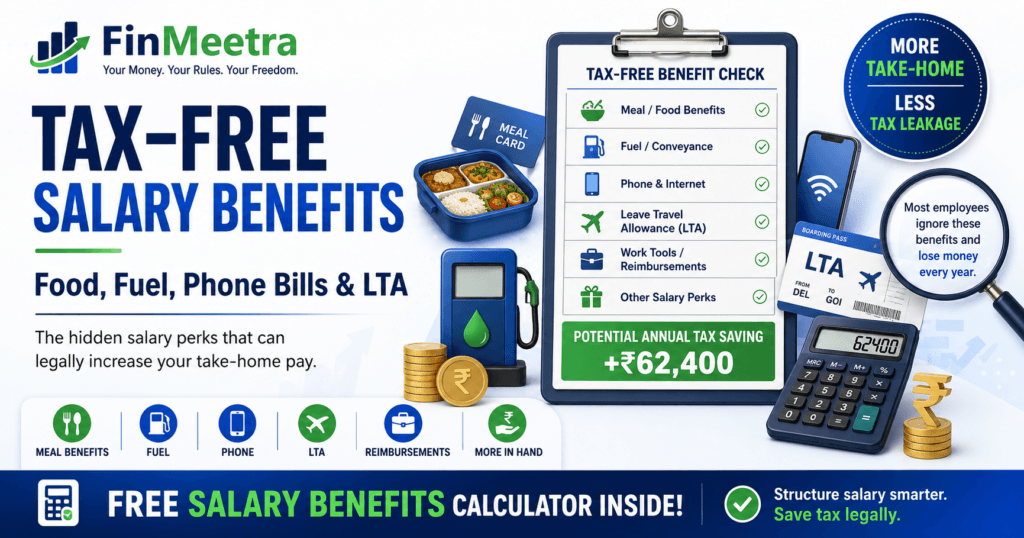
Tax-free salary benefits are salary components, reimbursements or employer-provided facilities that may reduce taxable salary when they follow income-tax rules, employer policy and proof requirements. For salaried employees, the most practical areas are food or meal vouchers, official fuel or conveyance reimbursement, telephone/mobile/internet facility, Leave Travel Allowance (LTA), official tour reimbursements, laptops/computers and certain health insurance benefits.
But here is the trap: a benefit is not tax-free just because HR writes it in your CTC. A flat cash allowance can be taxable. A reimbursement without proof can be taxable. LTA may become useless if you choose the wrong tax regime or do not travel. Fuel can become a taxable car perquisite if it is personal usage. The real power is not in adding random components. The real power is in designing salary structure around actual expenses, valid tax rules and clean documentation.
Latest update note: The Income-tax Rules, 2026 have been notified to come into force from 1 April 2026. For the new rules, the free food or paid voucher threshold shown in Rule 15 is Rs.200 per meal during working hours, subject to conditions. Some older payroll references and legacy guides still mention Rs.50 per meal under earlier rules. Always match the rule to the tax year and payroll treatment your employer is applying.
Rahul and Priya Had the Same CTC. One Got More Take-Home.
Rahul and Priya both earn Rs.18 LPA in Bengaluru. Their CTC is the same. Their work experience is similar. Their job title is almost identical. But Rahul gets slightly better monthly take-home than Priya. Priya assumes he has some secret bonus. Rahul smiles like a payslip detective who has seen the missing page.
The difference is not luck. Rahul’s salary has structured reimbursements: meal vouchers, mobile bill reimbursement, official fuel reimbursement and LTA. Priya’s salary has a large special allowance bucket. Special allowance is simple for payroll, but it is usually fully taxable. Rahul’s benefits are not free money. He submits bills, keeps proof and uses only eligible components. But the tax impact is real.
This is the salary structure problem most employees miss. They negotiate CTC, but they do not negotiate structure. They celebrate the offer letter, but they do not inspect whether the salary breakup is silently converting possible tax-friendly benefits into plain taxable income.
If you recently read FinMeetra’s hidden tax savings and extra TDS guides, this is the next layer. Tax saving is not only ELSS and NPS. Sometimes, it is hidden inside the salary breakup itself.
First, Understand the Difference Between Allowance, Reimbursement and Perquisite
Many employees use these words interchangeably. Payroll does not. Tax law does not. Your bank account should not.
| Term | Simple Meaning | Tax Risk |
| Allowance | A fixed amount paid as part of salary, whether or not you spend it | Often taxable unless a specific exemption applies |
| Reimbursement | Employer pays back actual expense based on proof | Can be non-taxable if expense is official/eligible and proof is maintained |
| Perquisite | A benefit or facility given by employer, like meal, car, phone, laptop or insurance | Can be taxable, exempt or valued at nil depending on rules |
| Exemption | Income specifically excluded from tax subject to conditions | Useful only if conditions and documentation are met |
| Deduction | Amount reduced from taxable income under specific sections | Regime-sensitive in many cases |
A smart salary structure does not simply add fancy components. It converts genuinely incurred, eligible expenses into correctly documented reimbursements or perquisites. That is the difference between legal tax planning and payroll decoration.
The Tax-Free Salary Benefits Calculator
Before reading further, calculate your own salary benefit gap. Enter your meal voucher amount, phone bill, official fuel or conveyance reimbursement, LTA, other official reimbursements and your applicable marginal tax rate. The calculator will show your eligible tax-free benefit, estimated tax saved, monthly take-home impact and proof risk.
Tax-Free Salary Benefits Calculator
Estimate tax saving from food, fuel, phone bills, LTA and reimbursements
Structure matters
Same CTC can create different take-home if eligible reimbursements are documented correctly.
Proof decides benefit
Food, fuel, phone and LTA benefits need policy, bills or proof. Payroll can reject weak claims.
LTA is regime-sensitive
LTA is generally useful under old regime. Compare regimes before depending on it.
What Your Calculator Result Means
| Result | Meaning | Action |
| Tax saving below Rs.10,000 | Small benefit, but still useful if proof is easy | Use phone/internet or meal benefits if already available |
| Tax saving Rs.10,000 to Rs.50,000 | Your salary structure has meaningful leakage | Ask HR if reimbursements can replace part of special allowance |
| Tax saving above Rs.50,000 | High salary-structure opportunity | Review benefits, regime and proof process carefully |
| High benefit but weak proof | Payroll may reject it later | Keep bills, declarations, travel proof and approvals ready |
| New regime selected with LTA | LTA may not help under new regime | Compare old vs new before relying on LTA |
Benefit #1: Food or Meal Vouchers
Food benefits are popular because they feel small but work every month. Under the latest Income-tax Rules, 2026, free food and non-alcoholic beverages provided during working hours at office/business premises or through paid vouchers usable only at eating joints can be outside taxable perquisite value up to Rs.200 per meal, subject to conditions. Older payroll references may still show Rs.50 per meal for earlier periods, so verify your payroll year and employer rule.
The real-world point is simple: if your company gives a food voucher benefit and you actually use it for meals during working hours, it can reduce taxable cash salary compared with receiving the same amount as plain special allowance.
| Food Benefit Point | What to Check |
| Is it a voucher or cash allowance? | Cash food allowance is usually risky. Structured vouchers are cleaner. |
| Is there a per-meal limit? | Use the limit applicable to the tax year and employer policy. |
| Is it during working hours? | The rule is linked to working hours and eligible usage. |
| Is it non-transferable? | Paid vouchers usable only at eating joints are generally safer. |
| Is the value excessive? | Excess over eligible limit may become taxable. |
Benefit #2: Phone, Mobile and Internet Bills
This is one of the most practical benefits for salaried employees working in finance, IT, sales, marketing, consulting, HR, operations and hybrid roles. Income Tax Department guidance on perquisites says expenses on telephones including mobile phone incurred by the employer on behalf of the employee are not treated as taxable perquisite. The salary guide also states that telephone or mobile facility provided by employer is not chargeable to tax as perquisite.
This does not mean every employee can invent a phone allowance and make it tax-free. The clean method is reimbursement or facility backed by bills, employer policy and business-use logic. If your company gives you Rs.2,000 per month as taxable communication allowance, it may not behave the same as reimbursing actual phone/internet bills under policy.
| Phone/Internet Case | Likely Treatment |
| Employer pays/reimburses actual mobile or telephone expenses under policy | Usually strong tax-free position as per perquisite guidance |
| Fixed communication allowance without bill proof | May be treated as taxable salary |
| Bills in family member name | Employer may reject unless policy permits |
| Personal entertainment subscriptions bundled in internet bill | Risky and may be excluded by payroll |
Benefit #3: Fuel, Driver and Conveyance Reimbursement
Fuel is the most misunderstood salary component. Employees often ask, “Can I make fuel reimbursement tax-free?” The better question is: “Is the travel official, documented and allowed by employer policy?”
Conveyance allowance granted to meet expenses in performance of office duties can be exempt to the extent of official expenditure. Expenses incurred wholly and exclusively for official purposes may also avoid taxable perquisite treatment in specific contexts. But personal fuel, home-to-office commuting, company car usage and mixed usage can have separate perquisite valuation rules. That is why fuel should never be handled casually.
| Fuel/Travel Situation | Better Way to Think |
| Client visits or official travel | Claim under official conveyance reimbursement with route, purpose and bills |
| Daily home-to-office commute | Do not assume automatic tax-free treatment |
| Company car with personal use | Perquisite valuation may apply |
| Fuel card without logbook | High payroll rejection risk |
| Own car used for official work | Maintain logbook, approvals and bills |
If fuel reimbursements push you to inflate car spending or EMIs, connect this with FinMeetra’s EMI Calculator and Salary Hike Trap. Tax saving should not become lifestyle leakage in a green costume.
Benefit #4: Leave Travel Allowance (LTA)
LTA looks attractive, but it is often overestimated. Income Tax Department guidance states that Leave Travel Allowance is exempt to the extent of actual travel expenses incurred in India by the employee and family. It is linked to travel fare, not hotel, food, sightseeing or shopping. The benefit is generally available for two journeys in a block of four calendar years, subject to conditions.
The biggest modern LTA trap is tax regime. If you choose the new tax regime, many exemptions that employees used under the old regime may not help. So before you rely on LTA, compare old vs new regime using FinMeetra’s Old vs New Tax Regime Calculator and your actual travel plans.
| LTA Myth | Reality |
| LTA means full vacation is tax-free | Usually only eligible travel fare is considered |
| Hotel bills are covered | Generally not covered for LTA exemption |
| Foreign travel qualifies | LTA is for travel in India |
| I can claim every year without travel | Claim needs actual eligible travel and proof |
| LTA works in every regime | Regime choice can affect usefulness |
Benefit #5: Laptops, Computers and Work Tools
Employer-provided laptops and computers are often one of the cleanest work benefits because Income Tax Department guidance lists use of laptops and computers as nil taxable value under movable assets rules. But there is a difference between using a company laptop and taking reimbursement for personal gadgets. Employer policy matters. Asset ownership matters. Business purpose matters.
For many employees, this does not create monthly cash saving, but it prevents unnecessary personal spending. If your job needs a laptop, monitor, office chair or work tool, check whether employer provides or reimburses it under a formal policy instead of buying everything from post-tax salary.
Benefit #6: Health Insurance Paid by Employer
Health insurance is not only a tax topic. It is a survival topic. Income Tax guidance indicates that approved employer-paid health insurance premium or reimbursement of eligible health insurance premium for employee/family under approved scheme can be exempt. This is separate from your personal 80D planning. If your employer provides meaningful family cover, the value may be much higher than what appears in CTC.
Do not compare only CTC. Compare usable benefits. This directly connects with FinMeetra’s Offer Letter Trap. A higher CTC with weak insurance can be worse than a slightly lower CTC with strong family medical cover.
The Salary Structure Trap: Special Allowance Eats Everything
When payroll wants simplicity, it creates a large special allowance. It is easy to process, easy to explain and easy to tax. But for the employee, it can become a tax dustbin. Money that could have been structured as valid reimbursement may sit inside special allowance and become fully taxable.
| Salary Component | Problem if Poorly Structured | Better Question to Ask HR |
| Special allowance | Usually fully taxable | Can a part be moved to valid reimbursements? |
| Food allowance | Cash allowance may be taxable | Is meal voucher facility available? |
| Communication allowance | Fixed cash may be taxable | Can actual bills be reimbursed under policy? |
| Fuel allowance | Personal use can be risky | Is official travel reimbursement/logbook process available? |
| LTA | Not useful without travel/proof/regime fit | Can I claim this based on my travel plan and tax regime? |
This is why two employees with the same CTC may have different net salary. One is paid mostly taxable cash. The other has a mix of salary and valid benefits that match real life expenses.
Case Study: How Priya Improved Take-Home Without Increasing CTC
Priya earns Rs.21 LPA. Her salary structure has a large special allowance. She spends on mobile/internet, meals during office days and occasional official client travel. She also travels once in two years with family within India. Earlier, all of this was paid from post-tax salary.
| Item | Before | After Restructure | Tax Effect |
| Meal benefit | No structured benefit | Rs.36,000 eligible annual meal voucher usage | Taxable salary reduced subject to limits |
| Mobile/internet | Paid personally | Rs.24,000 annual reimbursement with bills | Tax-free perquisite treatment possible under policy |
| Official fuel/conveyance | Paid from salary | Rs.30,000 annual official reimbursement | Exempt to extent of official purpose/proof |
| LTA | Ignored | Rs.60,000 eligible travel fare in old regime year | Useful only with travel and old regime fit |
| Special allowance | High taxable bucket | Reduced by structured components | Lower taxable salary if claims accepted |
Priya did not become richer because HR gifted free money. She simply stopped paying tax on eligible expenses that were already part of her life. That is the cleanest kind of salary planning.
The 7-Step Salary Benefits Action Plan
| Step | Action | Why It Matters |
| Step 1 | Download your salary breakup | Find how much is sitting in special allowance |
| Step 2 | List real monthly expenses | Food, phone, internet, official travel, LTA travel |
| Step 3 | Check employer policy | Not all companies allow all reimbursements |
| Step 4 | Compare old vs new tax regime | Especially before relying on LTA |
| Step 5 | Ask HR/payroll for structure options | Use professional language, not “give me tax-free salary” |
| Step 6 | Submit proofs monthly/quarterly | Avoid year-end rejection and extra TDS |
| Step 7 | Track payslip TDS and taxable salary | Confirm that restructuring actually worked |
How to Ask HR Without Sounding Like You Are Gaming Tax
| Instead of Saying | Say This |
| Can you make my salary tax-free? | Can you help me understand the available reimbursement components under company policy? |
| I want more take-home without more CTC | Can part of my special allowance be structured as valid reimbursements where I submit actual bills? |
| I heard food coupons save tax | Does our payroll support meal vouchers, and what limit is applicable for this tax year? |
| Can I claim fuel? | What is the official travel reimbursement process and documentation requirement? |
| LTA should reduce my tax | Can you confirm LTA eligibility, proof requirement and regime impact? |
Proof Checklist Before Payroll Rejects Your Claim
| Benefit | Proof to Keep | Common Rejection Reason |
| Meal vouchers | Employer voucher records, policy terms | Cash allowance instead of eligible voucher |
| Phone/mobile/internet | Bill, payment proof, employee name or accepted policy details | Bill in wrong name or no business policy |
| Fuel/official conveyance | Bills, route, purpose, approvals, logbook | Personal commute claimed as official travel |
| LTA | Tickets, boarding passes, travel proof, family details, leave records | Hotel bills only or foreign travel |
| Laptop/computer | Asset allocation records or approved reimbursement policy | Personal purchase without policy approval |
| Health insurance | Policy copy, premium receipt, employer scheme details | Non-approved policy or unclear family coverage |
Where Should the Extra Take-Home Go?
If better salary structure improves your monthly take-home by Rs.2,000, Rs.5,000 or Rs.10,000, do not let that money melt into snacks, subscriptions and “I deserve this” upgrades. Tax saved is only useful when it gets a job.
| Monthly Tax Saved | First Use | Second Use |
| Rs.2,000 | Build mini emergency buffer | Increase SIP slowly |
| Rs.5,000 | Emergency fund or credit-card cleanup | Start step-up SIP |
| Rs.10,000 | Close expensive debt faster | Invest for financial freedom |
| Rs.20,000+ | Avoid lifestyle inflation | Use goal-based investing |
Connect this with FinMeetra’s Emergency Fund Guide, SIP Calculator and When Will You Become Financially Free Calculator. The purpose of salary tax planning is not only lower tax. It is better financial breathing space.
Key Takeaways
✅ Tax-free salary benefits are powerful only when they match actual expenses, tax rules and employer policy.
✅ A cash allowance is not automatically tax-free. Reimbursement with proof is often cleaner.
✅ Food or meal vouchers have conditions and per-meal limits. Use the limit applicable to your tax year.
✅ Telephone/mobile expenses incurred by employer on behalf of employee can avoid taxable perquisite treatment under official guidance.
✅ Fuel and conveyance are sensitive. Official-purpose proof matters.
✅ LTA is useful only when you actually travel in India and the tax regime supports it.
✅ Special allowance is simple, but often fully taxable.
✅ The best salary structure increases usable take-home without pushing you into fake claims or risky documentation.
Frequently Asked Questions
Q: Are food coupons tax-free for salaried employees?
A: They may be tax-free up to the applicable per-meal limit if provided during working hours through eligible employer arrangements and conditions are met. The latest Income-tax Rules, 2026 text shows Rs.200 per meal from 1 April 2026, while older references may mention Rs.50 for earlier periods. Verify your payroll year.
Q: Is mobile bill reimbursement tax-free?
A: Official guidance says expenses on telephones including mobile phone incurred by the employer on behalf of the employee are not treated as taxable perquisite. Employer policy and proof are important.
Q: Is internet reimbursement tax-free?
A: It may be treated along with telephone/mobile/communication facility if employer policy supports it and bills are properly submitted. Payroll treatment can vary.
Q: Can fuel reimbursement reduce tax?
A: Fuel or conveyance reimbursement is safer when linked to official duties with proof, route, purpose and logbook. Personal commuting or personal car use can have different tax treatment.
Q: Is LTA available in the new tax regime?
A: LTA is generally an old-regime style exemption. If you choose the new regime, do not assume LTA will reduce tax. Compare regimes before relying on it.
Q: Can I claim LTA without travelling?
A: No. LTA exemption needs actual eligible travel in India and valid proof. It is not a free annual deduction.
Q: Can I restructure salary any time?
A: It depends on employer payroll policy. Some companies allow flexible benefits at joining or financial-year start, while others lock structure for the year.
Q: Which is better, higher basic or more reimbursements?
A: Higher basic can improve PF, gratuity and HRA formula, while reimbursements can improve tax efficiency. The best mix depends on your salary, rent, expenses, tax regime and goals.
Q: Are reimbursements better than deductions like 80C?
A: They solve different problems. Reimbursements reduce taxable salary when valid. Deductions reduce taxable income under specific provisions and may be regime-sensitive.
Q: What is the biggest mistake employees make?
A: They accept a salary breakup without checking how much is fully taxable special allowance and what valid benefits are available under company policy.
Related Articles You Should Read Next
- Hidden Tax Savings in Salary Structure – Understand the tax-saving levers inside CTC and salary structure.
- How to Stop Extra TDS From Eating Your Monthly Salary – Fix payroll declarations before TDS cuts your take-home.
- Old vs New Tax Regime Calculator – Compare regimes before depending on LTA or deductions.
- The Rs.3 Lakh Tax Saving Mistake – Avoid buying random tax products in March.
- You Earn Rs.20 LPA Salary. Why Does It Feel Poor? – See how tax, deductions and lifestyle reduce real comfort.
- The Salary Hike Trap – Understand why a higher salary may not improve freedom.
- The Offer Letter Trap – Compare CTC, tax, PF, variable pay and benefits before switching.
- Emergency Fund Guide – Use saved tax cash flow to build safety first.
- SIP Calculator – Turn improved take-home into long-term wealth.
Useful External Resources
- Income Tax Department – Salaried Individuals AY 2026-27
- Income Tax Department – Employees Benefits Allowable
- Income Tax Department – Income from Salary Guide
- Income Tax Department – Exempt Income
- Income Tax Rules, 2026 Notification
────────────────────────────────────────────────────────────
📩 ENJOYED THIS BLOG? HERE IS WHAT YOU CAN DO NEXT:
💬 Leave a Comment – Does your salary structure have only Special Allowance, or do you get valid reimbursements too?
📧 Subscribe to FinMeetra Newsletter – Real salary, tax and wealth insights for Indian employees every week.
🧮 Use the Tax-Free Salary Benefits Calculator – Check whether food, fuel, phone bills and LTA can improve your take-home.
Disclaimer
This blog is for educational and informational purposes only. It does not constitute financial advice, tax advice, legal advice, investment advice, payroll advice or career advice. Income-tax rules, reimbursement policies, perquisite valuation, food voucher limits, LTA treatment, fuel reimbursement rules, phone bill reimbursement, proof requirements, tax regime impact and employer payroll treatment may vary by financial year, tax year, employer policy and individual facts. Verify with official Income Tax resources, your employer payroll team, Form 16, Form 12BB, AIS/TIS and a qualified tax professional before making declarations or filing returns.
© 2026 FinMeetra.com | All Rights Reserved