
(The salaried employee guide to understanding credit card minimum due, revolving interest, new spending, late fees, credit score impact and how to escape the debt cycle.)
Quick Answer
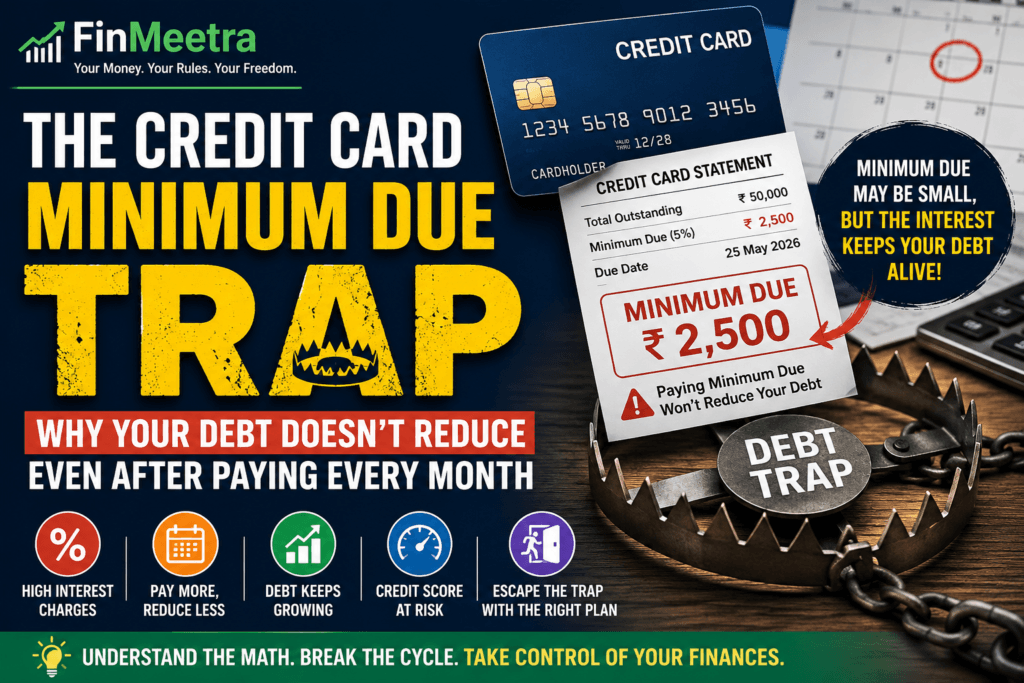
The credit card minimum due trap happens when you pay only the minimum amount due every month and assume your credit card debt is under control. In reality, the remaining unpaid balance may continue to attract finance charges, and if you keep using the card, your outstanding can stay almost the same or even grow. Minimum due can help you avoid immediate overdue status, but it does not mean the rest of the bill is interest-free or harmless.
For salaried employees, this trap is dangerous because it quietly converts lifestyle spending into a long-running monthly burden. You feel like you are paying. Your bank statement shows money going out. But the principal balance barely moves. This is why credit card debt often feels like a ghost EMI: invisible in the beginning, loud by month-end.
Why This Topic Belongs on FinMeetra
FinMeetra is not only about tax saving or salary structure. The real journey is bigger: earn salary, understand take-home, control monthly spending, reduce debt, build safety and finally invest for freedom. Credit card debt sits right in the middle of that journey.
A person may earn a good salary and still feel broke if credit card payments, EMIs and minimum due amounts eat the salary before the month starts. If that sounds familiar, first connect this article with FinMeetra’s guide on why a ₹20 LPA salary can still feel poor. That article explains the salary-side pain. This one explains the debt-side leak.
What Is Minimum Due on a Credit Card?
Minimum amount due is the smallest amount you must pay by the due date to keep your credit card account from slipping into immediate overdue trouble. It is usually calculated as a percentage of the outstanding amount, along with applicable EMI amounts, fees, taxes, past dues or issuer-specific components.
The mistake is in the interpretation. Many cardholders read minimum due as a safe payment option. It is actually a danger signal. It tells you the minimum needed to avoid one problem, but not the amount needed to solve the debt.
| Term | Simple Meaning | What Many People Assume | Reality |
| Total amount due | Full credit card bill payable | This is optional if minimum due is paid | Paying full bill is what protects you from revolving debt |
| Minimum amount due | Smallest amount needed by due date | This keeps everything normal | It may avoid late fee/default, but unpaid balance can attract finance charges |
| Finance charges | Interest on unpaid/revolving balance | Only small extra cost | Can become very expensive if debt continues |
| Credit limit | Maximum spend allowed | Extra salary available | Borrowed money that must be repaid |
| Billing cycle | Period for statement generation | Only a statement date | Controls due date, interest-free period and repayment discipline |
If your monthly cash flow is already tight, the minimum due trap often starts after one bad month. That is when budgeting becomes survival, not theory. FinMeetra’s 50-30-20 monthly budget rule can help you see whether your credit card payment is sitting inside your real capacity or silently borrowing from next month.
The Real Problem: Minimum Due Reduces Panic, Not Debt
Imagine a salaried employee with a credit card outstanding of ₹80,000. The card statement shows minimum due of ₹4,000. The employee pays ₹4,000 and feels relieved. But the remaining ₹76,000 does not disappear. It may continue to attract interest. If the employee spends another ₹10,000 in the same or next cycle, the outstanding remains heavy even after payment.
This is why the debt does not reduce: your payment is fighting three enemies at once – old balance, interest and fresh spending.
| Month | Opening Balance | Payment Made | New Spending | Interest / Charges | Closing Balance Trend |
| Month 1 | ₹80,000 | ₹4,000 minimum due | ₹8,000 | Finance charges apply | Debt still high |
| Month 2 | High balance continues | ₹4,500 minimum due | ₹10,000 | More charges apply | Debt barely moves |
| Month 3 | Balance feels stuck | ₹5,000 paid | ₹7,000 | Interest continues | Salary pressure grows |
| Month 4 | Card becomes monthly burden | Minimum due again | Fresh swipe for essentials | More cost | Debt becomes routine |
RBI Also Wants Cardholders to Understand This Clearly
Credit card billing and minimum due disclosure are regulated areas in India. RBI has directed that even when the minimum amount needed to keep the card valid is paid, billing communication should clearly indicate that interest will be charged on the amount due after the payment due date. RBI credit card directions also require payment terms, including minimum amount due, to avoid negative amortisation, meaning the payment structure should not allow debt to keep increasing in a way that principal never reduces.
This matters because the minimum due number is not designed to be your long-term repayment strategy. It is a minimum compliance number. Your financial freedom needs a closure number.
The FinMeetra Credit Card Minimum Due Trap Calculator
Use this calculator before deciding whether to pay only minimum due, convert to EMI, use a bonus/prepayment or create a debt closure plan. Enter your outstanding amount, minimum due percentage, monthly interest rate, planned payment, new spending and target closure period. The calculator estimates months to clear, total interest, suggested payment and debt trap risk.
| Action | Why it matters |
|---|
Disclaimer: This calculator uses simplified assumptions. Actual credit card interest, taxes, fees, payment allocation and minimum amount due rules vary by issuer and card terms. Verify your card statement and speak to your bank before making repayment decisions.
What Your Calculator Result Means
| Result | Meaning | Action |
| High risk / trapped | Your payment may not reduce principal meaningfully | Stop new spending and increase payment above minimum due |
| More than 24 months | Debt can survive for years at current payment speed | Use fixed payoff amount or prepayment |
| 12 to 24 months | Debt is reducing but slowly | Try to close faster before interest drains salary |
| Below 12 months | Manageable plan if no new spending happens | Stay disciplined and do not reduce payment later |
| Suggested payment higher than comfort | Your lifestyle may be above cash-flow capacity | Rebuild budget and cut non-essential spending temporarily |
If the calculator shows your card will take more than two years to close, do not ignore it. A credit card balance that survives many salary cycles can delay emergency fund creation. Before investing aggressively, check whether your safety net is ready using FinMeetra’s Emergency Fund Guide. Debt without emergency fund is a room with one door and no window.
Why Your Credit Card Debt Does Not Reduce Even After Paying Every Month
1. You Are Paying Minimum Due, Not Debt Closure Amount
Minimum due is generally much smaller than the full bill. It may keep the account from immediate overdue status, but the unpaid balance can continue to attract finance charges. The card stays active, but your debt stays alive.
2. Finance Charges Are Eating Part of Your Payment
When you revolve credit card dues, part of your next payment may effectively go toward interest/charges instead of reducing the original spend. This is why the outstanding feels stubborn.
3. You Continue Using the Card While Repaying Old Balance
This is the most common salaried employee mistake. You pay ₹5,000 but spend ₹7,000 again. On paper you paid. In reality, you replaced old debt with new debt.
4. You Treat Credit Limit Like Salary
Credit limit is not income. It is available borrowing. The moment you treat it like extra monthly salary, your real take-home becomes fake comfort.
5. You Do Not Track Card Spend Category-Wise
Food delivery, fuel, shopping, subscriptions and small online payments can become a cloud of transactions. The bill looks shocking because no single spend looked dangerous.
6. You Convert Everything to EMI Without Checking Total Cost
Credit card EMI can reduce immediate pressure, but it can also lock your future salary. EMI is useful only when total cost and closure plan are clear.
7. You Use One Card to Manage Another Card
Paying one card through another borrowing source may delay the crisis, but it does not solve the debt unless your total outstanding reduces.
If your EMIs and credit card dues already eat a large part of your income, use FinMeetra’s EMI Calculator to understand how loan payments are shaping your monthly cash flow before adding another EMI conversion.
A Realistic Salary Snapshot: How Minimum Due Becomes a Salary Leak
Consider a salaried employee earning ₹1.10 lakh net salary per month. The person has regular family expenses, one EMI and a credit card outstanding of ₹90,000. The statement shows minimum due of around ₹4,500 to ₹6,000 depending on card terms. Paying only that amount looks manageable. But the debt does not reduce because the employee still uses the card for groceries, fuel and online purchases.
| Monthly Item | Amount | What It Means |
| Net salary | ₹1,10,000 | Actual cash available |
| Existing EMI | ₹35,000 | Fixed commitment |
| Household expenses | ₹45,000 | Basic monthly spend |
| Credit card minimum due | ₹5,000 | Looks small but does not close debt |
| Fresh card spending | ₹12,000 | Cancels repayment progress |
| Emergency saving | ₹0 | No buffer, so card gets reused |
| Result | Salary shortage repeats | Debt becomes monthly routine |
This is the exact point where many people say, “My salary is decent, but nothing remains.” The issue is not only income. It is leakage. FinMeetra’s Salary Hike Trap guide explains why even a raise may not fix money stress if old debt habits survive the hike.
Minimum Due vs Full Payment vs Fixed Payoff: What Should You Choose?
| Payment Method | When People Use It | Financial Impact | FinMeetra Verdict |
| Minimum due only | When salary is short | Debt reduces very slowly and interest risk remains | Use only as emergency stopgap, not strategy |
| Full payment | When cash flow is strong | Avoids revolving debt and interest burden | Best habit |
| Fixed payoff amount | When full payment is not possible | Creates a planned closure path | Best practical recovery method |
| One-time prepayment | Bonus/refund/incentive available | Reduces interest-bearing balance quickly | Powerful if followed by spending freeze |
| Debt consolidation loan | Multiple cards/high interest debt | Can reduce stress if rate is lower and card use stops | Use carefully, not as new spending license |
The 7-Step FinMeetra Plan to Escape the Minimum Due Trap
Step 1: Freeze New Credit Card Spending for 30 Days
Do not use the card while trying to repay it. If you keep swiping, the calculator will keep moving the finish line away from you.
Step 2: Write the Full Outstanding Amount, Not Only Minimum Due
Your target is total debt, not minimum due. Put the full number on paper. Ugly clarity is better than beautiful confusion.
Step 3: Pay More Than Minimum Due With a Fixed Monthly Amount
Choose a monthly payment you can repeat. Keep it fixed even when minimum due falls. This accelerates principal reduction.
Step 4: Attack High-Interest Debt Before Low-Interest Goals
Credit card debt usually deserves urgent attention before optional investments. A SIP is good, but not when credit card interest is burning the floor beneath it.
Step 5: Use Any Bonus, Refund or Incentive Strategically
Use one-time money to reduce the outstanding principal, not to restart spending. A refund or bonus should become a debt cutter.
Step 6: Build a Small Emergency Buffer
Even ₹10,000 to ₹25,000 buffer can prevent the next emergency from going back to credit card. Do not wait for a perfect emergency fund.
Step 7: Restart Investing Only After the Debt Has a Clear Exit Date
Once the card is under control, restart SIPs with discipline. Then use FinMeetra’s SIP tools to convert monthly surplus into long-term wealth.
When you are ready to restart wealth creation, begin slowly with FinMeetra’s How to Start Your First SIP in India instead of jumping from debt pressure directly into aggressive investing.
Debt Snowball or Debt Avalanche: Which Works Better?
If you have multiple debts, two popular methods can help. Debt snowball means closing the smallest debt first for motivation. Debt avalanche means closing the highest-interest debt first for mathematical savings. Credit card debt usually belongs near the top of avalanche priority because the finance charges can be steep.
| Method | How It Works | Best For | Weakness |
| Debt snowball | Pay smallest debt first | People who need quick wins | May not minimize interest |
| Debt avalanche | Pay highest-interest debt first | People focused on total cost saving | Motivation may be slower |
| Hybrid method | Close tiny debts, then attack highest interest | Most salaried employees | Needs discipline and tracking |
If your credit card debt started because you had no emergency fund, your first victory after repayment should not be a new gadget. It should be safety. Once safety is built, connect the surplus to FinMeetra’s financial freedom calculator so debt recovery becomes a long-term freedom plan, not just a temporary cleanup.
Warning Signs That Minimum Due Has Become a Trap
- You pay the card every month but the outstanding does not reduce clearly.
- You use the card again within a week of making payment.
- You do not know the interest rate or finance charge on your card.
- Your salary plan includes “minimum due” as a normal monthly expense.
- You are converting credit card bills into EMI again and again.
- You avoid opening the card statement because it creates stress.
- You are using personal loans or another card to manage existing card dues.
- You cannot build even a small emergency fund because of card payments.
What Not to Do When Credit Card Debt Feels Heavy
| Mistake | Why It Is Dangerous | Better Action |
| Ignoring the statement | Interest and fees do not pause because you avoid looking | Open the statement and list all dues |
| Paying only minimum due forever | Debt can stay alive for years | Set a fixed closure payment |
| Using card for monthly essentials while repaying | New spending cancels progress | Use debit/UPI/cash budget temporarily |
| Taking personal loan without closing card use | Can create loan + card double burden | Cut card spending first |
| Closing all cards suddenly without plan | May affect credit availability and emergencies | First repay, then decide card strategy |
| Chasing reward points | Rewards are tiny compared to finance charges | Focus on debt closure, not cashback |
How Credit Card Minimum Due Can Affect Credit Score
Paying at least the minimum due by the due date may help avoid immediate overdue reporting and late payment trouble, but it does not automatically make your credit profile healthy. High outstanding balance, frequent revolving credit and high credit utilisation can still make lenders uncomfortable. Credit reports contain details of active and inactive credit accounts, repayment history and enquiries, so credit card behaviour becomes part of your larger borrowing profile.
The goal is not only to avoid late payment. The goal is to become a low-risk borrower again. That means paying on time, reducing outstanding, keeping utilisation controlled and not depending on credit cards for monthly survival.
Credit Card Debt Recovery Checklist
| Checklist Item | Where to Check | Why It Matters |
| Total outstanding | Latest card statement | Shows full debt, not just minimum due |
| Minimum due | Statement summary | Shows emergency payment floor |
| Finance charge / APR | MITC / card statement / bank website | Shows cost of revolving balance |
| Due date | Statement | Prevents late fee and overdue reporting |
| New spending after statement | Card app / transactions | Shows whether you are adding fresh debt |
| EMI conversions | Statement / card app | Shows locked future payments |
| Available monthly surplus | Budget sheet | Shows realistic payoff capacity |
| Emergency buffer | Bank account | Prevents card reuse |
| Closure target date | Your plan | Turns panic into repayment roadmap |
Where Should Extra Money Go: Credit Card, EMI, SIP or Emergency Fund?
When money is limited, priority matters. Do not throw small amounts randomly everywhere. Use a sequence. First avoid late payment. Then reduce high-cost credit card debt. Then create a small emergency buffer. Then restart investing. This order may not look glamorous, but it protects your future salary from old mistakes.
| Situation | Priority | Reason |
| Credit card overdue risk | Pay at least required amount immediately | Avoid late fee and credit damage |
| Credit card revolving balance | Pay more than minimum due | High-cost debt needs urgent reduction |
| No emergency buffer | Build small buffer after debt plan starts | Prevents card reuse |
| Existing SIP but high card debt | Pause/reduce temporarily if needed | Interest cost may beat expected returns |
| Debt under control | Restart SIP and step-up later | Move from recovery to wealth creation |
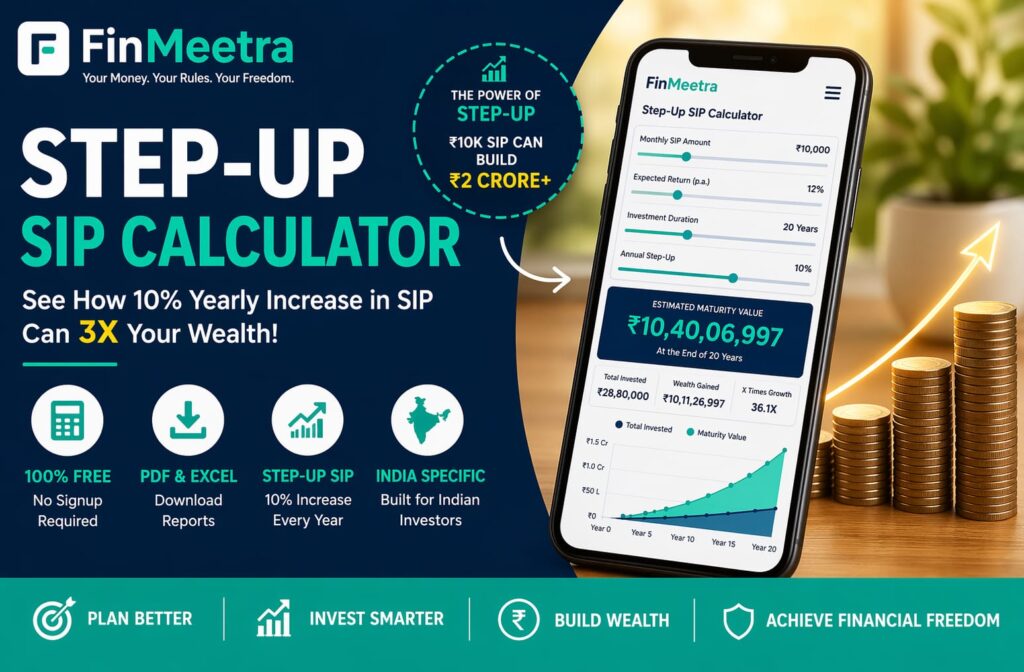
Once debt pressure reduces, you can use FinMeetra’s Step-Up SIP Calculator to gradually rebuild investments without shocking your monthly budget.
Key Takeaways
- Minimum due is not the same as debt repayment strategy.
- Paying only minimum due can keep credit card debt alive for years.
- The unpaid balance may continue to attract finance charges.
- Fresh card spending can cancel the progress made by your payment.
- A fixed payoff amount works better than blindly following minimum due.
- High-interest credit card debt should usually be cleared before aggressive investing.
- Emergency buffer is important because without it, the card gets reused.
- Use the calculator to estimate your debt closure timeline and suggested payment.
- Financial freedom starts when salary stops paying for old swipes.
Frequently Asked Questions
Q: What is minimum due in a credit card bill?
It is the smallest amount you must pay by the due date to keep the account from immediate overdue trouble. It is not the full amount needed to close the bill.
Q: Does paying minimum due stop credit card interest?
Usually no. Paying only minimum due may avoid certain late payment consequences, but the remaining unpaid amount can continue to attract finance charges based on card terms.
Q: Why is my credit card outstanding not reducing?
Because your payment may be too low, interest may be added and you may be making fresh spends. All three together can keep the outstanding balance alive.
Q: Should I convert credit card bill to EMI?
It can help if the rate and tenure are clear and you stop new spending. But EMI conversion without behavior change can create another long-term burden.
Q: Is it better to take a personal loan to close credit card debt?
Sometimes it can reduce cost if the loan rate is lower and you fully stop using the card. But it is dangerous if you take a loan and then rebuild card debt again.
Q: Can minimum due affect my CIBIL score?
Timely minimum payment may help avoid immediate overdue status, but high utilisation and revolving balances can still hurt your credit profile. Credit behaviour matters beyond just one payment.
Q: How much should I pay above minimum due?
Use a fixed amount that can close the debt within 6 to 12 months if possible. The calculator can estimate the required amount based on your outstanding and interest assumptions.
Q: Should I stop SIP to pay credit card debt?
If card debt is expensive and cash flow is tight, temporarily reducing SIP to clear high-cost debt may be practical. Restart investing after the debt has a clear closure path.
Q: What is the first step if I am already trapped?
Freeze new card spending, list full outstanding, pay more than minimum due and create a monthly payoff plan.
Q: Is using credit card always bad?
No. A credit card is useful when paid fully and used within budget. The problem begins when it becomes extra salary or monthly survival money.
Useful External Resources
- Reserve Bank of India – Master Circular on Credit Card, Debit Card and Rupee Denominated Co-branded Pre-paid Card Operations
- Reserve Bank of India – FAQs on Master Direction for Credit Card and Debit Card
- Reserve Bank of India – Credit card overdue/reporting guidance
- TransUnion CIBIL – Free CIBIL Score and Report
Enjoyed This Blog? Here Is What You Can Do Next
Leave a Comment — Have you ever paid minimum due and wondered why the outstanding did not reduce?
Use the Credit Card Minimum Due Trap Calculator — Check how long your debt may survive at your current payment speed.
Disclaimer
This blog is for educational and informational purposes only. It does not constitute financial advice, credit advice, debt counselling, legal advice, investment advice or banking advice. Credit card interest rates, finance charges, minimum due formulas, payment allocation, late fees, EMI conversion cost, GST, credit bureau reporting and issuer policies may vary by bank, card type, statement date and customer profile. Please verify your card statement, MITC, bank terms and official RBI resources, and consult a qualified financial professional before making debt repayment decisions.
© 2026 FinMeetra.com | All Rights Reserved

Pingback: Should You Convert Credit Card Bill to EMI or Take a Personal Loan?