(How HRA exemption under Section 10(13A) can reduce tax, why it disappears in the new tax regime, and how to calculate the real monthly salary impact before payroll cuts your TDS.)
Quick Answer
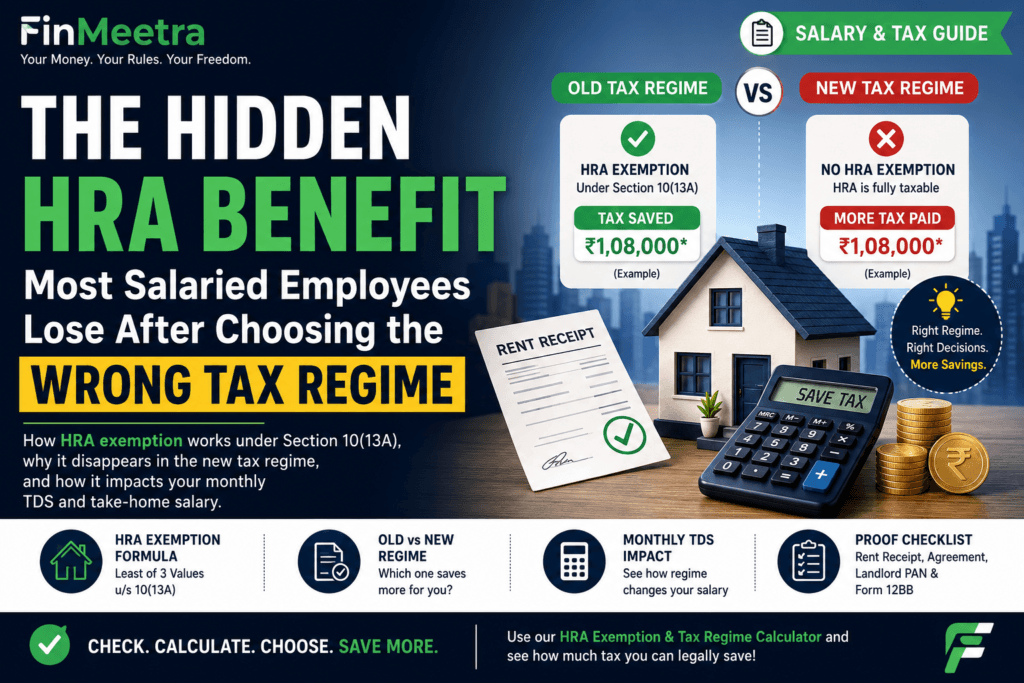
| The salary-rent truth in one paragraph HRA, or House Rent Allowance, can reduce taxable salary under Section 10(13A) and Rule 2A if you receive HRA as part of salary, pay rent, do not live in your own house, and choose the old tax regime. The new tax regime is the default regime, but HRA exemption is not available in it. That is why many salaried employees paying rent lose HRA tax benefit simply because they select the wrong tax regime or submit incomplete rent proof. The right decision is not “old regime is always better” or “new regime is always better.” The right decision is to calculate your HRA exemption, compare old vs new regime, and then declare correctly before payroll closes. This blog is posted to show the hidden HRA benefit most employee lose. |
Priya Paid ₹35,000 Rent Every Month. Her HRA Benefit Still Went Missing.
Priya works in Hyderabad and earns ₹21 LPA. Her monthly rent is ₹35,000. Every month, rent leaves her bank account with military discipline. No delay. No discount. No mercy. So when tax declaration season arrives, she naturally assumes one thing: “I pay rent, so my HRA tax benefit will reduce my TDS.”
Then January salary comes. Her take-home drops sharply. Payroll says her tax projection has changed. HR portal shows she selected the new tax regime by default and did not submit complete HRA proof. Suddenly, the rent she actually paid is not helping her tax calculation at all.
This is the hidden HRA problem. It does not look like a mistake at the start of the year. It looks like a harmless option in a payroll portal. One radio button. One missed Form 12BB. One landlord PAN not collected. One rent receipt uploaded late. Then TDS starts nibbling salary every month like a quiet termite with a calculator.
The painful part is that Priya did not avoid tax planning. She simply did not connect four moving pieces: salary structure, rent paid, tax regime, and proof submission. HRA is not an automatic discount. It is a rule-based exemption. If the rule chain breaks, the benefit disappears.
What Exactly Is HRA?
HRA means House Rent Allowance. It is a salary component paid by an employer to help an employee meet house rent expenses. For a salaried employee, HRA can become partly exempt from tax under Section 10(13A) read with Rule 2A, subject to conditions.
But there is one key distinction that most employees miss. HRA received is not automatically exempt. Only the eligible portion is exempt. The remaining portion becomes taxable salary.
Also, if you do not receive HRA in your salary structure, you cannot claim HRA exemption under Section 10(13A). You may need to evaluate Section 80GG separately if eligible, but that is a different route with different conditions. This blog focuses on employees who receive HRA in salary.
Latest Tax Rule Context: Why HRA Confusion Increased After the New Regime Became Default
For AY 2026-27, the Income Tax Department’s salaried individual guidance continues to show the old regime and the new regime under Section 115BAC. For non-business salaried taxpayers, the new regime is the default regime, and they can generally change the option every year while filing the return, subject to the applicable filing timeline and conditions.
The new regime gives lower slab rates and a higher rebate threshold, but it allows very few deductions and exemptions compared to the old regime. HRA exemption under Section 10(13A) is one of the big items that does not fit into the new-regime benefit world for salaried employees. The CBDT e-filing validation rules also identify 10(13A) HRA schedule entries among items not applicable when the new regime is selected.
That is why a rented employee should not choose the new regime blindly. The new regime may still be better for many employees, especially those with low deductions. But if your rent, HRA and other deductions are large, the old regime can sometimes win. The calculator has to decide. Not office gossip. Not WhatsApp tax gyaan. The calculator.
The HRA Exemption Formula Under Section 10(13A) and Rule 2A
The exempt portion of HRA is the least of the following three amounts:
| No. | HRA Formula Component | Meaning |
| 1 | Actual HRA received | The HRA component shown in your salary breakup or Form 16 |
| 2 | Rent paid minus 10% of salary | Annual rent paid minus 10% of basic salary plus DA, if applicable |
| 3 | 40% or 50% of salary | 50% if rented house is in Mumbai, Delhi, Kolkata or Chennai; 40% for other cities |
For this formula, “salary” generally means basic salary plus dearness allowance if it forms part of retirement benefits, plus turnover-based commission where applicable. For many private sector employees, the practical base is basic salary.
Important: If you live in your own house, or you do not actually pay rent, HRA is fully taxable. It is not a decorative line item that magically reduces tax.
Metro vs Non-Metro: The Bengaluru and Hyderabad Surprise
For HRA calculation, the 50% salary limit is available only when the house is situated in Mumbai, Delhi, Kolkata or Chennai. Many employees assume Bengaluru, Hyderabad, Pune, Gurugram or Noida should also be treated as metro cities because rent is high. For HRA formula purposes, that assumption can break the calculation.
| Rented House Location | Formula Limit | Reality Check |
| Mumbai, Delhi, Kolkata, Chennai | 50% of salary limit | Higher HRA cap |
| Hyderabad, Bengaluru, Pune, Gurugram, Noida, Ahmedabad and other cities | 40% of salary limit | Lower HRA cap even if rent is high |
HRA Calculator: Check Whether Old Regime Saves More Than New Regime
Before reading further, calculate your HRA benefit honestly. Enter annual gross salary, basic plus DA, HRA received, monthly rent, city type and other old-regime deductions. The calculator will estimate HRA exemption, taxable HRA, old regime tax, new regime tax and the monthly salary impact.
HRA Exemption & Tax Regime Calculator
Check whether old regime HRA benefit beats the new tax regime
HRA is regime-sensitive
HRA exemption helps under the old regime. It does not reduce tax under the new regime.
Metro rule is narrow
Only Mumbai, Delhi, Kolkata and Chennai get the 50% salary limit for HRA formula.
Proof decides payroll
Rent agreement, receipts, landlord PAN and Form 12BB can decide your monthly TDS.
What Your Calculator Result Means
| Calculator Output | Meaning | Action |
| Old regime tax is lower | Your HRA plus deductions may be stronger than lower new-regime slabs | Declare old regime, submit proofs and verify payroll projection |
| New regime tax is lower | Lower slabs beat your HRA and deductions | Choose new regime but understand that HRA exemption is not being used |
| HRA exemption is zero | Rent is too low, HRA missing, no rent paid, or formula does not create exemption | Check salary structure and proof eligibility |
| Taxable HRA is high | Your HRA received is more than eligible exemption | Estimate TDS impact and do not assume full HRA is tax-free |
| Monthly salary impact is high | Wrong regime can cut take-home every month | Fix declaration before payroll closes |
Case Study: Rahul’s ₹30,000 Rent Created a ₹89,856 Tax Difference
Rahul earns ₹18 LPA and lives in Hyderabad. His annual basic salary is ₹7.2 lakh, annual HRA received is ₹3.6 lakh, and monthly rent is ₹30,000. Since Hyderabad is treated as non-metro for the HRA formula, the 40% salary cap applies.
| Particulars | Amount / Result |
| Annual Basic Salary | ₹7,20,000 |
| Annual HRA Received | ₹3,60,000 |
| Annual Rent Paid | ₹3,60,000 |
| City Category for HRA | Non-metro, 40% salary cap |
| Actual HRA Received | ₹3,60,000 |
| Rent Paid minus 10% of Salary | ₹3,60,000 – ₹72,000 = ₹2,88,000 |
| 40% of Salary | ₹2,88,000 |
| Eligible HRA Exemption | Least of above = ₹2,88,000 |
| Taxable HRA | ₹72,000 |
If Rahul is in the 30% tax bracket under the old regime, a ₹2.88 lakh HRA exemption can reduce tax by roughly ₹89,856 including 4% cess. That is around ₹7,488 per month of TDS impact. It is not a tiny benefit hiding in some dusty rulebook. It is one grocery bill, one EMI buffer, or one SIP that payroll may quietly swallow if the declaration is wrong.
But here is the twist. Rahul should still compare old vs new regime. If he has no 80C, no 80D, no NPS and no other old-regime deductions, the new regime may still compete strongly because slab rates are lower. HRA is powerful, but the final verdict needs complete tax comparison.
Why Most Salaried Employees Lose HRA Benefit
| Mistake | What Happens | Why It Hurts |
| Mistake 1 | They choose the new regime without calculating HRA | HRA exemption is not available in new regime, so rent does not reduce taxable salary there |
| Mistake 2 | They assume rent receipt alone saves tax | Rent receipt helps only when HRA is received and old-regime exemption conditions are met |
| Mistake 3 | They do not collect landlord PAN | If annual rent exceeds ₹1,00,000, landlord PAN reporting to employer is mandatory |
| Mistake 4 | They miss payroll proof deadline | Employer deducts higher TDS because proof is missing or rejected |
| Mistake 5 | They misunderstand metro city rule | Bengaluru and Hyderabad are not the 50% HRA cities under this formula |
| Mistake 6 | They do not check salary structure | Low HRA or mismatched basic can reduce the practical HRA exemption |
| Mistake 7 | They pay rent in cash without trail | A clean bank trail and genuine agreement are safer for proof and future queries |
The Old vs New Regime HRA Decision Framework
Do not ask, “Which regime is best?” Ask, “Which regime is best for my salary structure, rent, deductions and proof quality?” That tiny change in question prevents a yearly tax headache.
| Step | Action | Why It Matters |
| Step 1 | Calculate HRA exemption | Use basic + DA, HRA, rent paid and city type |
| Step 2 | Add other old-regime deductions | 80C, 80D, NPS, home loan interest, professional tax where applicable |
| Step 3 | Calculate old regime tax | Old slabs plus HRA and deductions |
| Step 4 | Calculate new regime tax | New slabs, standard deduction, limited deductions only |
| Step 5 | Compare monthly TDS impact | Annual tax difference divided by 12 or remaining payroll months |
| Step 6 | Check proof availability | Rent agreement, rent receipts, landlord PAN, bank transfer trail |
| Step 7 | Declare before payroll cut-off | The best tax plan is useless if not declared on time |
Proof Checklist: What to Keep Before Claiming HRA
| Proof | Importance | Why It Matters |
| Rent agreement | Strongly recommended | Shows landlord, tenant, property and rent terms |
| Monthly rent receipts | Usually required by employer | Proof of rent paid during the year |
| Bank transfer proof | Very useful | Creates clean payment trail |
| Landlord PAN | Mandatory if annual rent exceeds ₹1,00,000 | Payroll may reject HRA without it |
| Form 12BB | Required for employer declaration | Used by employer to calculate TDS correctly |
| Landlord declaration if PAN not available | May be asked by employer | Rules and employer policies can differ |
| Owner details and address | Required | Supports genuineness of claim |
Can You Pay Rent to Parents and Claim HRA?
This is one of the most searched and most misused HRA questions. If you genuinely live with your parents in a house owned by them and you actually pay rent through a proper banking channel, HRA may be claimed subject to documentation and genuineness. Your parents should ideally report the rent as income in their tax return if applicable. A rent agreement, rent receipts and bank transfer trail become important.
But fake rent paid only on paper is not tax planning. It is a paper palace built on wet sand. If a claim is questioned later, the document trail should tell the same story as the bank statement and the living arrangement.
Can You Claim HRA and Home Loan Benefits Together?
Sometimes, yes. For example, you may own a house in your hometown but live on rent in another city for work. In such cases, HRA and home loan-related benefits may coexist depending on facts, tax regime and property treatment. But if you live in your own house and still receive HRA, the HRA is generally taxable because there is no rent expense for that house.
The key is not to blindly mix deductions. Match the claim with reality: where you live, who owns the property, whether rent is paid, whether your employer accepts proof, and whether old regime actually produces lower tax than new regime.
How HRA Connects With Your Salary Structure
HRA is not only a tax rule. It is also a salary structure issue. If your offer letter has no HRA component, or HRA is too small compared with rent, your exemption may be limited. If basic salary is structured strangely, the formula can change because basic salary influences both the 10% rent adjustment and the 40% or 50% cap.
That is why HRA should be checked during job switch and offer evaluation. A higher CTC with poor salary structure can leave you with weaker tax efficiency. This connects directly with FinMeetra’s Offer Letter Trap and Salary Hike Trap articles, where the real point is simple: headline salary is decoration. Monthly take-home is reality.
Internal Links to Add Naturally
Use these internal links inside the article only where the reader’s next logical question appears:
- Old vs New Tax Regime Calculator — When explaining regime comparison
- The ₹3 Lakh Tax Saving Mistake — When discussing missed deductions and late planning
- You Earn ₹20 LPA Salary. Why Doesnt It Feel Like It? — When discussing salary vs take-home
- The Salary Hike Trap — When linking HRA to job-switch salary structure
- Before You Accept That Offer Letter, Read This Once — When explaining HRA and offer-letter checks
- The Offer Letter Trap — When discussing higher CTC but weaker monthly value
- PPF vs ELSS vs NPS Calculator — When talking about old-regime deductions
- Emergency Fund Guide — When explaining what to do with tax savings
- SIP Calculator — When suggesting investing monthly tax savings
What Should You Do With the Monthly Tax Saving?
If your HRA calculation reduces TDS by ₹4,000 to ₹8,000 per month, do not let the saved money evaporate into food orders and random subscriptions. Give the saved tax a job.
| Monthly Tax Saving | Suggested Action | Why |
| ₹2,000 per month saved | Start or increase emergency fund | Creates safety before March surprises |
| ₹5,000 per month saved | Start SIP or step-up existing SIP | Turns tax efficiency into wealth building |
| ₹8,000+ per month saved | Split between emergency fund, SIP and debt reduction | Improves financial freedom faster |
Key Takeaways
- HRA exemption is not automatic. It depends on salary structure, rent paid, city type, tax regime and proof.
- HRA exemption under Section 10(13A) and Rule 2A is generally relevant under the old tax regime, not the new tax regime.
- The new tax regime is the default regime, so salaried employees paying rent must actively compare before selecting a regime.
- The exempt HRA is the least of actual HRA, rent paid minus 10% of salary, and 40% or 50% of salary depending on city.
- Only Mumbai, Delhi, Kolkata and Chennai get the 50% salary limit for HRA formula. Most other cities use 40%.
- If annual rent exceeds ₹1,00,000, landlord PAN reporting to employer is mandatory.
- The best regime is the one that gives lower tax after complete calculation, not the one that sounds popular.
- Submit proof early. A correct calculation submitted late can still damage monthly salary through higher TDS.
Frequently Asked Questions
Q: Is HRA available in the new tax regime?
A: Generally no. HRA exemption under Section 10(13A) is not available when computing salary income under the new tax regime. That is why employees paying rent should compare old vs new before selecting the regime.
Q: What is the HRA exemption formula?
A: HRA exemption is the least of actual HRA received, rent paid minus 10% of salary, and 40% of salary or 50% if the rented house is in Mumbai, Delhi, Kolkata or Chennai.
Q: What does salary mean for HRA calculation?
A: Salary generally means basic salary plus DA if it forms part of retirement benefits, plus turnover-based commission where applicable. For many private employees, basic salary is the main base.
Q: Can I claim HRA if I live in my own house?
A: No. If you live in your own house and do not pay rent, HRA is fully taxable.
Q: Is Bengaluru or Hyderabad treated as metro for HRA?
A: No. For HRA exemption formula, the 50% city category is generally limited to Mumbai, Delhi, Kolkata and Chennai. Bengaluru, Hyderabad, Pune, Gurugram and Noida normally fall under the 40% category.
Q: Is landlord PAN mandatory for HRA?
A: It is mandatory for the employee to report landlord PAN to the employer if rent paid is more than ₹1,00,000 in a year.
Q: Can I claim HRA by paying rent to parents?
A: It may be possible if the arrangement is genuine, rent is actually paid, documents are maintained, and the parent reports rental income where applicable. Fake paper rent can create tax risk.
Q: What if I do not have HRA in salary?
A: You cannot claim HRA exemption under Section 10(13A) without HRA. You may evaluate Section 80GG separately if eligible, but it has different conditions.
Q: Which is better for HRA, old regime or new regime?
A: HRA benefit is available under the old regime. But the final answer depends on total income, HRA, rent, 80C, 80D, NPS, home loan and other deductions. Use a calculator before deciding.
Q: How does HRA affect monthly TDS?
A: If HRA exemption reduces taxable salary under the old regime, annual tax may reduce. Payroll then deducts lower monthly TDS after accepting your declaration and proof.
Related Articles You Should Read Next
- Old vs New Tax Regime Calculator — Compare regime before selecting HRA claim route.
- The Rs.3 Lakh Tax Saving Mistake — Avoid year-end tax panic and missed deductions.
- You Earn ₹20 LPA Salary. Why Doesnt It Feel Like It? — Understand salary, TDS and take-home reality.
- The Salary Hike Trap — See why a hike can still fail financially.
- The Offer Letter Trap — Compare salary structure before accepting a new offer.
- PPF vs ELSS vs NPS Calculator — Plan old-regime deductions properly.
- SIP Calculator — Invest the monthly tax savings instead of spending it.
Useful External Resources
- Income Tax Department – Salaried Individuals for AY 2026-27
- Income Tax India – Allowances Allowable to Taxpayer, HRA Section 10(13A) and Rule 2A
- CBDT e-Filing ITR-1 Validation Rules AY 2026-27
| 📩 ENJOYED THIS BLOG? HERE IS WHAT YOU CAN DO NEXT: 💬 Leave a Comment — Did your HRA benefit disappear after choosing the wrong tax regime? 📧 Subscribe to FinMeetra Newsletter — Real salary, tax and wealth insights for Indian salaried employees. 🧮 Use the HRA Exemption & Tax Regime Calculator — Compare old vs new before payroll locks your TDS. |
Disclaimer: This blog is for educational and informational purposes only. It does not constitute tax advice, legal advice, investment advice, financial planning advice or payroll advice. HRA eligibility, rent proof requirements, salary structure, tax regime selection, deductions and TDS treatment can vary based on employer policy, individual facts, city, tax regime and current law. Please consult a qualified tax professional or your payroll team before making tax declarations or filing returns.
© 2026 FinMeetra.com | All Rights Reserved