
Table of Contents

Walk into any conversation about investing in India and you’ll hear the same questions over and over again: “Which mutual fund should I buy?” “Is this the right time to invest?” “Should I switch to a better SIP?” Everyone seems obsessed with finding the next big fund or timing the market just right. Scroll Instagram for 10 minutes and you’ll get 50 different fund recommendations — each one claiming to be “the best.”
But here’s the uncomfortable truth: even if you somehow pick the “perfect” fund, it barely matters in the long run. Because there’s a much bigger question hiding underneath — one almost nobody asks: 👇
👉 How should I split my money across different types of investments?
That single question — called asset allocation strategy— quietly decides about 90% of your long-term investment returns. 🤯 A famous study by Gary Brinson and his team found that ~91.5% of a portfolio’s return comes from how you split your money across asset classes. Only ~9% comes from picking the right fund or timing the market. Yet most Indians do the exact opposite — they spend 90% of their energy on fund selection and zero on allocation.
We’ve already covered how to pick the right mutual fund using a 7-filter framework. But that’s actually step 2 of investing. Step 1 — and the more important one — is deciding how much of your money should go into equity, debt, and gold in the first place. This post walks you through the exact framework smart investors use to make that decision. By the end, you’ll know your ideal allocation, the simple math behind it, and how to actually set it up in India. Let’s dive in. 👇
What Is Asset Allocation ? (Simple Definition)
Asset allocation is the strategy of dividing your investments across different asset classes — primarily Equity, Debt, and Gold — based on your goals, risk capacity, and time horizon. It answers a deceptively simple question: “Out of every ₹100 you invest, how many rupees go where?”
Think of it like building a cricket team. 🏏 You can’t win matches with only batsmen. You need batsmen (equity for runs/growth), bowlers (debt for defence/stability), and a few all-rounders (gold for balance). Each player has a different role. Pick all batsmen and your team falls apart the moment the pitch turns. Pick all bowlers and you’ll never score enough. The magic is in the balance.
Or here’s a simpler analogy — a meal plate. 🍽️ Rice = debt (your stable base). Curry = equity (the main growth, sometimes spicy). Pickle = gold (small but adds protection). Skip any one and the meal feels off.
Most Indians never think this way. They simply put everything in FDs (parents’ advice) or 100% in equity (YouTube advice). Both extremes are quietly dangerous. ⚠️
The 3 Asset Classes Every Indian Should Understand
Before you can split your money, you need to understand what each asset class actually does for you. Let’s break them down in plain language. 👇
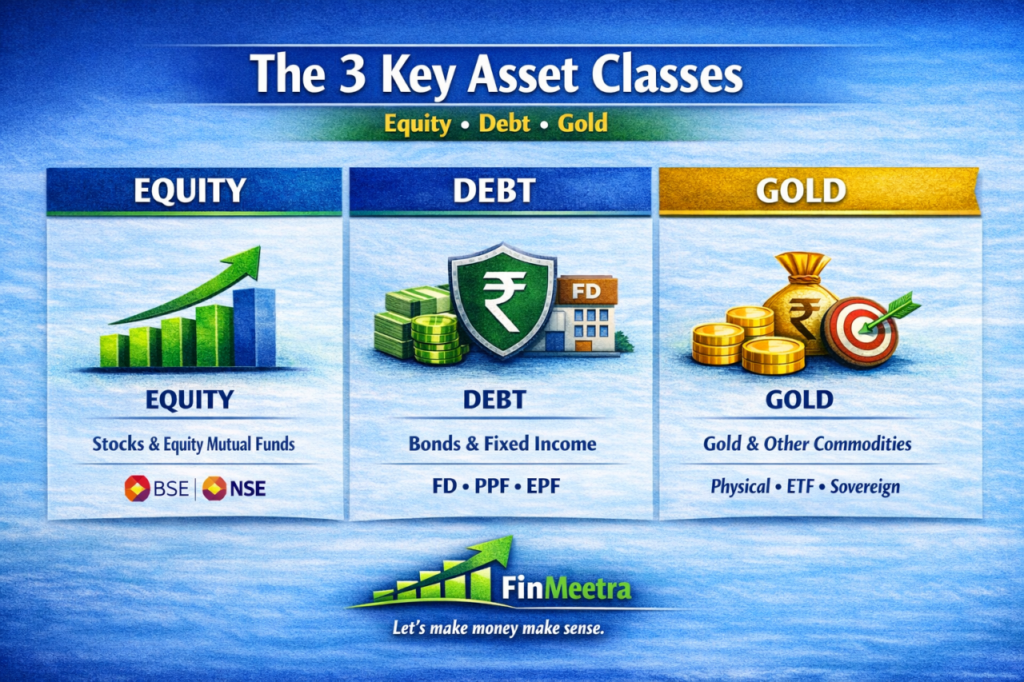
| Asset Class | What It Does | Risk | Long-term Return | Best For |
| 📈 Equity | Builds long-term wealth | High | 12-15% | 7+ year goals |
| 🛡️ Debt | Protects & stabilises | Low-Medium | 6-8% | Short-medium term |
| 🪙 Gold | Hedge against inflation & crises | Medium | 8-10% | Diversification |
📈 Equity — The Wealth Builder
Equity (stocks, equity mutual funds, index funds) is the engine of long-term wealth. Historically, Indian equity markets have given 12-15% CAGR over 15-20 year periods. A ₹10,000 SIP in equity for 25 years can easily build over ₹1.8 crore at 12% returns. But here’s the catch — equity is volatile. In short stretches, it can fall 30-40% (March 2020 is a recent example). That’s why it’s only suitable for long-term goals (7+ years).
🛡️ Debt — The Stability Provider
Debt includes PPF, EPF, debt mutual funds, FDs, bonds, and NPS (debt portion). These give predictable, lower returns (6-8%) but rarely lose value in the short term. In India, PPF and EPF are particularly powerful because they’re tax-efficient and government-backed. Debt is the calm, boring uncle of your portfolio — and that’s exactly why you need it. When equity crashes, debt holds the fort.
🪙 Gold — The Crisis Insurance
Indians love gold — but mostly in the wrong form. Jewellery is consumption, not investment (you lose ~15-20% in making charges). The right way to hold gold for your portfolio is via Sovereign Gold Bonds (SGB), Gold ETFs, or Digital Gold. Gold typically rises when equity falls, making it a beautiful insurance against crashes. In 2008 and 2020, when equity tanked, gold delivered double-digit returns. Just 5-10% in gold can dramatically reduce portfolio volatility.
Why Asset Allocation Decides 90% of Your Returns
This is the part most Indians have never been told — and it’s the single most important insight in this entire post.
Back in 1986, Gary Brinson and his team published a landmark study analyzing 91 large pension funds over a 10-year period. Their goal was to figure out: what actually drives portfolio returns? The conclusion shocked the investing world. 👇
📊 91.5% of the variation in portfolio returns came from asset allocation alone. Only ~9% came from security selection and market timing combined.

Read that again. The fund you pick, the stock you buy, the day you invest — all of it adds up to barely 10% of your total returns. The rest is decided by one thing: how you split your money across asset classes. 🤯
Here’s how this plays out in India. Take two friends, Anil and Pooja, both 30 years old, both investing ₹15,000/month. Anil obsesses over picking the “top mutual fund” but keeps it 100% in equity. Pooja picks an average fund but splits her money 60% equity, 30% debt, 10% gold. 20 years later, despite Anil’s “better fund,” Pooja often ends up with a similar or larger corpus — because she stayed invested through crashes that scared Anil out of the market. Allocation wins over selection. Every. Single. Time.
🎯 Master your allocation first. Worry about fund picks second. That’s the sequence every wealth-builder follows.
The Age-Based Asset Allocation Rule
Here’s the simplest rule of thumb that’s served investors well for decades:
📊 Classic Rule: Equity % = 100 – Your Age
If you’re 30, you’d hold 70% in equity. If you’re 50, you’d hold 50%. The rest goes to debt and gold. Simple, clean, time-tested. The logic is straightforward — younger investors have more time to recover from market crashes, so they can take more equity risk. As you age, you gradually shift towards stability.
But here’s the catch — this rule was designed for the US, where life expectancy, inflation, and retirement behavior are all different. For India, it’s slightly too conservative. So a modified version has gained popularity:
🇮🇳 Modified India Rule: Equity % = 110 – Your Age
Why? Three reasons: (1) Indians are living longer — average life expectancy has crossed 70 and rising fast, (2) Retirement is happening later as people stay productive into their 60s, (3) Indian inflation (5-7%) eats wealth faster than US inflation (2-3%), so we need more equity to beat it. The extra 10% equity exposure helps Indians build larger corpuses over a longer lifespan.
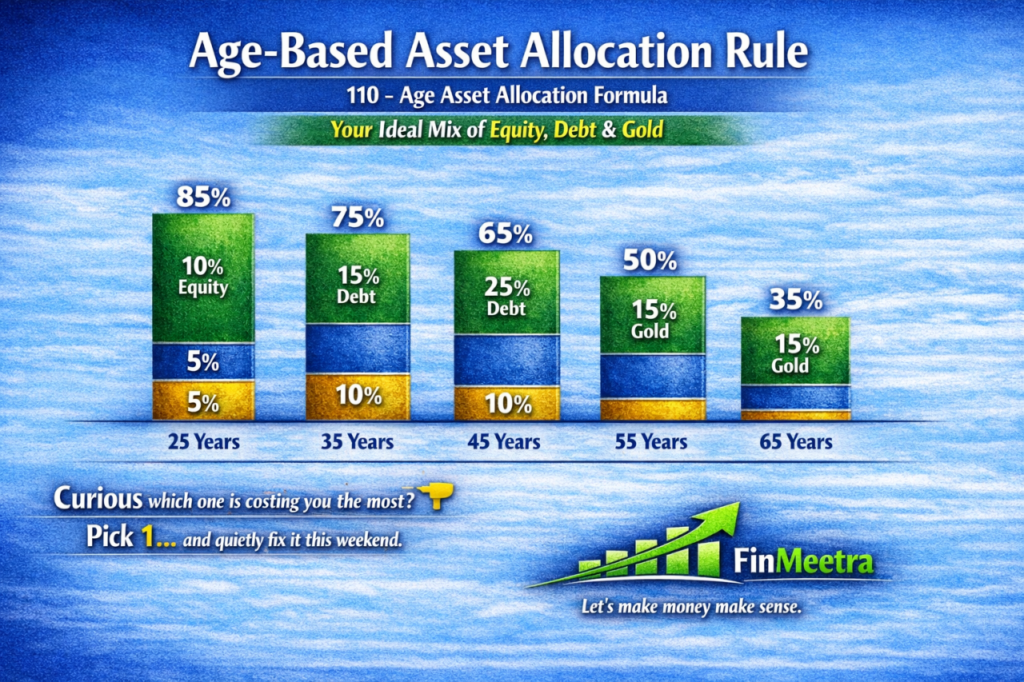
Here’s how this plays out across different ages, with simple debt and gold splits added:
| Age | Equity % | Debt % | Gold % |
| 25 | 80% | 15% | 5% |
| 30 | 75% | 20% | 5% |
| 35 | 70% | 22% | 8% |
| 40 | 65% | 25% | 10% |
| 45 | 60% | 30% | 10% |
| 50 | 55% | 35% | 10% |
| 60 | 40% | 50% | 10% |
Important caveat: age is just one factor. A 30-year-old IT professional with a stable salary and good emergency fund can take more equity risk than a 30-year-old freelancer with irregular income. Adjust the rule down by 10-15% if your income is uncertain or you have heavy dependents. The framework is a guide, not a law. 🎯
3 Popular Asset Allocation Models (Pick Yours)
Age is a guide, but your risk capacity, goals, and personality also matter. So most Indians fall into one of these 3 well-known allocation models. Pick the one that fits your life stage. 👇
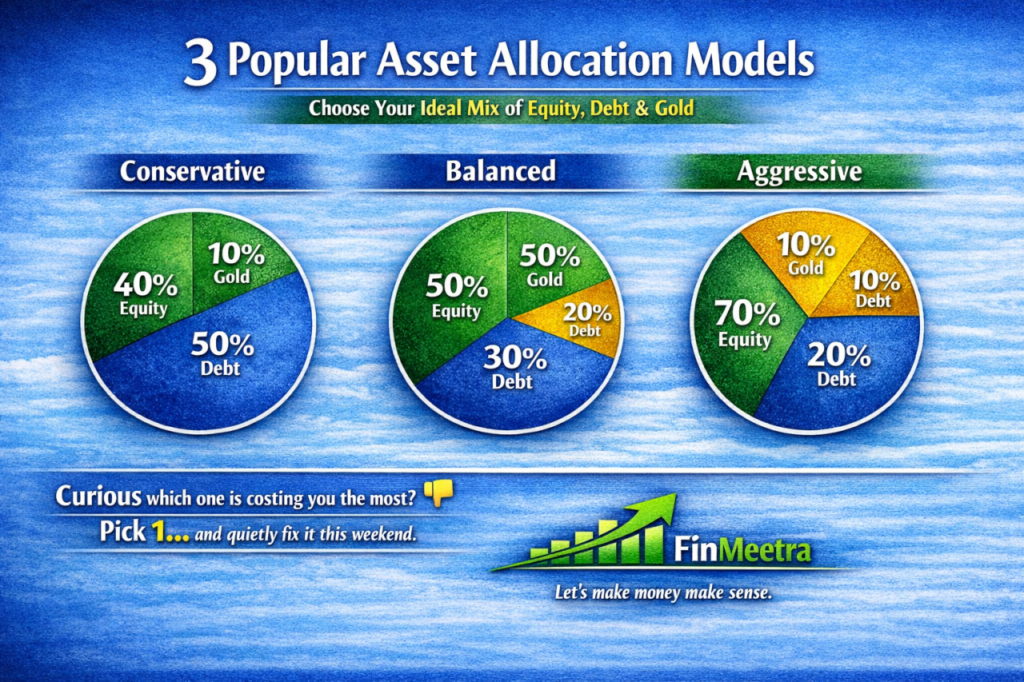
🟢 Model 1: Conservative (Safety First) — 40/50/10
Best for: Investors aged 50+, those near retirement, or anyone who genuinely can’t handle market volatility. Expected returns: ~8-10% long-term with low volatility. The conservative portfolio rarely drops more than 10-12% even in major crashes, which makes it sleep-friendly. The trade-off? Slower wealth growth — it won’t compete with aggressive portfolios over 20+ year windows. But if you’re 5-10 years from retirement, that stability is worth more than chasing extra returns.
🟢 Model 2: Balanced (The Sweet Spot) — 60/30/10
Best for: Most salaried Indians aged 30-45 with moderate risk capacity. Expected returns: ~10-12% long-term. This is the most popular allocation in India for a reason — it gives the best risk-adjusted return for the average investor. You get solid equity growth (60% equity does most of the heavy lifting), real downside protection in crashes (30% debt cushions the fall), and crisis insurance (10% gold). Most financial planners recommend this model as the default for working professionals.
🚀 Model 3: Aggressive (Maximum Growth) — 80/10/10
Best for: Young investors aged 25-35 with no major dependents, stable income, and a 15+ year investment horizon. Expected returns: ~12-14% long-term — the highest of the three models. But here’s the price tag: sharp drops in crashes. Your portfolio can drop 30-40% in 6 months during a serious correction. Most people think they can handle this until they actually live through it. Honest self-check before picking this model: if you panic-sold in March 2020, aggressive isn’t for you yet.
💎 Pro tip: You’ll naturally migrate between models as life evolves. Aggressive at 28, balanced at 38, conservative at 55. That’s the rhythm of a healthy investing life — gradually shifting from growth to preservation.
🎯 Reality check: if you can’t sleep well during a 30% market drop, you’re not aggressive — you’re just optimistic. Pick a model you can actually stick with through 20 years of ups and downs.
Real-Life Example: How Asset Allocation Saved Two Investors in 2020
Let me bring all this theory to life with a story. Meet Ravi and Sneha. Both are 32. Both are software engineers earning ₹1.5 lakh/month in Bengaluru. Both started investing ₹30,000/month in January 2020. Both used the same broker. The only real difference was their philosophy. 👇
🟢 Ravi: Put 100% in equity mutual funds. “Long-term mein equity hi best hai!”
🟢 Sneha: Split ₹30K as 60% Equity (₹18K), 30% Debt via PPF + debt MF (₹9K), 10% Gold via SGB (₹3K).
Then March 2020 hit. ⚡
| Metric | Ravi (100% Equity) | Sneha (60/30/10) |
| Portfolio fall (30 days) | -38% | -18% |
| Emotional state | Panic | Calm |
| Action taken | Stopped SIP | Continued + rebalanced |
| 3-year return (Mar 2023) | +22% CAGR | +19% CAGR |
| 5-year return (Mar 2025) | +11% CAGR | +14% CAGR |
Look at the 5-year column carefully. Even though Ravi’s pure-equity strategy looked smarter in 2023 (during the bull run), his behavior during the crash ruined his long-term returns. He stopped his SIP for 4 months — missing the cheapest buying opportunity in a decade. Sneha, with her cushioned portfolio, never panicked. She actually rebalanced at the crash bottom, buying more equity using her debt funds. That single decision made her portfolio outperform Ravi’s over 5 years.
💎 Lesson: A well-allocated portfolio isn’t about “maximum theoretical returns.” It’s about returns you can actually hold on to. Behaviour beats brilliance. The investor who never panics quietly beats the investor who picks the perfect fund. 🧘
The Hidden Hero — Rebalancing Your Portfolio
Here’s something most beginners completely miss — even after setting up the right allocation. Once you decide on a split (say 60/30/10), it won’t stay there forever. Markets move. Equity may grow faster, debt may stay flat — and within 12 months, your portfolio could drift to 70/22/8 instead of 60/30/10. Suddenly, you’re carrying more equity risk than you signed up for. 🚨
That’s where rebalancing comes in. 🔄
Rebalancing means bringing your allocation back to the target — usually once a year. If equity grew too much, you sell a little and shift it to debt. If gold underperformed, you may top it up. Let’s make this concrete with numbers. Suppose you start with a ₹10 lakh portfolio at 60/30/10 (₹6L equity, ₹3L debt, ₹1L gold). After 12 strong months in equity, it becomes ₹8L equity, ₹3.2L debt, ₹1.1L gold (a total of ₹12.3L). Your allocation is now 65/26/9 — drifted. To rebalance, you’d sell ₹0.4L of equity and buy ₹0.3L debt + ₹0.1L gold. Back to 60/30/10. Done. ✅
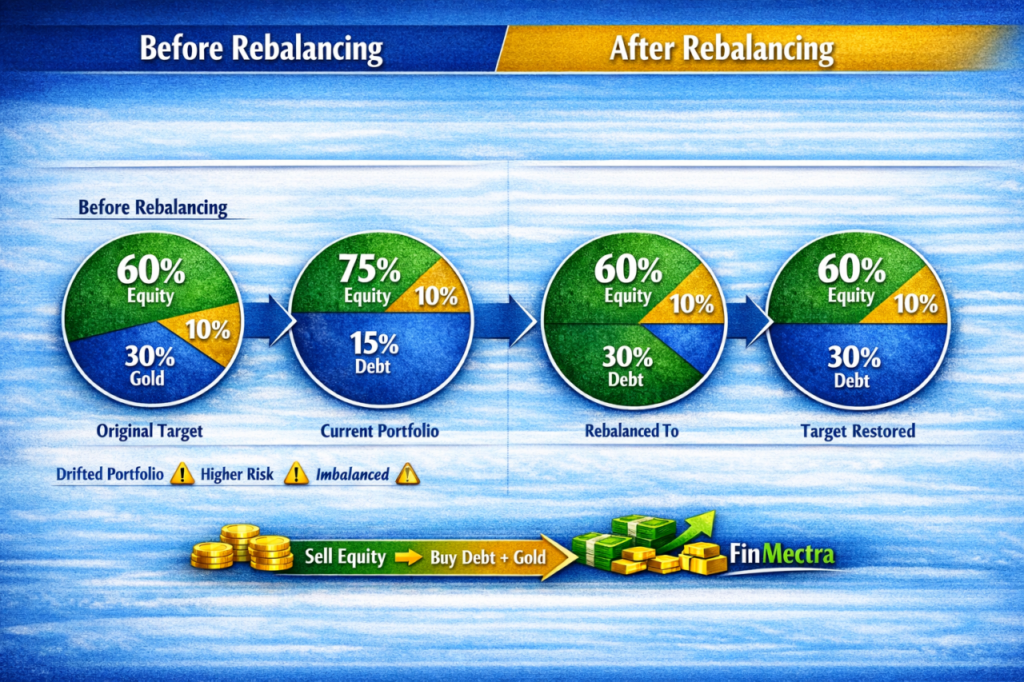
✨ The magic of rebalancing: It forces you to “sell high, buy low” automatically — without needing to predict markets. Over decades, this single habit can add 1-2% extra return per year. ⚠️ Tax note: equity sold within 1 year attracts STCG (15%), beyond 1 year attracts LTCG (10% above ₹1L). Plan rebalancing accordingly.
✅ Once a year (set a fixed date — e.g., financial year-end)
✅ When any asset deviates 5%+ from target
❌ NOT every time markets move — that’s overtrading
How to Actually Build Your Asset Allocation in India
Enough theory. Here’s the practical, step-by-step process to actually set this up in your real Indian life. Let’s say you’re 30 years old, earn ₹80,000/month, and can invest ₹15,000/month. Here’s exactly what you’d do. 👇
🪜 Step 1: Calculate Your Target Allocation
Use the 110-age rule. At 30: 110 – 30 = 80% equity. Split the rest 70:30 between debt and gold = 14% debt, 6% gold. Round it cleanly: 80/15/5. For a ₹15,000 monthly investment, that’s ₹12,000 equity + ₹2,250 debt + ₹750 gold.
🪜 Step 2: Pick the Right Instruments
Each asset class has multiple options in India. Pick what fits your style and tax bracket. 👇
| Asset | Indian Options |
| 📈 Equity | Mutual Funds (Flexi/Large Cap), Index Funds (Nifty 50, Nifty Next 50), ELSS, Stocks (advanced) |
| 🛡️ Debt | PPF, EPF, Debt Mutual Funds, FDs, Bonds, NPS Tier-1 |
| 🪙 Gold | Sovereign Gold Bonds (SGB), Gold ETFs, Digital Gold (avoid jewellery for investment) |
For equity, choose your mutual funds using the 7-filter mutual fund framework. Don’t pick funds based on YouTube tips or last year’s top performers — that’s the fastest way to underperform.
🪜 Step 3: Start SIPs in Each Bucket
Don’t try to invest a lump sum. Start monthly SIPs in each asset class — this builds your allocation automatically. If you’re new to SIP investing, follow this beginner’s SIP guide first. Use Groww, Zerodha Coin, Kuvera, or MF Central — all are reliable. For PPF, use your bank’s net banking. For SGB, watch RBI’s bi-monthly issue announcements.
🪜 Step 4: Automate Where Possible
Set up auto-debits for all SIPs on salary day (1st or 2nd of the month). PPF can be auto-contributed annually. SGB can be bought when issued (every 2-3 months). This single step removes 95% of human emotion from investing. 🤖
🪜 Step 5: Review and Rebalance Annually
Pick a fixed date — your birthday, financial year-end, or January 1st. Once a year, review allocation. If anything has drifted 5%+ from target, rebalance back. That’s it. Set it. Forget it. Let compounding do the heavy lifting. 🌱
And remember — every yearly bump in your SIP amount (via Step-Up SIP) supercharges this entire system. Allocation tells you WHERE to invest. Step-Up tells you HOW MUCH to invest. Together — they’re unstoppable. 🚀
Common Asset Allocation Mistakes
Even smart investors fumble asset allocation. Watch out for these 5 silent traps:
❌ Mistake 1: Putting 100% in FDs
FDs feel “safe” but quietly lose to inflation. A 7% FD against 6% inflation gives just 1% real return. Over decades, this is wealth destruction in disguise. Check the power of compounding to see how this single choice can cost you crores over a working life.
❌ Mistake 2: Going 100% Equity
Sounds aggressive, but most 100% equity investors panic-sell in their first crash. Without debt cushion, you have nothing to lean on emotionally or financially. Diversification isn’t optional — it’s survival. 🛡️
❌ Mistake 3: Ignoring Gold Entirely
Most Indians either over-buy gold (jewellery) or skip it completely in their portfolio. The sweet spot is 5-10% in SGB or Gold ETFs — enough to balance the portfolio without overdoing it.
❌ Mistake 4: Never Rebalancing
Setting an allocation and never reviewing it = letting markets decide your risk. Over 5 years, a 60/30/10 portfolio can silently drift into 80/15/5 — making you far more exposed than you realised. ⚠️
❌ Mistake 5: Changing Allocation Based on News
“Markets will crash, let me move to gold!” “Equity is booming, let me go 100% equity!” These emotional shifts based on news cycles destroy long-term returns. Set your allocation calmly. Stick with it through cycles. 🧘
Key Takeaways
✅ Asset allocation decides ~90% of your investment returns. Fund selection is only ~10%.
✅ Split your money across 3 buckets: Equity (growth), Debt (stability), Gold (protection).
✅ Use the 110-age rule for India: Equity % = 110 – Your Age. Adjust for your situation.
✅ Pick a model that fits you: Conservative (40/50/10), Balanced (60/30/10), Aggressive (80/10/10).
✅ Rebalance once a year — it forces you to sell high, buy low automatically.
✅ Use PPF, EPF, Debt MFs for debt. SGB and Gold ETFs for gold. Diversified MFs for equity.
✅ Don’t go 100% in any single asset — it’s the fastest way to lose sleep and money.
✅ The richest investors aren’t the smartest. They’re the most disciplined.
✅ Asset allocation is the foundation. Everything else — funds, SIPs, returns — sits on top.
Frequently Asked Questions
Q: What is asset allocation in simple words?
A: Asset allocation is the strategy of dividing your investments across different asset classes — primarily Equity, Debt, and Gold — based on your goals, time horizon, and risk capacity. It decides how much of your money sits where, and is the single biggest factor in your long-term returns.
Q: Why is asset allocation more important than fund selection?
A: Studies like the Brinson Study show that ~90% of portfolio returns come from how you split your money across asset classes, while only ~10% comes from fund selection or market timing. The right allocation with average funds beats the wrong allocation with great funds — every single time.
Q: What is the 60-30-10 rule?
A: The 60-30-10 rule is a popular balanced asset allocation model — 60% in Equity, 30% in Debt, and 10% in Gold. It’s considered the sweet spot for most salaried Indians aged 30-45, providing solid long-term growth with manageable downside during market crashes.
Q: How often should I rebalance my portfolio?
A: Once a year is ideal. You can also rebalance if any asset class deviates more than 5% from your target allocation. Avoid rebalancing too frequently — that’s overtrading, which adds costs and hurts returns. Pick a fixed date each year and stick to it.
Q: Is gold a good investment in India?
A: Gold is not a great wealth-builder on its own (returns ~8-10% long-term, less than equity), but it plays a critical role as a portfolio diversifier. Gold tends to rise sharply when equity crashes, making it a great insurance asset. Keep 5-10% of your portfolio in gold via SGB or Gold ETFs.
Q: Should I include real estate in asset allocation?
A: Real estate can be considered a separate asset class, but most Indians already have heavy real estate exposure through their home. For investment purposes, focus on Equity-Debt-Gold first, since they’re liquid, easy to manage, and have transparent returns.
Q: Can asset allocation protect me from market crashes?
A: Yes — partially. A diversified portfolio (e.g., 60/30/10) falls much less than a 100% equity portfolio during crashes. In March 2020, equity fell 38%, but a balanced portfolio fell only 18%. It won’t eliminate losses, but it makes them survivable.
Q: What’s the best asset allocation for a 30-year-old in India?
A: For a 30-year-old in India, a Balanced or Aggressive model works well. Using the 110-age rule: 80% Equity / 15% Debt / 5% Gold (aggressive) or 70% Equity / 20% Debt / 10% Gold (balanced). Adjust based on your risk capacity, dependents, emergency fund, and existing investments.
Related Articles You’ll Love
The Power of Compounding — How ₹5,000/Month Grows into ₹1.76 Crores
How to Start Your First SIP in India — Complete Beginner’s Guide

Pingback: 90% Indians Own the Wrong Mutual Fund Category | FinMeetra